


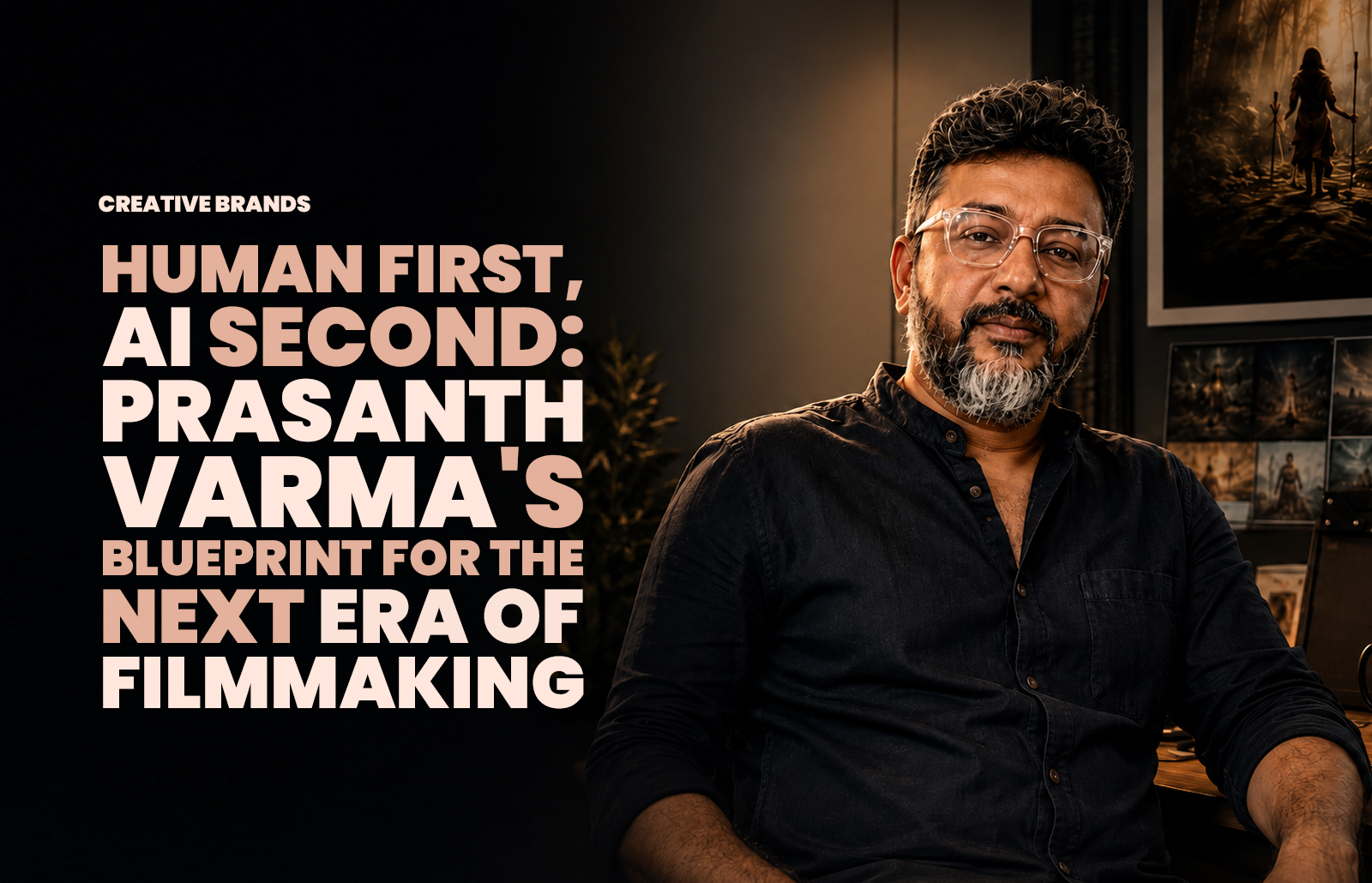
The rise of artificial intelligence has transformed filmmaking from a technology-driven process into a creative revolution, where imagination is no longer constrained by budget, infrastructure or conventional production methods. Few professionals have witnessed this transformation as closely as Prasanth Varma, Founder and Creative Director of Axion AI and the creative force behind the Epic India Universe. Having journeyed from the era of hand-drawn animation and advertising to today’s AI-powered cinematic storytelling, Varma brings nearly three decades of creative evolution into every project he undertakes.
Today, he is building a new generation of original intellectual properties, including Maya & Me, Nagabandha, The Guardians and several AI-driven narrative worlds that blend India’s cultural heritage with cutting-edge cinematic technologies. For Varma, however, AI is not a replacement for creativity but an extension of it—an extraordinary collaborator that accelerates execution while leaving imagination, emotion and purpose firmly in human hands.
In this exclusive interview with Creative Brands Magazine, Prasanth Varma reflects on the evolution of AI filmmaking, the ethics of creative technology, the future of storytelling, and why originality, human emotion and cultural authenticity will remain the defining ingredients of great cinema—even in the age of artificial intelligence.
AI integration in creativity: How has AI changed the way you approach the creative process compared to traditional methods?
When I began my creative journey in the mid-1990s, animation was a completely different world. Every frame was drawn by hand. Also, we had 3D Studio which was working in DOS Version. We planned every movement, expression, background, and transition manually. It was a slow, disciplined process that taught me patience and the fundamentals of storytelling.
From there, I moved into advertising, spending over a decade creating campaigns, brand identities, and visual communication. Advertising taught me how to communicate powerful emotions within a very short span of time.
Today, I find myself at another historic turning point with AI filmmaking. Looking back, I feel privileged to have witnessed the entire evolution—from the era of traditional Disney-style 2D animation to today’s AI-powered cinematic productions.
The world between 1995 and 2026 has changed at an unimaginable pace. What once took weeks to create can now be visualised in hours. AI has dramatically accelerated execution, but it hasn’t changed the essence of creativity. Ideas still begin in the human mind. Technology simply gives us a faster and broader canvas to express ourselves.
Human vs Machine Creativity: Where do you draw the line between human intuition and machine-generated ideas?
Having worked through every major technological shift over the last three decades, I’ve learned one thing: every new technology raises the same question—”Will it replace creativity?”
The answer has always been no.
AI can generate visuals, music, or dialogue, but it cannot experience compassion, nostalgia, faith, love, sacrifice, or human conflict. Those emotions belong to people.
I don’t see AI as the creator. I see it as an extraordinary creative collaborator. The vision, emotional intelligence, and purpose behind every story still come from the filmmaker.
Technology changes tools. Human imagination creates meaning.
AI tools in workflow: Which AI platforms have become indispensable in your day-to-day creative workflow?
Our production pipeline combines multiple AI technologies rather than relying on a single platform.
We use AI language models for scripting and research, image generation platforms for concept development and character design, AI video tools for cinematic scene creation, voice synthesis for narration, AI music platforms for original compositions, and professional editing software for post-production.
However, I’ve always believed that tools are only as powerful as the creative process behind them. The real strength lies in designing an efficient workflow in which every tool contributes to telling a compelling story.
Ethics of AI in advertising: What ethical considerations do you keep in mind?
Ethics becomes even more important as technology becomes more powerful.
At Axion AI, we believe AI should enhance creativity, never mislead audiences. We respect intellectual property, maintain transparency where necessary, verify factual information, and ensure that every final output is subject to human creative supervision.
AI should help us tell better stories—not manipulate people.
Personalisation at Scale: How do you use AI without losing authenticity?
Consumers today expect personalised experiences, but authenticity cannot be automated.
AI helps us understand audiences, adapt communication, and produce content more efficiently. However, every successful campaign still begins with understanding human emotions.
Whether it’s advertising, filmmaking, or documentary production, people remember stories that make them feel something—not those that simply demonstrate technological capability.
AI and Storytelling: In what ways has AI influenced storytelling?
Storytelling has become more democratic than ever before.
Earlier, cinematic production required large budgets, big studios, and complex infrastructure. Today, AI has empowered independent creators to produce visually stunning narratives that were once beyond their reach.
One of the most exciting developments is the rise of vertical cinema.
Today’s 30-second and one-minute vertical films are, in many ways, the modern evolution of advertising. They tell complete emotional stories within extremely short durations. These films aren’t just selling products—they’re building characters, creating emotional connections, and delivering meaningful narratives.
This represents an entirely new storytelling language.
Collaboration with AI: Do you see AI as a collaborator, tool, or competitor?
Definitely a collaborator.
Throughout history, creators have adopted new tools—from pencils to cameras, from film to digital, and now AI.
AI expands our creative possibilities. It removes technical barriers and accelerates experimentation.
But it never replaces the responsibility of the storyteller.
The director still decides what story deserves to be told and how it should emotionally connect with people.
Impact on Creative Teams: How has AI reshaped creative roles?
AI hasn’t reduced the need for creative professionals—it has transformed their responsibilities.
Today’s creative teams need to understand storytelling, cinematography, editing, prompt engineering, visual aesthetics, sound design, and production workflows simultaneously.
The future belongs to multidisciplinary creators who can think beyond software and understand the complete filmmaking process.
Learning has become continuous.
The software may change every six months.
Creative thinking remains timeless.
Future of AI in Advertising: What do you believe will be the next breakthrough?
I believe we’re entering an era where AI-native content production will become mainstream.
Brands will increasingly create personalised advertisements, documentaries, films, and interactive experiences specifically tailored for different audiences without compromising cinematic quality.
At the same time, AI will democratise filmmaking.
Independent creators and small studios will soon compete with much larger production houses because technology is making world-class production accessible to everyone.
We’re witnessing one of the biggest creative revolutions since the transition from analogue filmmaking to digital cinema.
Balancing Speed and Originality: AI accelerates execution, but how do you ensure originality remains at the core?
Speed has become easier.
Originality has become more valuable.
At our studio, we never begin with AI.
We begin with an idea.
We begin with emotion.
We begin with purpose.
Only then do we choose the technology required to bring that vision to life.
Whether I’m developing an original IP like Maya & Me, creating historical documentaries, or producing spiritual films, my objective remains the same—to tell stories that people remember long after the screen goes dark.
Technology may create the visuals.
But only human imagination creates experiences that stay in people’s hearts.
Closing Thoughts
I often say that I have been fortunate to witness three generations of creative evolution.
I began my journey in the world of traditional hand-drawn animation. I grew professionally through advertising during the digital revolution. Today, I work in AI filmmaking, creating original intellectual properties, documentaries, and cinematic narratives.
From the slow, handcrafted workflows of the 1990s to today’s AI-assisted production pipelines, one thing has remained constant: the power of a great story.
People often ask whether AI will eventually replace human creativity. My answer is always the same: AI itself is a product of human creativity. It is the result of human imagination, research, engineering, and decades of innovation. Nothing can truly exist beyond the creative potential of the human mind that conceived it.
The next generation may grow up with AI as their natural creative environment. They may never experience drawing every animation frame by hand, editing on analogue systems, or witnessing the technological evolution that many of us have lived through. That will naturally shape how they think and create.
There is also a possibility that some creators may become overly dependent on AI, allowing it to generate ideas instead of challenging their own imagination. While AI can produce remarkable outputs, it should never become a substitute for curiosity, observation, or original thought.
The creativity that truly moves people has always come from a deeper place—from human emotions, lived experiences, culture, nature, spirituality, and the ability to imagine what does not yet exist. No algorithm can genuinely experience love, compassion, sacrifice, faith, joy, or loss. Those emotions remain uniquely human, and they are the foundation of every memorable story.
I believe the future belongs to creators who embrace AI as a collaborator rather than a replacement. Let AI handle the repetitive tasks, accelerate production, and expand creative possibilities. But never stop questioning, exploring, imagining, and thinking beyond what technology suggests.
The greatest stories will never be created by AI alone. They will always be created by human minds that dare to think beyond the obvious, with AI serving as a powerful creative companion.
Discover more from Creative Brands Mag
Subscribe to get the latest posts sent to your email.













Leave a comment