


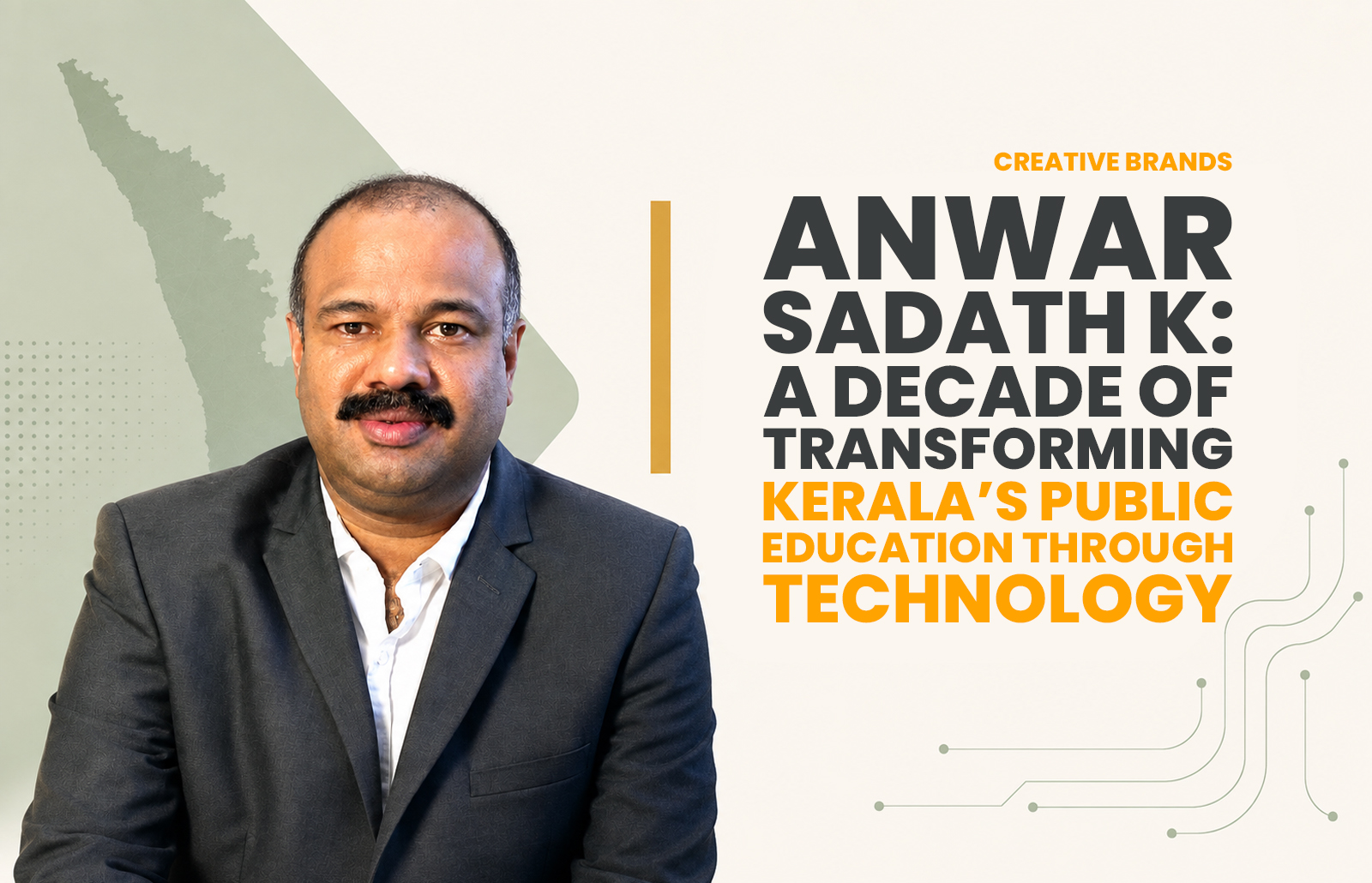
For a decade, Anwar Sadath K has steered KITE through a technology-led transformation of Kerala’s public education system. From hi-tech classrooms and digital learning to FOSS, AI, robotics and media literacy, his tenure has placed technology at the heart of equitable education, earning international recognition for Kerala’s innovative digital education model.
When Anwar Sadath K took charge as Chief Executive Officer of Kerala Infrastructure and Technology for Education (KITE) in 2016, technology was already emerging as an important component of Kerala’s public education system. A decade later, his tenure has become closely associated with a much broader transformation — one in which digital infrastructure, open-source technology, artificial intelligence and new approaches to learning have become integral to the classroom.
With more than 27 years of experience spanning e-governance, information and communication technology, Free and Open Source Software (FOSS) and educational technology, Sadath has worked at the intersection of technology and social development for much of his career. At KITE, the challenge was to translate that experience into a scalable model capable of reaching millions of students across Kerala.
One of the most visible achievements of his tenure has been the Hi-Tech School project. The initiative upgraded around 45,000 classrooms and 11,000 laboratories, creating a technology-enabled infrastructure across Kerala’s public schools. Rather than treating digitalisation as an isolated technology project, KITE positioned it as part of a larger educational ecosystem involving teachers, students, content and infrastructure.
The COVID-19 pandemic presented an unprecedented test of that ecosystem. When schools were forced to close, KITE launched the First Bell digital classes through the KITE VICTERS channel. The programme enabled students to continue their education remotely, demonstrating how Kerala’s existing digital infrastructure could be rapidly adapted during a crisis.
Another major initiative has been Little KITES, a network of IT clubs established in around 2,000 schools. Designed to encourage students to explore technology beyond conventional classroom learning, the programme has helped create a culture in which young people are not merely consumers of technology but are encouraged to understand and experiment with it.
KITE’s commitment to FOSS has also been central to Sadath’s vision. Under his leadership, school education in Kerala completed its migration to Free and Open Source Software for its technology requirements. The approach has reduced dependence on proprietary systems while promoting technological independence, adaptability and digital skills among students and teachers.
The technology agenda has subsequently expanded into newer areas. Programmes on fake-news detection have reached around two million students, while artificial intelligence and robotics are increasingly being introduced into schools. These initiatives reflect a changing understanding of digital literacy — from simply knowing how to use technology to understanding how technology shapes information, communication and everyday life.
The international education community has taken note of this work. Sadath became the first Indian recipient of the International Contributions Award from the Association for Educational Communications & Technology (AECT) in the United States, recognising his contributions to educational technology and digital learning.
His career before KITE included leadership roles at the IT@School Project, now KITE, Information Kerala Mission and the Akshaya Project. He also headed the UNDP-funded e-Krishi project, worked as a scientist at C-DAC and served as Manager (e-Governance) at the Kerala State IT Mission.
His engagement extends beyond administration. Sadath is a member of the CUSAT syndicate, serves on the advisory board of CIET, NCERT, and chairs Kerala’s ICT textbook creation committee. His academic qualifications include an MCA from the College of Engineering Thiruvananthapuram, a degree in Physics from Government Victoria College, Palakkad, an MBA and an LLB.
A science writer as well as a technology professional, he has authored books on cybercrimes and Indian cyber law, nanotechnology and internet applications. The combination of technical expertise, policy experience and public communication has shaped his approach to digital education.
After ten years at the helm of KITE, Anwar Sadath’s contribution extends beyond the number of classrooms equipped or programmes launched. It lies in helping establish a distinct model of technology-enabled public education — one that places access, openness, innovation and social equity at its centre. Kerala’s digital education journey, in many ways, has become a story of technology being used not simply to modernise schools, but to widen the possibilities of learning itself.
Discover more from Creative Brands Mag
Subscribe to get the latest posts sent to your email.













Leave a comment