


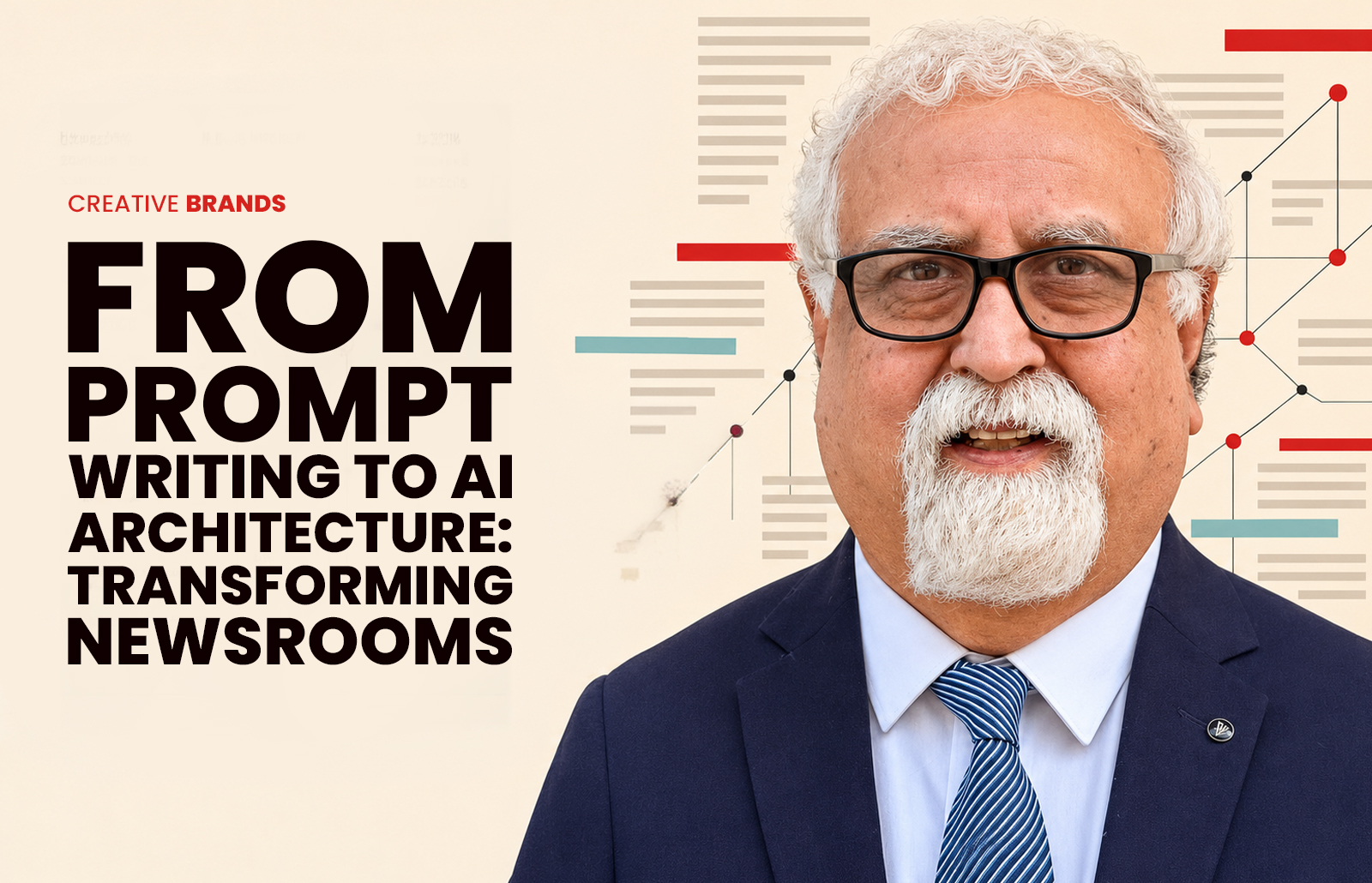
As artificial intelligence reshapes journalism, WAN-IFRA’s AI Master Prompt Architecture workshop aims to help media professionals develop structured, repeatable AI workflows. Led by veteran media professional and AI trainer Sunil Saxena, the programme focuses on practical applications that enhance newsroom productivity, strengthen editorial quality and promote ethical AI adoption.
Artificial intelligence is rapidly transforming journalism, but the real challenge for media organisations is no longer simply adopting AI tools. It is learning how to use them intelligently, systematically and responsibly. Moving beyond basic prompting to structured AI workflows is the central focus of WAN-IFRA’s three-day virtual workshop, ‘AI Master Prompt Architecture’, scheduled for 1–3 December 2026.
The workshop will be conducted by Sunil Saxena, an award-winning media professional, educator and AI trainer with extensive experience in journalism, digital media and media education. He currently serves as Director of The AI Media Academy, where he leads initiatives to train students and media professionals in AI-powered media strategies. Through workshops, online courses and professional events, Saxena focuses on equipping the next generation of media practitioners with practical knowledge and tools to navigate the rapidly changing media environment.
His expertise spans AI training, content marketing and web content creation, bringing together technological understanding and practical media experience. His professional journey, which includes working with leading Indian media organisations, provides a valuable foundation for understanding the challenges facing contemporary newsrooms.
At the heart of Saxena’s training philosophy is the belief that artificial intelligence should strengthen journalism rather than diminish its professional values. His mission is to empower media professionals and students to harness AI for ethical and impactful storytelling. By bridging technology with editorial judgement, he seeks to encourage innovation and efficiency in content creation while maintaining the highest professional standards.
This philosophy is particularly relevant to the concept of Master Prompt Architecture. The workshop aims to help participants understand why effective AI adoption requires much more than entering questions into a chatbot. The quality, relevance and reliability of AI-generated output depend significantly on the instructions, context, structure and evaluation criteria provided by the user.
Master Prompt Architecture introduces a more systematic approach to designing instructions that can be reused, tested and adapted to different newsroom requirements. Rather than treating every AI interaction as an isolated experiment, journalists can develop structured prompts that support recurring editorial tasks and improve the consistency of their output.
For journalists, this could have considerable practical value. Reporters can use structured prompts to organise field notes, develop story ideas, analyse information and prepare initial drafts. Sub-editors can explore applications in headline writing, copy improvement and content restructuring, while digital editors can develop workflows for multiple platforms and formats.
An important consideration is consistency. News organisations have distinctive editorial identities, writing styles and audience expectations. Generic AI-generated content can often sound repetitive and lack the character of an individual publication. Well-designed master prompts can help journalists establish clearer instructions for tone, language, structure and editorial standards, while retaining human control over the final output.
The workshop’s emphasis on AI-enabled media workflows is particularly relevant to newsroom managers, who must look beyond individual experimentation and consider how AI can become part of an organisation’s working culture. Instead of allowing journalists to use different AI tools in disconnected ways, media organisations need clearly defined workflows that improve efficiency, maintain consistency and establish accountability.
However, technological efficiency cannot become a substitute for journalistic responsibility. AI-generated information must be checked, sources independently verified and potential inaccuracies identified before publication. Human judgement remains indispensable in deciding what is newsworthy, understanding social context and ensuring that journalism serves the public interest.
This is where Saxena’s approach to AI education assumes particular significance. His emphasis on connecting technological capabilities with editorial judgement highlights the need to develop journalists who can question, evaluate and responsibly use AI rather than blindly depend on its outputs.
WAN-IFRA’s initiative comes at a time when news organisations worldwide are reassessing their editorial structures, workforce capabilities and approaches to digital transformation. As generative AI becomes increasingly accessible, the competitive advantage may belong to organisations that develop intelligent workflows rather than those that simply acquire more tools.
The transition from prompt writing to prompt architecture represents a broader shift in professional thinking. It encourages journalists to move from occasional experimentation towards purposeful and repeatable applications of AI.
Ultimately, the future newsroom will not be defined by how much artificial intelligence it uses, but by how effectively human intelligence guides it. Through this workshop, Sunil Saxena aims to help media professionals understand that distinction and prepare for a new era in which AI-enabled efficiency and responsible journalism must go hand in hand.
Discover more from Creative Brands Mag
Subscribe to get the latest posts sent to your email.












Leave a comment