


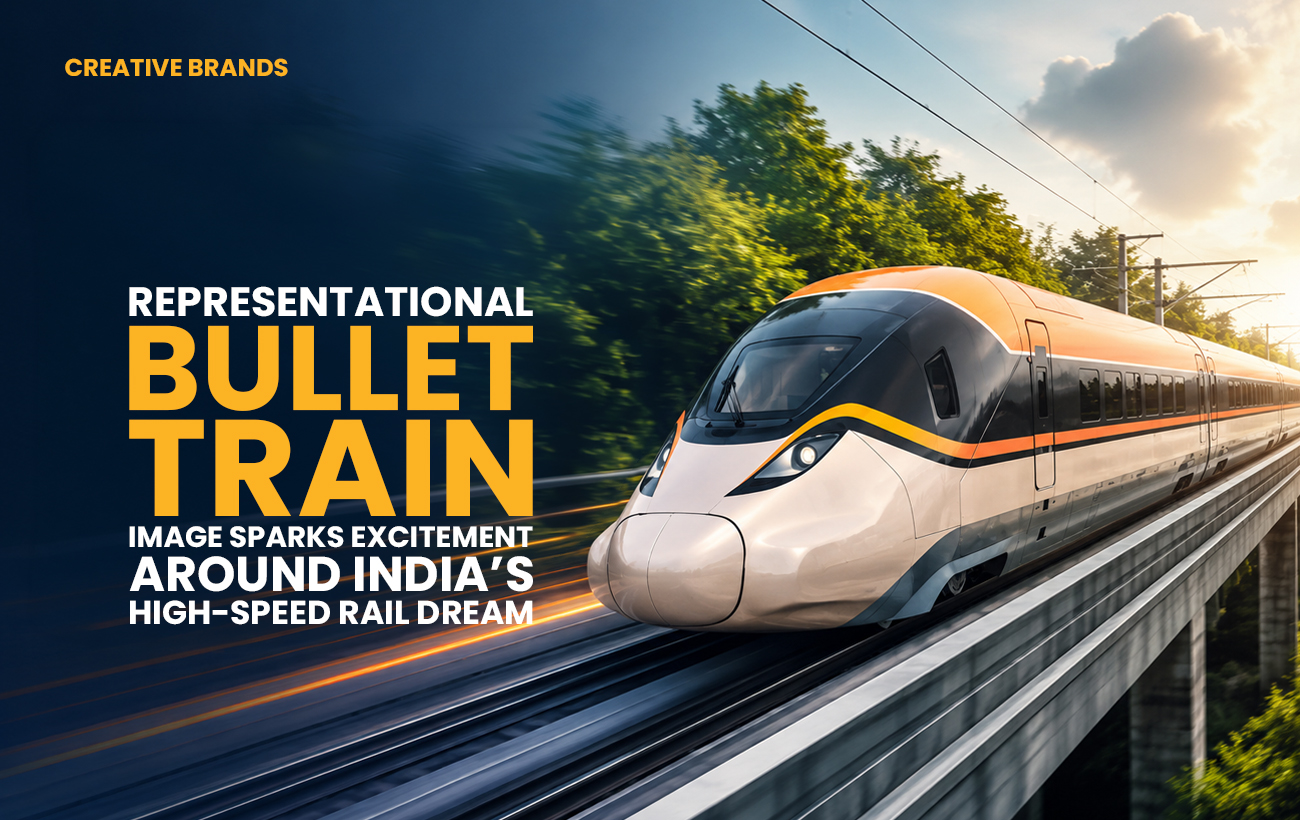
A representational image of India’s proposed Mumbai-Ahmedabad bullet train displayed at Rail Bhawan in New Delhi has generated widespread attention and speculation. Railway officials clarified that the image is not the final design, but it has nevertheless reignited public interest in the country’s ambitious high-speed rail project.
India’s long-awaited bullet train project has once again captured public imagination after a sleek image of a proposed high-speed train was displayed prominently at the Ministry of Railways headquarters in New Delhi. Mounted near Gate Number 4 of Rail Bhawan, the image offers what officials describe as a “representational look” at the train expected to operate on the ambitious Ahmedabad-Mumbai high-speed rail corridor.
The streamlined design, featuring a futuristic aerodynamic nose and modern styling associated with high-speed rail systems across the world, quickly drew attention on social media and in news reports. Several early reports described the display as the first “real glimpse” of India’s bullet train, triggering excitement among railway enthusiasts and the wider public eager to see the country enter the elite league of nations operating high-speed rail services.
However, railway officials later clarified that the image was only conceptual and should not be mistaken for the final design of the train that will eventually run on the corridor. According to senior officials quoted by PTI, the image merely serves as a visual representation of the proposed service rather than an official unveiling of the final rolling stock.
“It is a representational image and not the final one. We might remove it if it creates a controversy,” a senior official said, underlining the sensitivity and public curiosity surrounding the project. Another official noted that because the bullet train remains one of India’s “most ambitious and dream projects”, even symbolic representations tend to generate significant public reaction.
The Mumbai-Ahmedabad High-Speed Rail corridor, India’s first bullet train project, has been under development for several years and represents a major leap in the country’s transport infrastructure ambitions. The corridor is expected to connect Mumbai in Maharashtra with Ahmedabad in Gujarat through trains capable of travelling at speeds exceeding 300 kilometres per hour, dramatically reducing travel time between the two cities.
The project has been developed with technical and financial assistance from Japan and is based on the renowned Shinkansen technology, celebrated globally for its safety, punctuality and efficiency. For many Indians, the bullet train project symbolises technological progress and the country’s growing aspirations to modernise public transport infrastructure at a global standard.
Despite the enthusiasm, the project has also faced delays, land acquisition challenges and political debate since its announcement. Questions surrounding cost, environmental impact and feasibility have periodically surfaced, particularly as construction timelines shifted over the years. Yet the government has continued to project the high-speed corridor as a transformational initiative capable of reshaping intercity travel and stimulating economic growth along the route.
The representational image displayed at Rail Bhawan appears to have reignited public fascination precisely because the bullet train project has remained more of a promise than a visible reality for many citizens. Until now, most visual references associated with the project have come through technical presentations, artist impressions or computer-generated graphics released during official announcements.
The latest display, although unofficial as a final design, offered something more tangible for passers-by and observers — a visual cue that India’s high-speed rail ambitions are inching closer to reality. The train’s appearance bears similarities to global high-speed rail models, particularly the Japanese Shinkansen systems that inspired the project, though officials stressed that the final look could differ substantially.
Transport analysts say such imagery plays an important role in shaping public perception around infrastructure projects. Large-scale projects often rely on visual communication to sustain public interest and political momentum, especially when construction periods stretch across many years. In the case of the bullet train, the image at Rail Bhawan serves not merely as decoration but as a symbolic representation of India’s aspirations in engineering, mobility and urban connectivity.
For supporters of the project, the image represents optimism and national ambition. For critics, it also highlights the gap between vision and execution, with many still waiting to see operational progress on the ground. Nevertheless, the public response demonstrates the emotional and symbolic weight attached to the bullet train concept in India’s development narrative.
As work on the Mumbai-Ahmedabad corridor continues, the debate around the bullet train is likely to remain active. Whether viewed as a futuristic necessity or an expensive aspiration, the project has firmly established itself as one of the most closely watched infrastructure ventures in contemporary India.
For now, the image at Rail Bhawan remains a glimpse into possibility rather than certainty — a carefully crafted representation of a transport future India hopes eventually to board.
Discover more from Creative Brands Mag
Subscribe to get the latest posts sent to your email.















Leave a comment