


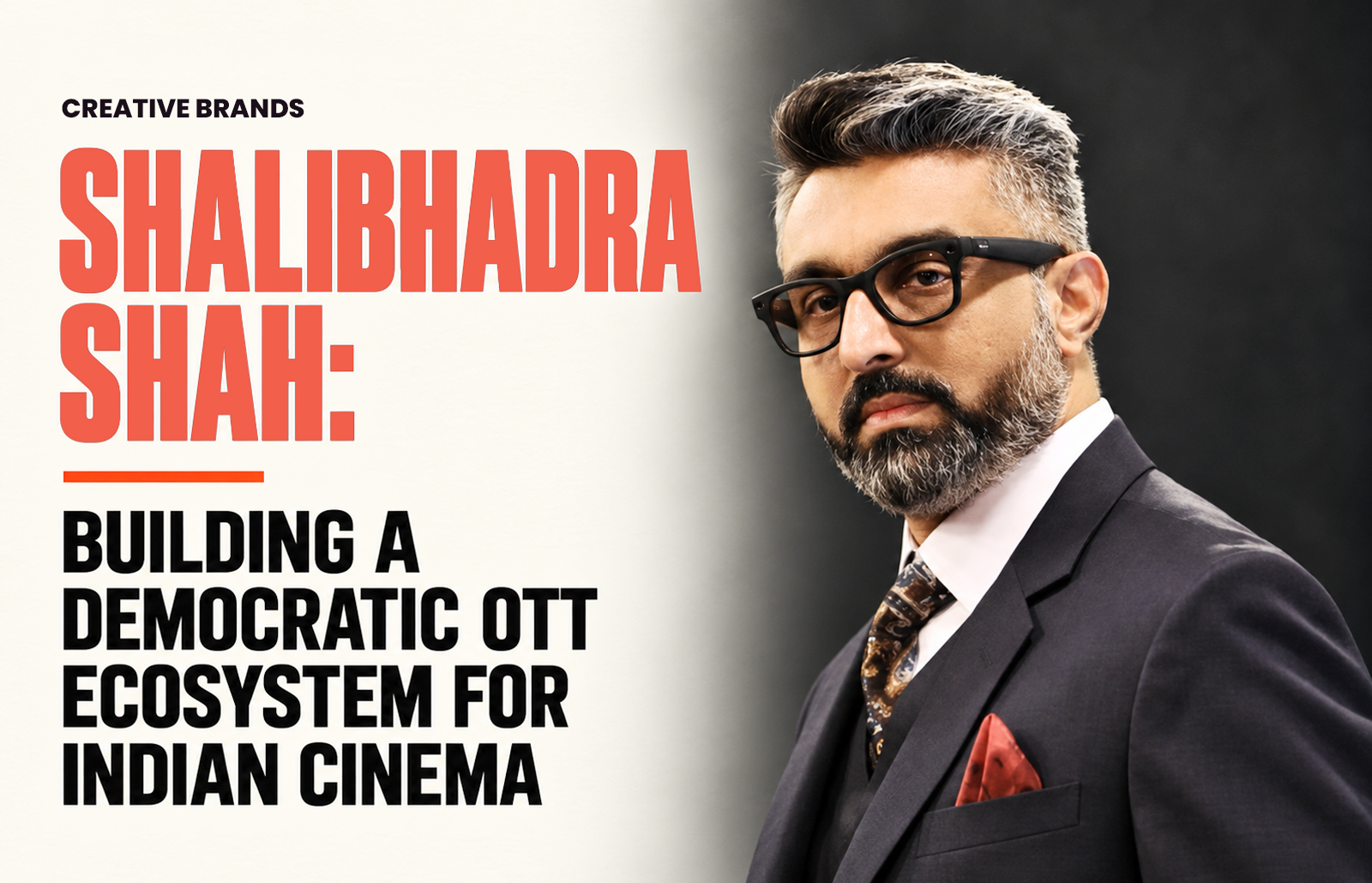
An exclusive conversation on ABC Talkies, My Talkies, the future of regional cinema, affordable entertainment, and the transformative role of artificial intelligence.
With over 28 years of experience in strategic business operations, business transformation, branding, and creative communication, Shalibhadra Shah has worked across diverse sectors, including government, education, entertainment, and corporate enterprises. His professional journey includes leadership roles in business development, digital transformation, integrated marketing, and large-scale communication initiatives. He has also been closely involved in major national events, flagship government projects, election campaigns, and the Vibrant Gujarat Summits.
As the Founder and CEO of ABC Talkies Pvt. Ltd., Shah is now extending his vision into the digital entertainment space with an innovative approach to film distribution and monetisation. ABC Talkies, an open-access film streaming platform, and My Talkies, a platform dedicated to Malayalam cinema, aim to address a persistent challenge in the Indian film industry: the difficulty independent filmmakers face in finding platforms to showcase and monetise their work.
In this exclusive interview, Shah discusses the thinking behind these ventures, the potential of regional cinema, the importance of affordable pay-per-view entertainment, and his vision of creating a comprehensive ecosystem that connects filmmakers, audiences, and investors.
“Our Objective Is to Ensure That Every Film Gets an Opportunity to Reach Its Audience”
Q: India already has a crowded OTT ecosystem dominated by established global and national players. What are ABC Talkies and My Talkies bringing to the table, and how are they different from mainstream OTT platforms and television?
Shalibhadra Shah: You are right that the OTT market is already crowded, with several well-established global and national players. However, when we examine their business models, most platforms acquire content selectively, depending on their target audience, content strategy, and budget. They have specific criteria for acquiring films, and their primary focus is customer acquisition and retention.
As a result, they cannot acquire every film produced in a particular language. India produces a tremendous number of films across different languages, and even when all the major platforms are considered together, a substantial volume of content remains without a distribution or monetisation opportunity.
For many filmmakers, the only option left is to upload their films to YouTube. There is a significant gap between mainstream OTT acquisition and such open platforms. ABC Talkies, and now My Talkies, aim to bridge that gap by creating an ecosystem through which films can reach audiences and generate revenue.
An Open-Access Approach to Cinema
Q: ABC Talkies is described as an open-access film streaming platform. What exactly does that mean?
Shalibhadra Shah: I would describe open access as a democratic approach to entertainment. Our fundamental philosophy, both for ABC Talkies and My Talkies, is simple: “No rejection.”
In a democracy, everybody should get an opportunity and everybody should have a voice. We want to apply that principle to filmmaking and content distribution.
If a film has a story, meets our prescribed quality standards, and complies with government guidelines, we will accept it on our platforms. Content must not violate applicable guidelines or contain prohibited material, but beyond those requirements, we want to provide filmmakers with an opportunity rather than reject their work because it does not fit a particular commercial category.
The second important aspect is our pay-per-view model. A viewer should not have to pay for an entire month or several months of subscription simply to watch one film.
On our platforms, viewers pay only for what they want to watch. The price can be as low as ₹2 or ₹3 and generally ranges up to ₹15 or ₹20 for an entire film, depending on the content. This gives consumers greater flexibility and makes entertainment accessible to a wider audience.
My Talkies: Taking Malayalam Cinema to More Viewers
Q: My Talkies focuses primarily on Malayalam films, and you have partnered with the Kerala Film Chamber of Commerce (KFCC). Why did you choose Malayalam cinema for this initiative?
Shalibhadra Shah: There are two main reasons.
First, Malayalam cinema has a strong storytelling tradition. Its stories are deeply rooted in society and everyday experiences, which makes them relatable to audiences. The acceptance of Malayalam content has also grown considerably, including among viewers who do not speak the language.
Second, the Malayalam film industry’s organisational ecosystem is relatively well-defined. The various industry bodies and stakeholders are active, and there is a willingness to explore new approaches to distribution and monetisation. The industry has been proactive in supporting this initiative. KFCC has made significant efforts to help move the idea forward, and we have received a positive response from the producers’ community as well.
Transparency is an important aspect of this collaboration. The objective is to create a win-win situation without vested interests on either side.
I believe Malayalam cinema provides a strong starting point for a model that could eventually be extended to other languages and regions. It could establish a precedent for the wider Indian film industry.
Addressing the Monetisation Challenge for Filmmakers
Q: Do you have data on films, filmmakers, audience behaviour, and market demand to support the approach you are taking?
Shalibhadra Shah: When we look at the content available in the market, we understand that a significant percentage of films are unable to generate revenue after their theatrical release.
Our estimate is that nearly 70% of films produced are unable to monetise effectively, and the actual figure may be even higher. If we consider the Malayalam film industry, which produces approximately 180 to 240 films annually, this could mean that around 120 to 130 films face monetisation challenges after their theatrical run.
That represents a considerable opportunity for a platform like ours. We want to provide filmmakers with another avenue through which they can generate revenue from the films they have already produced.
On the consumer side, transactional video on demand, or TVOD, is a model that has not yet gained widespread acceptance in India. The concept exists internationally, and some established platforms have experimented with it, but pricing remains an important consideration.
Our approach is to make entertainment available at the price of a cup of tea, or what we commonly call a cutting chai. If the price is affordable and the content is accessible, consumers are more likely to pay for individual films, even if they intend to watch them only once.
We have already seen encouraging growth in the number of people willing to pay for content on ABC Talkies. This reinforces our belief that the model can benefit both filmmakers and consumers.
More Than Streaming: Building a Complete Film Distribution Ecosystem
Q: You are creating a niche digital ecosystem. What will audiences and filmmakers gain from it beyond simply watching films online?
Shalibhadra Shah: For audiences, the primary benefit is access to a wider range of stories that they may want to watch but cannot find on mainstream platforms. They can watch content at an affordable price without being tied to a recurring subscription.
Our business model also gives us the flexibility to introduce incentives for viewers. As audiences spend more time on the platform and consume more content, we can explore ways to reward their engagement. This is an additional opportunity offered by our model.
For filmmakers, however, the vision goes beyond an OTT platform. We are developing an ecosystem that can help films reach multiple distribution channels.
Through ABC Talkies, we aim to support monetisation not only through digital streaming but also through global platforms, satellite television, airborne and seaborne entertainment systems, and cable networks.
The idea is to provide filmmakers with a broader distribution network instead of making them entirely dependent on a single OTT acquisition deal.
As the platform grows and receives greater industry support, we also intend to explore additional services, including last-mile funding and marketing support.
Ultimately, our objective is to create an integrated environment in which filmmakers have more opportunities to distribute, promote, and monetise their work.
The Growing Global Appeal of South Indian Cinema
Q: There is a growing perception that Malayalam, Tamil, Telugu, and Kannada films will become increasingly relevant to future generations of viewers. Do you agree with this assessment?
Shalibhadra Shah: Based on the acceptance of South Indian cinema over the past five to six years, and even longer, I believe there is considerable substance to that view.
Films from South Indian languages have found audiences across India and internationally. When these films are dubbed into other languages and made easily accessible, viewers are willing to consume them.
Malayalam cinema, in particular, has a distinctive strength in its storytelling. Its content is often rooted in real-life experiences and situations with which audiences can identify.
The appeal is not necessarily dependent on established stars or large budgets. Films featuring relatively unknown or emerging actors have also performed exceptionally well at the box office.
This demonstrates that audiences are willing to embrace compelling stories regardless of the scale of production or the prominence of the cast.
As distribution improves and language barriers become less significant, regional cinema will have opportunities to reach much larger audiences. I believe this trend will continue to create new possibilities for filmmakers and the entertainment industry.
Artificial Intelligence: A New Frontier for Entertainment
Q: Artificial intelligence is increasingly entering the entertainment industry. What is your view on films created entirely using AI, and how do you see AI becoming part of your OTT platforms?
Shalibhadra Shah: There are two aspects to consider when discussing AI: its role in supporting and promoting content, and its role in actually creating content. Both are becoming increasingly relevant.
From a platform perspective, we intend to make extensive use of AI in areas such as recommendation engines, audience behaviour analysis, content discovery, and marketing.
AI can help us understand viewers’ preferences and recommend the kind of content they are more likely to enjoy. It can also make the decision-making process easier by helping audiences discover films that match their interests.
However, effective AI systems require a reasonably large dataset from which to learn. As our user base grows and we gather more insights into viewing behaviour and preferences, we will be able to develop these capabilities progressively.
On the content creation side, AI-generated material is already being consumed, and I believe it will increasingly exist alongside mainstream cinema.
At the same time, we need to be mindful of the misuse of AI, particularly when it comes to fake content and misinformation. In the future, we may see more formal mechanisms for regulating AI-generated content.
One of the areas where AI could have a particularly significant impact is dubbing. If films can be translated and dubbed efficiently into multiple languages while preserving the quality of the viewing experience, their global reach could expand considerably.
A film that was previously accessible only to people who understood its original language could become available to audiences across the world. Viewers may not necessarily care whether a film features an A-list or B-list actor; if the story is compelling and they can watch it in their own language, they may be willing to engage with it.
As language barriers diminish, the potential for content discovery and monetisation could increase significantly.
Looking Five Years Ahead: From an OTT Platform to an Industry Institution
Q: Looking five years ahead, what do you envision for ABC Talkies and My Talkies? What will audiences gain, and what is the larger ambition behind these ventures?
Shalibhadra Shah: I would not describe our vision simply in terms of a unique selling proposition. What we are attempting to build is much larger than an OTT platform where films are uploaded and audiences come to watch them.
I see this as an ecosystem and an institution in the making.
If the model can be replicated across the country, films from different linguistic regions could find audiences beyond their traditional markets. An Odia film could reach Malayalam-speaking viewers, a Malayalam film could find audiences in Odisha or northern India, and films from the Northeast could become more accessible to viewers elsewhere.
At present, the range of languages represented on major OTT platforms can be limited by their content acquisition priorities. Many languages, including Bhojpuri, Bengali, Gujarati, Marathi, and Assamese, do not always receive the breadth of representation that their film industries could benefit from.
We want to create a system in which content from different regions can travel across linguistic and geographical boundaries.
Another important aspect is the democratisation of consumption. Viewers should have a choice. They may prefer subscriptions, but they should also be able to watch individual films without being tied to a recurring payment model.
Over time, this flexibility could encourage broader changes in how audiences access digital entertainment.
Our long-term vision also extends to film production and financing. There are many people who want to invest in cinema or contribute to the industry but do not know how to enter the ecosystem.
We want to develop a structured process through which someone with a certain amount of money can invest in a film or a portfolio of films and become a stakeholder, with appropriate structures and processes in place.
Similarly, young filmmakers should have an opportunity to develop and produce their work through a more organised system.
An audience member should eventually be able to participate in the industry through the platform rather than having to personally approach multiple people to find an opportunity.
That is the larger vision: an integrated ecosystem that connects production, financing, distribution, monetisation, and audiences, while creating more opportunities for people across the Indian film industry.
A New Chapter for Regional Cinema
Shalibhadra Shah’s vision for ABC Talkies and My Talkies centres on addressing two interconnected challenges: the limited distribution opportunities available to many films and the need for more flexible, affordable ways for audiences to access content.
By combining open-access film submissions with a pay-per-view model, the platforms aim to provide an alternative to subscription-led streaming and selective content acquisition. The focus on Malayalam cinema through My Talkies, in collaboration with KFCC, represents an initial step towards a broader multilingual network.
The proposed expansion into AI-powered recommendations, multilingual accessibility, alternative distribution channels, and potential film-financing opportunities reflects an ambition that extends beyond streaming.
Whether this model can scale across India’s diverse film industries will depend on audience adoption, sustainable monetisation, industry participation, and execution. But the underlying idea is clear: to create more pathways for films to reach their audiences and for filmmakers to participate in the digital entertainment economy.
For Shah, the ultimate goal is not merely to build another OTT platform, but to help shape a more accessible and interconnected ecosystem for Indian cinema.
Discover more from Creative Brands Mag
Subscribe to get the latest posts sent to your email.











Leave a comment