


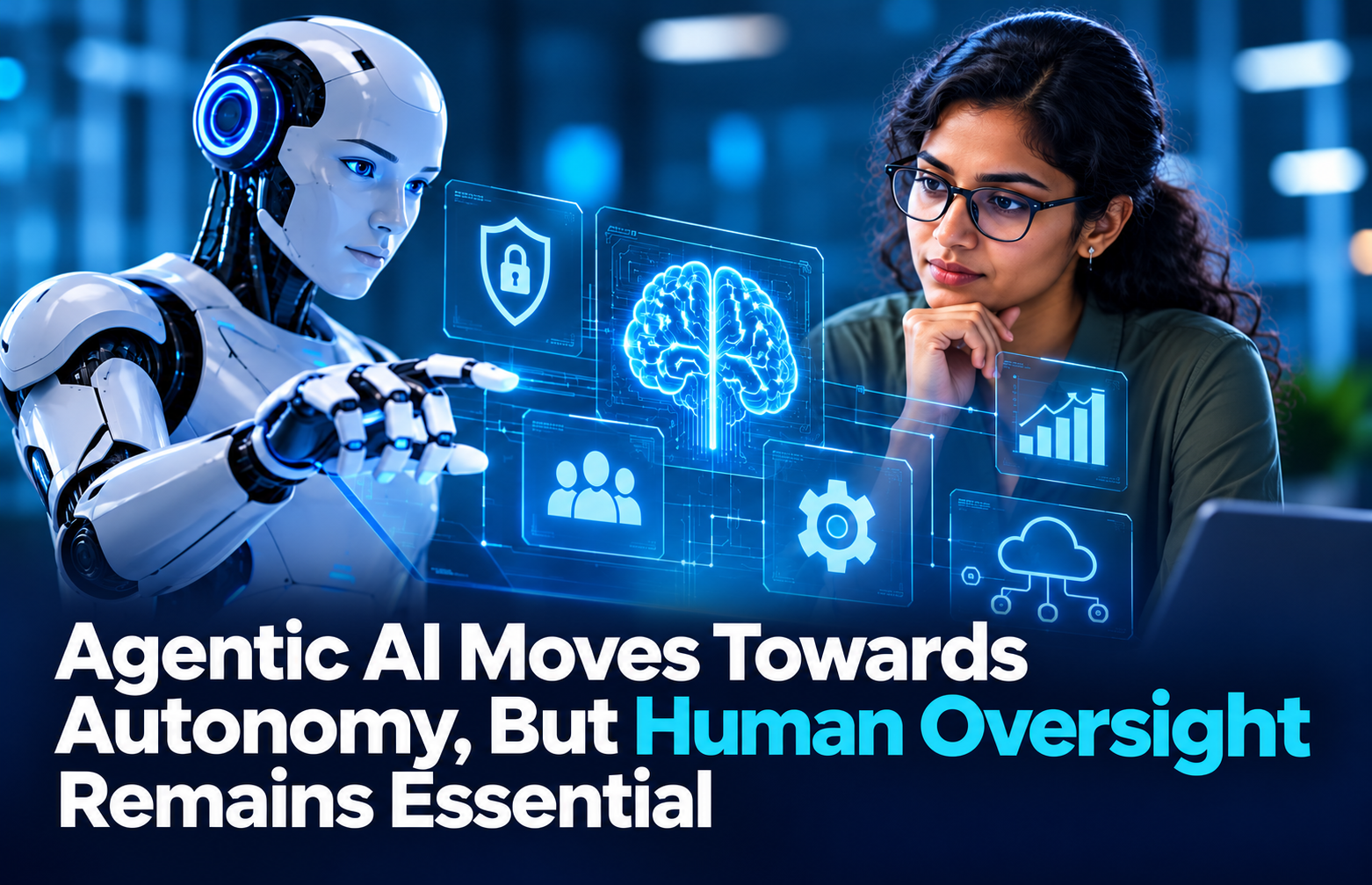
Agentic AI is moving rapidly from experimentation to real-world deployment, transforming business operations and customer experiences. However, a global study reveals that trust, security and reliability remain significant challenges. As organisations expand automation, human oversight and real-time monitoring are emerging as essential foundations for responsible autonomous operations
Artificial intelligence is entering a new phase, moving beyond responding to instructions towards independently making decisions, coordinating tasks and executing complex operations. Known as agentic AI, this emerging technology is steadily transforming how organisations operate, manage resources and engage with customers. Yet, as businesses embrace greater autonomy, questions about trust, accountability and reliability are becoming increasingly important.
The 2026 research report, The Pulse of Agentic AI: Building Trust in Autonomous Operations from Pilot to Production, published by Dynatrace, highlights this changing landscape. Based on a global survey of 919 senior leaders and decision-makers involved in AI development and implementation, the report examines how organisations are adopting agentic AI, the challenges they encounter and the measures needed to make autonomous systems dependable.
The findings indicate that agentic AI is no longer confined to experimental projects. Organisations are increasingly deploying AI agents across critical business functions, particularly IT operations, software engineering, cybersecurity and customer support. However, the technology’s expansion is accompanied by a growing recognition that autonomy without adequate control can introduce risks and undermine operational reliability.
IT operations and system monitoring currently lead adoption, with 70 per cent of respondents using agentic AI for these purposes. Data processing and reporting account for 51 per cent, while cybersecurity stands at 49 per cent. Beyond internal operations, customer service and support have emerged as significant applications, with 47 per cent of organisations using AI agents in this area. Personalised customer engagement follows at 44 per cent.
The growing interest is also reflected in investment plans. Nearly three-quarters of respondents, 74 per cent, expect their agentic AI budgets to increase over the next year. Current spending is concentrated in the range of $2 million to $5 million, demonstrating that businesses increasingly view the technology as a strategic investment rather than a passing technological trend.
Despite this momentum, the transition from pilot projects to large-scale deployment remains challenging. Half of the surveyed organisations have already deployed agentic AI in production for limited use cases, while 44 per cent report broader adoption within selected departments. However, only 23 per cent have achieved mature, enterprise-wide integration.
Security, privacy and compliance concerns remain among the biggest obstacles. More than half of respondents identify these issues as barriers to production. Technical difficulties in managing and monitoring AI agents at scale are another major concern, cited by 51 per cent. A shortage of skilled employees and inadequate training also complicate implementation.
One of the most significant findings concerns the continuing importance of human involvement. Although agentic AI is designed to operate with limited intervention, 69 per cent of AI decisions are currently verified by humans. Data quality checks, human reviews and monitoring for unusual behaviour are among the most widely used validation measures.
Interestingly, 64 per cent of organisations are developing a combination of fully autonomous and human-supervised agents. Only 13 per cent are building exclusively autonomous systems. This suggests that businesses are not necessarily looking to eliminate human involvement but are seeking a balance in which artificial intelligence handles repetitive and time-sensitive activities while people retain responsibility for judgement, accountability and strategic decisions.
The report also highlights reliability and resilience as essential measures of success. Sixty per cent of respondents identify technical performance as their leading measure of agentic AI success. Operational efficiency, developer productivity and customer satisfaction are also important indicators. Organisations increasingly recognise that failures in interconnected AI systems can spread quickly, affecting applications, data and customer experiences.
An important concept emerging from the study is observability, which refers to the ability to understand what is happening within complex digital systems through connected data and real-time monitoring. Traditional monitoring tools, largely designed for predictable software behaviour, may not adequately explain the decisions and actions of generative AI agents.
The report finds that 69 per cent of organisations use observability during the implementation stage of the agentic AI lifecycle, while 54 per cent use it during development and 57 per cent during operationalisation. Nevertheless, existing tools leave gaps in visibility, making it difficult to identify unexpected behaviour, trace decisions and understand their wider consequences.
Notably, 44 per cent of organisations still rely on manual reviews of communication flows between AI agents. This underlines the need for more advanced monitoring systems capable of identifying anomalies and providing accurate, contextual information in real time.
The study argues that observability must evolve into a control mechanism for autonomous operations, ensuring that AI agents make decisions based on reliable facts and operate within clearly defined boundaries. Such systems can help organisations detect errors, prevent unintended consequences and maintain accountability.
The research draws on responses from leaders across 15 countries, including 70 respondents from India, and was conducted during November and December 2025. It offers a glimpse into an increasingly automated business environment in which artificial intelligence is expected to become a vital partner in productivity and decision-making.
The future of agentic AI, therefore, may not be about machines replacing people, but about creating a more effective partnership between human intelligence and autonomous systems. The organisations that succeed will be those capable of combining technological innovation with transparency, security, human judgement and trust. As AI agents become more independent, ensuring that they remain accountable could prove just as important as expanding what they can do.
Discover more from Creative Brands Mag
Subscribe to get the latest posts sent to your email.















Leave a comment