


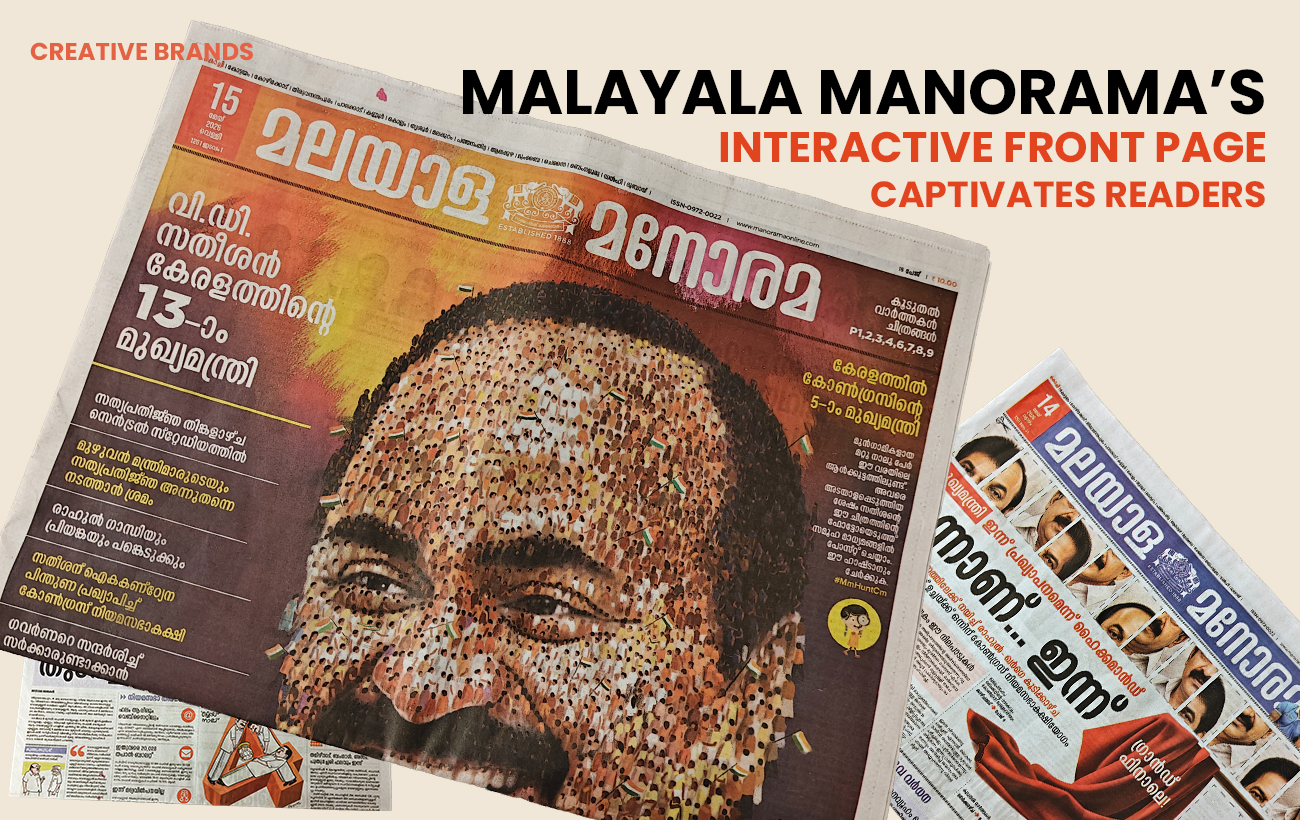
Manorama has reinvented its front page during the Kerala Assembly season with interactive experiments. From puzzles and digital paintings to reader-driven headlines, the newspaper has invited audiences to play, tag, and share. The #MmHuntCm challenge and other innovations have been widely praised for blending creativity with political coverage.
Malayala Manorama has long been a fixture in Kerala’s media landscape, but this Assembly season it has chosen to break convention and reimagine the front page as a space for interaction, creativity, and reader participation. In doing so, the newspaper has not only reported politics but also invited its audience to play an active role in shaping the narrative.
Today’s edition is perhaps the most striking example of this experiment. A digital painting of VD Satheesan, the Chief Minister elect, dominates the front page. Yet it is not simply a portrait; it is a puzzle in itself. Readers are asked to identify four other figures hidden within the crowd—Congress leaders who previously held the position of Chief Minister in Kerala. Once spotted and tagged, readers are encouraged to photograph the page and share it on social media with the hashtag #MmHuntCm. In this way, the front page becomes a participatory hunt, blending art, politics, and digital engagement.
This is part of a series of inventive gestures that have marked Malayala Manorama’s coverage of the Assembly season. On the day votes were counted, the newspaper presented a front page with deliberate white space, inviting readers to write their own headlines once the results were declared. It was a bold move, transforming the newspaper into a canvas for public imagination. Later, when the Chief Minister was announced, the front page became a jigsaw puzzle featuring cutouts of the three contenders. Readers could piece them together as they wished, reflecting the uncertainty and drama of political competition.
Such experiments are not merely gimmicks. They represent a deeper shift in how newspapers can engage with their audiences in an era of digital saturation. By encouraging readers to interact, tag, and share, Malayala Manorama has extended the life of its front page beyond print, into the social media ecosystem where participation and visibility matter as much as information. The hashtag #MmHuntCm is emblematic of this strategy, creating a bridge between traditional journalism and contemporary digital culture.
The response from readers has been overwhelmingly positive. Many have praised the newspaper for its originality and willingness to break from routine. In a season where political coverage can often feel repetitive or predictable, Malayala Manorama’s experiments have injected a sense of playfulness and creativity. They have also underscored the role of newspapers not just as conveyors of information but as cultural actors capable of shaping how events are experienced.
There is also a symbolic dimension to these experiments. By inviting readers to write headlines, assemble puzzles, or hunt for leaders, Malayala Manorama has acknowledged the participatory nature of democracy itself. Politics is not only about leaders and parties; it is also about citizens engaging, interpreting, and making meaning. The newspaper’s front page has become a metaphor for this process, reminding readers that they are not passive consumers but active participants in the democratic story.
At a time when print media faces challenges from digital platforms, Malayala Manorama’s approach offers a glimpse of how newspapers can remain relevant. Rather than competing with social media, it has embraced its logic—hashtags, sharing, user-generated content—while retaining the authority and tradition of print. The result is a hybrid form of journalism that is both rooted in legacy and attuned to contemporary expectations.
The Kerala Assembly season has provided the perfect backdrop for these experiments, with its mix of anticipation, drama, and public interest. Yet the implications extend beyond politics. Malayala Manorama has demonstrated that newspapers can be playful, interactive, and imaginative without sacrificing seriousness. It has shown that the front page can be more than a static display; it can be a living space where readers are invited to co-create meaning.
As the season concludes, the legacy of these experiments will likely endure. They have set a precedent for how newspapers might innovate in the future, blending art, design, and reader participation with traditional reporting. For Malayala Manorama, the experiment has been more than a novelty; it has been a statement about the evolving role of journalism in a participatory age.
What stands out is not just the digital painting of VD Satheesan or the jigsaw puzzle of contenders, but the spirit of engagement that underpins them. Malayala Manorama has reminded its readers that news is not only to be read but also to be experienced, shared, and played with. In doing so, it has reaffirmed its place at the heart of Kerala’s public life, not only as a chronicler of events but as a creator of cultural moments.
Discover more from Creative Brands Mag
Subscribe to get the latest posts sent to your email.











Leave a comment