


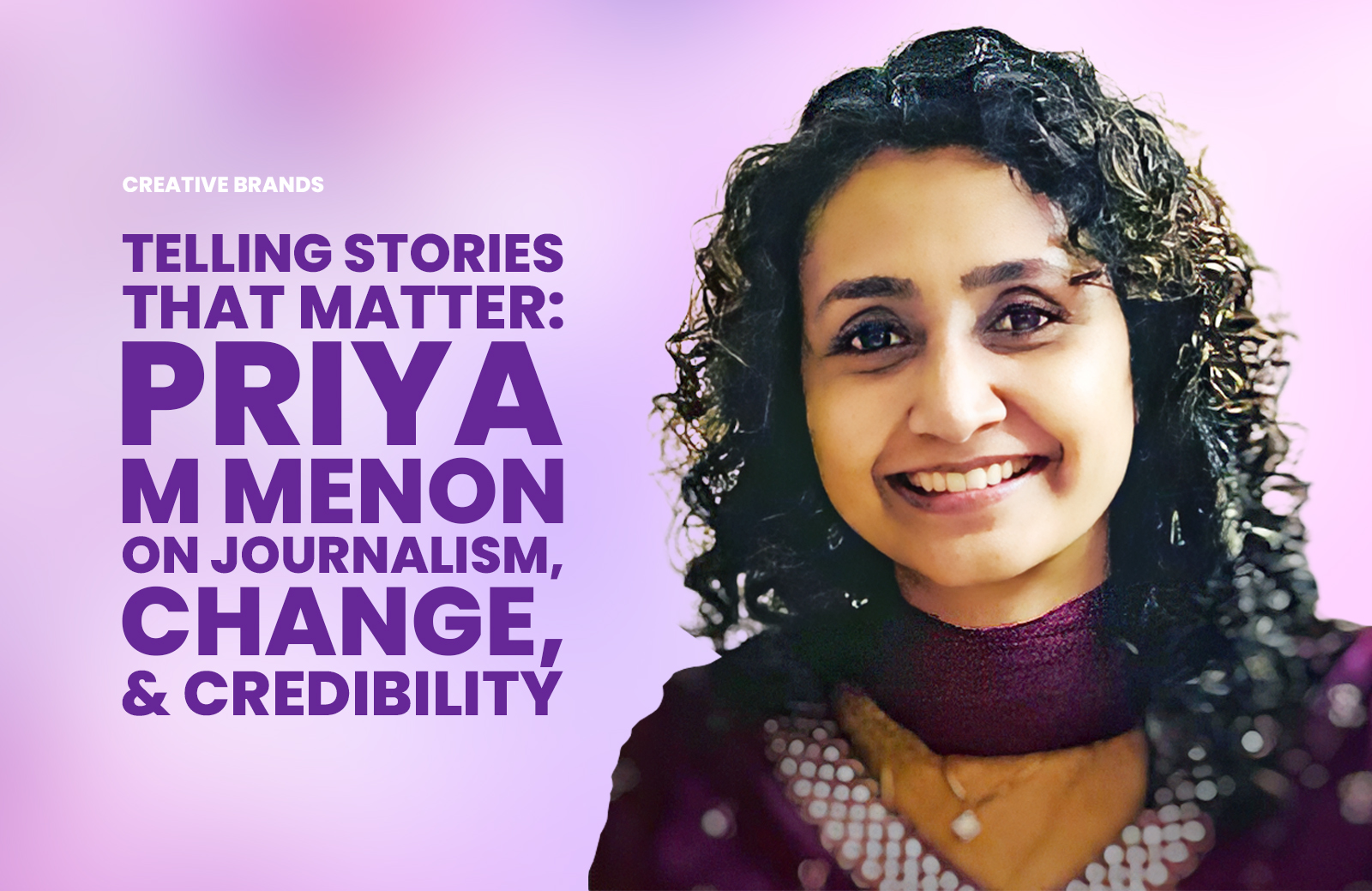
In a quiet newsroom, long before headlines go live, the real work of journalism begins—with listening closely and shaping stories that endure. For Senior Journalist Priya M Menon, that process has defined a career spanning more than two decades across some of India’s leading publications, as well as international and independent media spaces.
Menon began her journey in 1999 as a sub-editor and reporter in the Features department of The New Indian Express in Chennai. She went on to lead Features teams at The New Indian Express, The New Sunday Express Magazine, and later at The Times of India, building a body of work that consistently foregrounded human-centred storytelling. Writing across beats such as food, film, and fashion, she developed a strong focus on gender, mental health, animal welfare, and the lived experiences of marginalised communities.
Her career later expanded beyond traditional newsrooms when she took on the role of Senior Journalism Adviser, South Asia, with the Journalism Centre on Global Trafficking. In this capacity, she worked closely with journalists across the region, designing fellowships, conducting workshops, and supporting in-depth reporting on complex issues such as human and wildlife trafficking. Alongside this, she also initiated independent projects like Hues of Pride, aimed at addressing misinformation around the LGBTQIA+ community and mentoring young journalists.
At a time when journalism is being reshaped by digital disruption and new technologies, Menon’s work reflects a consistent commitment to credibility, empathy, and impact. In this interview, she reflects on her journey, the changing media landscape, and the enduring importance of telling stories that truly matter.
In this interview, Priya M Menon reflects on her journey, the shifting boundaries of journalism, and the enduring responsibility of telling stories that not only inform but also resonate and endure.
You began your career in news feature journalism before moving into the International communication space—how did that transition reshape your Understanding of storytelling and impact?
A: I began my career in 1999 as a sub-editor and reporter in the Features Department of The New Indian Express in Chennai, and went on to lead Features teams at The New Indian Express, The New Sunday Express Magazine, and The Times of India. Those years shaped my approach to storytelling. While I wrote across beats—from food and films to fashion— I specialised in covering gender issues, especially the challenges faced by the LGBTQIA+ community in India, as well as mental health and animal welfare. These stories, grounded in data and rigorous reporting, were written in simple yet powerful language and made an impact as they had a strong human connect.
After 25 years in the newsroom, I moved into an international role as Senior Journalism Adviser, South Asia, with the Journalism Centre on Global Trafficking. There, I designed and implemented fellowships on human and wildlife trafficking, curated workshops, and provided editorial support to journalists across the region. This phase also gave me the time and flexibility to initiate independent work. After receiving a TechCamp grant, I launched Hues of Pride (huesofpride.com), an online initiative to combat misinformation and disinformation around the LGBTQIA+ community in India, and to help train aspiring young journalists to report on it in a sensitive and informed manner. The platform was later handed over to DHISHA Kerala and the Institute of Communication, Kerala Media Academy, to ensure it continued as a resource-driven initiative.
That transition expanded my understanding of storytelling in two ways. First, it made me more conscious of the structural gaps in journalism—many independent reporters lack access to strong editorial mentorship and institutional support. Second, it reinforced the resilience and commitment that drive impactful journalism. I worked with journalists who, despite financial and personal challenges, pursued difficult stories because they believed they needed to be told.
My role was to support that process—helping them access resources, sharpen their narratives, and build strong, credible stories, while respecting editorial independence. It deepened my belief that good storytelling is not just about writing well, but about enabling the right stories to be told.
From your experience, how does mainstream journalism differ from development-focused or advocacy-driven communication in terms of priorities, ethics, and audience engagement?
A: In my career, I strike a balance between both roles. At present, I work both as a media adviser and an independent journalist, so I aim to always ensure editorial integrity. In my experience, there are clear distinctions between mainstream journalism and development-focused or advocacy-driven communication. In the former, stories can be event-based or issue-driven. In my own career as a journalist, whether I was writing on gender, the LGBTQIA+ community, mental health issues or animal welfare, the intent was always to go beyond the immediate story and delve into the larger issue.
The main difference between mainstream journalism and advocacy-driven communication lies in the way you approach, explore and present a story. As a journalist, even if you are personally invested in an issue, you approach it as a professional, setting aside personal biases, and explore all aspects of the issue, presenting a well-rounded article. In advocacy communication, while the work may be grounded in facts and credible information, it is aligned with a particular goal — such as raising awareness, influencing policy, or shifting behaviour over time. The storytelling and framing, therefore, aimed towards it. The difference, in my opinion, lies less in what we tell and more in why and how we tell it.
Looking at today’s media landscape, do you think mainstream journalism is still able to effectively cover grassroots and developmental issues, or has that space shrunk?
A: I think it depends on how we define “mainstream journalism” today. If we are looking only at traditional print spaces, there has certainly been a shrinking of space for in-depth coverage of grassroots and developmental issues. However, the broader media landscape has also expanded in other ways. Many mainstream publications now have dedicated pages or verticals—especially on their digital platforms—that focus on social, environmental, and developmental reporting. At the same time, a number of independent digital platforms have emerged that are committed entirely to these issues. Platforms like BehanBox, which focus on gender, or People’s Archive of Rural India, which documents rural India, have created space for stories that may not always find prominence in traditional news cycles.
Importantly, digital platforms are not constrained by space in the way print is, which allows journalists to explore issues in far greater depth and with more nuance. Mainstream newspapers have also adapted to this shift. Publications like The Hindu and The Times of India have dedicated newsletters focusing on areas such as gender and health, reflecting both audience interest and the need for more sustained coverage of these issues. So, while the space within traditional newsrooms may have become more constrained, the overall ecosystem has become more diverse. The challenge, however, is visibility and reach—stories from smaller or niche platforms do not always receive the same amplification as those from large media houses. So, I would say the space has not disappeared, but shifted. The opportunity now lies in how mainstream and independent platforms can complement each other to ensure that grassroots realities continue to be reported, and more importantly, heard.
Having worked both inside and outside traditional newsrooms, what do you see as the biggest structural challenges facing journalism today?
Having worked in traditional newsrooms and outside, I think journalism today is dealing with a mix of structural and transitional challenges. Many legacy media houses are still figuring out how to effectively leverage digital platforms—not just in terms of presence, but in how stories are produced and consumed online.
Newsrooms are also still experimenting with AI and its applications—developing their own internal systems and trying to understand how it can be effectively used in editing or production. Another key issue is the erosion of the middle rung. You often have very senior editors and young journalists who are digitally savvy but lack the perspective and skill sets that come with experience.
There are also broader concerns, such as business model and revenue pressures. At the same time, media schools are seeing fewer enrolments, as fewer people are entering a profession where long working hours make work- life balance difficult, and pay is often not very attractive compared to other professions.
Overall, the challenge is not just adapting to change, but doing so while retaining the depth, judgement, and credibility that define good journalism.
With the rapid rise of artificial intelligence, how do you think AI is transforming journalistic practices—particularly in reporting, verification, and audience trust?
A: AI is already transforming journalistic practices in very practical ways. Many reporters are using it for writing, editing, gathering information and crunching data as well as for page-making.
However, I see AI as an assistant. I don’t think it is yet at a stage where it can replace human journalists. It still makes errors, lacks an individual voice, and requires human oversight to cross-check and correct information. It can help you write or refine a story, but the perspective, nuance, and judgement have to come from the journalist. Even if you use AI to draft a story, you still have to go through it, verify information and even polish up the copy.
While AI can be useful in analysing data or identifying patterns, there are also concerns. The risk of misinformation, deepfakes, and AI-generated content means that the need for human judgement and rigorous fact-checking has become even more critical. Audience trust is closely linked to this. Readers need to know that what they are consuming is credible and independently verified. Many newsrooms now carry notes indicating when AI has been used in content creation.
Used thoughtfully, AI can strengthen journalistic practice—but it cannot replace the human judgement, ethics, and voice that define it.
What emerging trends in journalism—whether digital, independent, or community-led—give you hope for the future of credible and impactful storytelling?
A: What gives me hope is the emergence of a more diverse media ecosystem. A number of independent and digital platforms are doing consistent, issue-driven reporting with depth and integrity. Platforms like BehanBox, People’s Archive of Rural India, The News Minute, The Wire, and Scroll.in are creating space for stories on gender, rural realities, policy, and regional issues that are often underrepresented in mainstream coverage. At the same time, independent journalists are building their own platforms and audiences. For instance, Faye D’Souza launched Beatroot News, a digital content brand.
What is also encouraging is that audiences today are more willing to engage with long-form, issue-based content, especially when it is presented with clarity and credibility. Digital spaces have made it possible to go deeper, sustain conversations, and build communities around issues. These trends point to a future where journalism is not limited to traditional newsrooms but is shaped by a wider range of voices and formats. That diversity, if supported by strong editorial standards, has the potential to make storytelling both more inclusive and more impactful.
Discover more from Creative Brands Mag
Subscribe to get the latest posts sent to your email.













Leave a comment