


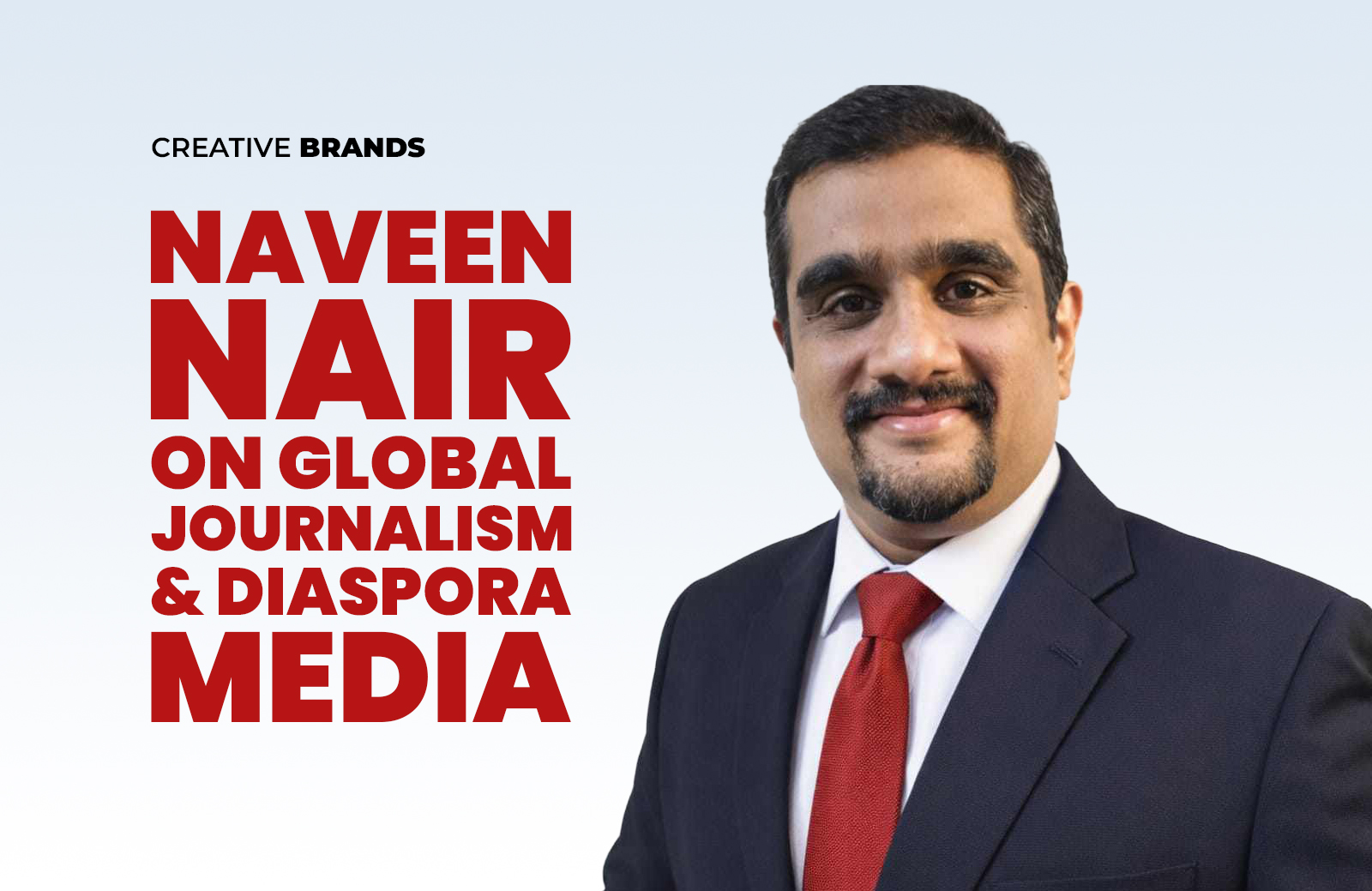
Journalism is rapidly evolving across borders; few media professionals embody this transition as seamlessly as Naveen Nair. From the bustling newsrooms of India to the dynamic media landscape of the United Kingdom, Naveen’s journey reflects both the changing contours of global journalism and the enduring values that underpin credible storytelling.
Having served as Bureau Chief for leading networks such as CNN-IBN and India Today, Naveen built a reputation for sharp reportage, editorial leadership, and an instinct for stories that matter. His years in India’s competitive television news industry placed him at the heart of breaking news cycles and complex narratives, shaping his understanding of audience engagement in a fast-paced media environment. Those experiences now inform his broader, more global perspective on news and communication.
Naveen’s move to the UK marked not just a geographical shift but also a reinvention of his professional identity. As the founder of The News Monk UK, he ventured into independent journalism, creating a platform that bridges communities and amplifies diverse voices, particularly within the Indian diaspora. His work reflects a nuanced understanding of cross-cultural storytelling, where local issues intersect with global conversations.
Currently based in Stoke-on-Trent, close to the vibrant city of Manchester, Naveen continues to play a significant role in shaping diaspora media narratives. As a Board Member of Flowers 24 UK & Europe, he is part of a growing effort to expand regional language content and connect audiences across continents. His role highlights the increasing importance of niche broadcasting and culturally rooted media in an increasingly fragmented digital ecosystem.
This exclusive interview explores Naveen’s journey from mainstream Indian television to entrepreneurial media ventures in the UK, his insights on the future of journalism, and the challenges of maintaining editorial integrity in a rapidly shifting information landscape. It also delves into his vision for diaspora media and how platforms like Flowers 24 are redefining content consumption for global Malayali audiences.
What will you be planning for 24News UK?
My role at 24News UK is purely editorial guidance. We are still in the process of creating a product that will cater to the needs of the global Malayalee. So I guess there will be a lot of experimentation that will happen in the days to come.
There is a young team in the UK for FlowersTV & 24News which, if I am being honest, is more bent towards entertainment than ”news” in that sense. So I guess my primary responsibility will be to inculcate that newsroom culture in the team.
Secondly, we need to understand that covering news in the UK and Europe is a lot different from India. Here right to privacy takes precedence over a lot of things and so it is very important to tread carefully. One of my roles would be to keep a close eye on how we generate content and how we use it.
And certainly, there will be a lot of suggestions that I will throw in terms of content strategy, planning potential partnerships, etc.
The NRI impact on Indian news?
Yes, it is certainly big. See, we need to understand that today you have an Indian diaspora out there that is more demanding, more aspiring, and more pushy than ever…and in that the Malayalee certainly stands at the top as always. So, there is a lot of space for impactful media, and news is still a top commodity among our NRIs.
I think there is a lot of interest in not just what happens back home but more importantly how India plays itself in the global affairs after Modi came to power. This Viswaguru idea has really rubbed off on the diaspora in a big way. Also, there is this growth of extreme nationalism among the NRIs, like never before, which means there is an ever-growing global Indian audience waiting to consume all that comes their way about India and mostly pro-Indian narratives.
It is going to be a challenge over the next few years for media houses on how you can satisfy your target audience. It is also an audience that perceives most of the well-established global news outlets as anti-India, like the BBC or New York Times, which means it opens a lot of space for pro-India voices to come up. It may be more of narrative building than pure journalism, but that is what new-age social media consumers want.
Your take on journalism today?
That is a very broad question. I feel it has evolved so much that sometimes I find it difficult to reconcile with the kind of journalism that is being done today compared to say 23 years ago when I started with the New Indian Express, and I am not even talking about technology. Technology, for sure, has evolved for the better, and we need to adapt to that. Gone are the days when you needed at least a three-member crew to cover TV news: a reporter, a cameraperson, and a camera assistant. It’s all on your mobile phones now, and you can’t tell the difference between a reporter or cameraperson now. That is great for the longevity of the news industry.
But the way journalism is done today is what worries me. It’s just the target audience that matters now. Nothing else. How many of us even remember the golden rule, “Doing justice to both sides of a story”?
Now it is all about building a narrative that suits your audience, where fact is often forced to take the backbench. I think the boundaries between fact and fiction have blurred so much that we are certainly on a slippery slope more than ever. The impact will be on our credibility as storytellers.
We should not forget that today we are living in a world that has become more volatile and dangerous than ever, where sheer power holds the upper hand above everything else. The need for credible journalists and journalism is now more than ever! Are we living up to it? I have my doubts.
Is AI impacting journalism?
Absolutely. No sector can escape the impact of AI right?. Even in this present war in the Middle East, we are seeing how AI is impacting coverage. The other day I saw a BBC report on how the Iranian state television was using AI to create fake videos of attacks at major landmarks in Dubai and Bahrain, claiming them as Iranian hits. Not surprising at all. We saw such attempts during the Indo-Pak conflict too. So AI, among all the positive attributes it brings, will generate a lot of fake content that journalists will have to be wary of and it will get more and more complex as we go along.
But for me what is key is how far AI can influence storytelling. As journalists, we all grew up in the culture of “putting the human element at the heart of a story.” That, for me, is journalism even now. But can AI really do that? Can AI be empathetic with suffering or relish success? Can it really tell the human story? Not yet, at least. So all these gimmicks that you see now—newsrooms using AI to amplify their live presence, generating content with AI—yes, all this is fine as long as you just have commercial gain in mind. Good for the business and good for virality in quick time, but can it build the narrative for a great story, I still don’t think so. I strongly feel that at the end of the day no AI can replace a good journalist.
What are your future plans?
At 24News UK it will continue to be an advisory role for me, contributing my insights into whatever growth is possible.
But thinking ahead there is an entrepreneur in me who says there is a lot more to be done for the Indian diaspora, and you cannot stick to one language or region for that.
As I said before, the NRIs right now are a highly aspirational group of people, and I strongly feel it will be a shame if we do not have a creative space where the identity for interaction should never be just Malayalee, Tamilian, or Gujarati. It should be Indian. Over the years we have had a lot of so-called Indian media abroad, but sadly, they have been vernacular entities mostly.
So there is something in the making at the moment. I call it my baby. A pro-India digital platform for the diaspora that is multilingual and will try to capture the true essence of India as a rising global power. It will be based in the UK.
It should have taken wings coinciding with these assembly elections, but a lot of circumstances have pushed it a bit further away. But it will be there soon.
Discover more from Creative Brands Mag
Subscribe to get the latest posts sent to your email.














Leave a comment