


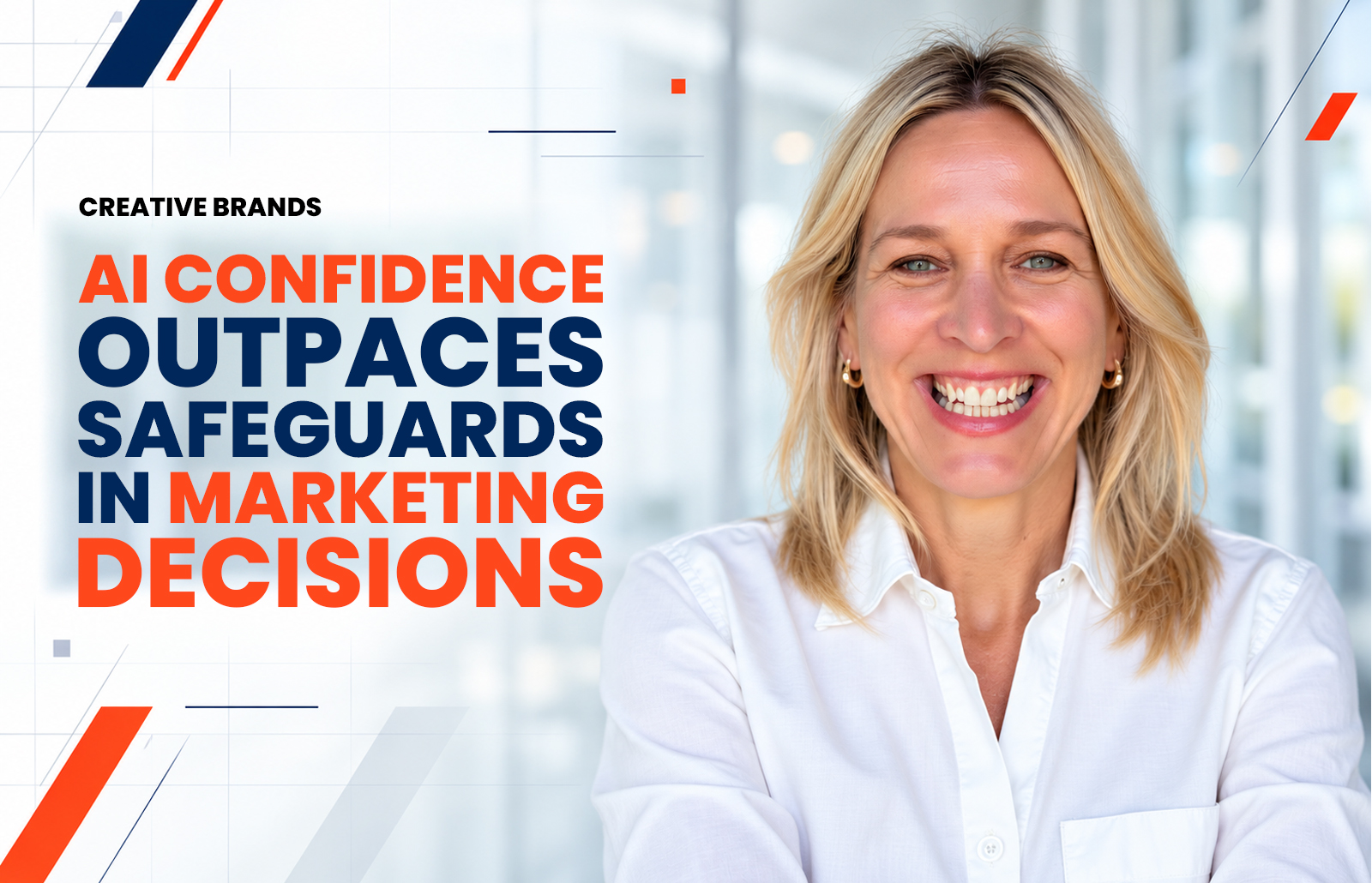
Senior marketers across Australia report rising confidence in decision-making, with AI now a trusted advisor. Bench Media’s The Confidence Equation reveals 90 per cent find decisions easier, yet governance lags behind trust. Leaders stress instinct, context and “veto literacy” as essential, warning that unchecked reliance on AI risks strategic blind spots.
Senior marketers are making decisions with greater confidence than a year ago, and artificial intelligence is a major reason why. Yet a new report warns that the safeguards around AI-assisted decision-making have not kept pace with the trust marketers now place in it.
The Confidence Equation, published by Bench Media, draws on a Bench Lens survey of more than seventy senior client-side marketing leaders across Australia. It found that 90 per cent of respondents say decision-making has become easier over the past year. This is despite 59 per cent identifying the sheer volume of AI and new technology tools as the biggest factor still complicating decisions.
Jess Torstensson, General Manager, Growth at Bench Media, admitted she expected the opposite outcome. “I went into this research expecting AI to make senior marketers less confident, with them second-guessing their own judgement,” she said. “The data said the opposite. Confidence isn’t about trusting AI more, it’s about knowing when to trust it, when to challenge it, and when to trust yourself.”
The report highlights three key insights. First, AI has shifted from tool to trusted advisor. Nearly half (48 per cent) say AI has made them more confident in their decisions, while 41 per cent rely on AI most when weighing calculated risks. That reliance grows with the size of the budget: leaders managing over $20 million are twice as likely to lean on AI for risk decisions as those managing under $20 million.
Second, trust has outpaced governance. More than a third (38 per cent) accept AI-generated strategic recommendations without human review, rising to 45 per cent for budget recommendations and creative concepts.
Third, instinct still has the final say. Most leaders (59 per cent) back their own judgement when AI recommendations conflict with it. Bench predicts this ability to override AI will become a defining leadership skill. Torstensson calls it “veto literacy”: the scarce skill of knowing when to override AI and defending that call to a Board that increasingly assumes the machine is right.
The survey also ranked seven influences on confidence. AI led at 23 per cent, followed by data (21 per cent) and experience (20 per cent). Internal leadership and industry conversation each accounted for 11 per cent, agencies 8 per cent and peers 6 per cent. With no single input dominating, Bench argues organisations must build frameworks clarifying which input leads on which decision.
Industry voices echo the need for balance. Michelle Wee, General Manager – Marketing at Hisense, said: “The strongest decisions come from combining technology with a deep understanding of consumers, culture, brands and business objectives. AI should enhance our thinking, not replace it.” Emma Fogarty, Head of Marketing & Category at nudie Foods, added: “There still needs to be a human in the loop. The outputs need to be challenged, validated and considered in context.”
Torstensson recommends pairing AI outputs for strategic and budget decisions with fast, targeted primary research. “Confidence is useful when you can explain what informed the decision. That means giving leaders a process for testing AI’s advice, challenging it and standing behind the final decision,” she said.
Discover more from Creative Brands Mag
Subscribe to get the latest posts sent to your email.














Leave a comment