


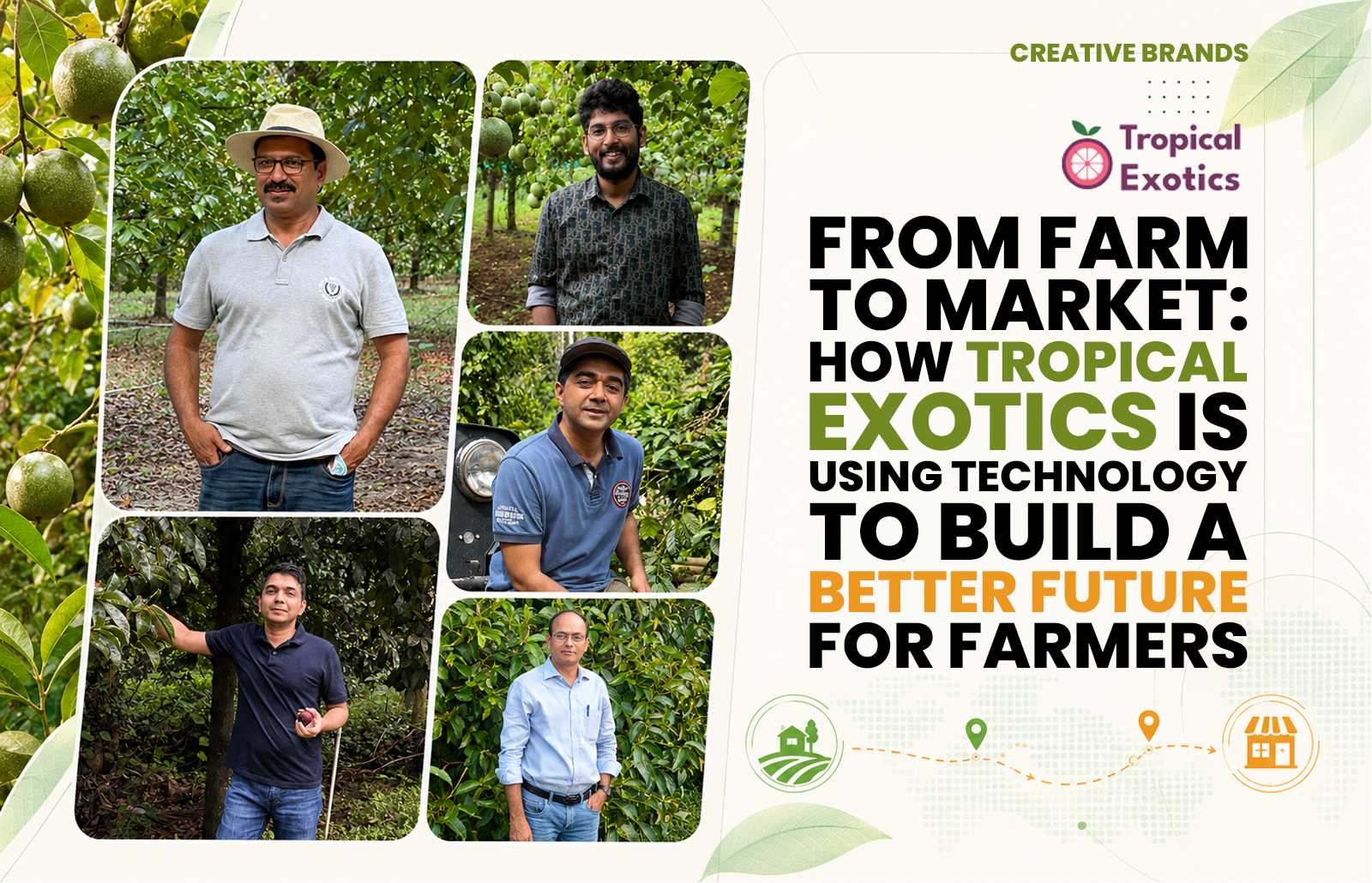
Tropical Exotics is bringing together farmers, technology and modern supply chains to address one of agriculture’s oldest challenges: finding dependable markets for fresh produce. Born during the COVID-19 lockdown, the Kerala-based venture aims to reduce uncertainty for farmers while delivering fresher, high-quality fruits to consumers across India.
Behind every fruit that reaches a customer’s doorstep is a farmer, a family, a piece of land and a story. For Tropical Exotics, that story begins not in a warehouse or supermarket, but on farms where generations of agricultural knowledge meet the demands of a rapidly changing market.
The company was born from a simple but significant realisation: farmers may be capable of producing high-quality crops, but getting those crops to the right market at the right time can be just as challenging as growing them.
The idea took shape during the COVID-19 lockdown in 2020, when the founders returned from Bengaluru to their hometowns in Kerala. Coming from farming backgrounds, they were familiar with agriculture, but being back home brought them closer to the everyday difficulties faced by farmers.
One incident particularly stayed with them. A trader had asked farmers to harvest a large quantity of rambutan and mangosteen. The farmers prepared for the order, harvested the fruits and got them ready for dispatch. The following day, the order was cancelled.
For fruits with a shelf life of only a few days, a cancelled order is far more than a business inconvenience. It can turn months of cultivation and care into a financial loss. With no dependable market to fall back on, farmers were left carrying the risk.
The experience led to a straightforward question: what if farmers had a reliable buyer even before they harvested?
That question became the foundation of Tropical Exotics.
At the heart of its agricultural operations is Jomy Mathew, whose association with farming stretches back more than three decades. After completing his MBA in 1992, Mathew chose farming over a conventional corporate career and developed extensive experience in cultivating high-value crops and understanding the realities of agricultural production.
His contribution to the venture is rooted in that experience. Farming, he understands, is not simply about planting a crop and waiting for harvest. Weather, soil, labour, disease, cultivation practices, timing and market conditions can all influence the outcome. A farmer may invest months in a crop without knowing what price it will command when it is finally ready.
Mathew’s agricultural expertise has therefore become an important part of Tropical Exotics’ approach to working with farmers. The emphasis is on improving cultivation practices, encouraging scientific methods, planning harvests and creating stronger links with dependable markets. His work was also recognised in 2020 when he received the United Nations Best Pepper Planter Award.
Technology forms the other major pillar of the business. Jobin Tharappel and Deepu Tharappel, co-founders of technology company Fortunesoft, brought years of experience in developing digital solutions for businesses. Their understanding of technology, combined with their agricultural roots, helped shape the company’s approach.
For them, the problem was not necessarily that farmers could not grow good produce. It was what happened after the crop was ready. Who would buy it? Would an order remain valid? How quickly could the produce reach consumers? How much would the farmer ultimately earn?
These questions led to an effort to introduce technology into a traditionally fragmented agricultural ecosystem. Procurement, inventory, supply-chain management and digital commerce became part of the company’s strategy to make the journey from farm to market more organised and predictable.
Jiji Varghese, who returned to India after working in the United States, brought another technology perspective to the founding team. His international exposure and professional experience contributed to the ambition of building a modern agricultural enterprise in which data, technology and efficient systems could work alongside farming knowledge.
Godwin BP, an MBA graduate, has contributed to the business and operational side of the venture. As Tropical Exotics expanded, the challenge became increasingly complex. Bringing together farmers, procurement, logistics, inventory, quality control, customers and business relationships required an integrated operational structure.
The founders’ different backgrounds have consequently become complementary strengths. Farming provides the understanding of the land and its challenges. Technology provides tools to address inefficiencies. Business expertise helps turn the idea into an organisation capable of operating at scale.
The result is an approach in which the farmer remains at the centre of the supply chain.
Tropical Exotics works with farmers across different agricultural regions of India, with its relationship extending beyond simply buying whatever happens to be available at harvest. Crop planning, scientific cultivation, harvesting practices and market requirements form part of the broader engagement.
This is particularly important for fruits such as mangosteen, rambutan and passion fruit. Timing matters enormously. Produce harvested at the appropriate stage and moved quickly can arrive at the customer in excellent condition. The same fruit, left without a buyer or held up in transportation, can rapidly lose value.
For Tropical Exotics, therefore, the supply chain begins well before a consumer places an order.
Moving agricultural produce from farms to cities is one of the company’s central challenges and opportunities. Its operations are designed around the short shelf life of fresh produce, with coordinated supply-chain systems intended to reduce waiting time and unnecessary delays.
The underlying principle is straightforward: fruit should spend more of its journey moving towards a customer and less time waiting for one.
That philosophy has allowed the company to serve businesses, modern retail and quick-commerce markets while also developing a direct-to-consumer presence. It represents a shift from a conventional trading model towards a more connected farm-to-market ecosystem.
Although exotic tropical fruits remain central to the company’s identity, the larger ambition goes beyond rambutan, mangosteen, passion fruit, avocado and jackfruit. Tropical Exotics is exploring opportunities involving berries, spices, teas, coffee and other farm-based products.
The objective is not simply to increase the number of products available. It is to strengthen the connection between the people who grow food and those who eventually consume it.
Behind the technology and logistics, however, the company continues to be defined by the farm. Early mornings, farmers inspecting their crops, workers sorting freshly harvested produce, changing weather conditions and the anticipation surrounding a new harvest remain fundamental to the story.
Technology can improve visibility. Data can improve planning. Supply-chain systems can reduce delays. But none of these can replace the farmer whose work begins the entire process.
That is perhaps the central idea behind Tropical Exotics’ journey. Its ambition is to create a system in which Indian farmers can cultivate high-value crops, access better markets and benefit from technology while retaining the human connection between people and the land.
The company now looks towards expanding into more markets while strengthening its relationships with farming communities. Yet the original purpose remains remarkably simple: make farming more rewarding for the farmer, make fresh produce more accessible to the customer and build a dependable bridge between the two.
What began as a conversation during one of the most uncertain periods in recent history has evolved into a business built around a much older relationship — the relationship between people and the food they grow.
At Tropical Exotics, the journey from farm to table is not merely a supply chain. It is a story of farmers, technology, enterprise and trust, with the farm remaining at the heart of it all.
Visit: https://tropicalexotics.in/
Discover more from Creative Brands Mag
Subscribe to get the latest posts sent to your email.















Leave a comment