


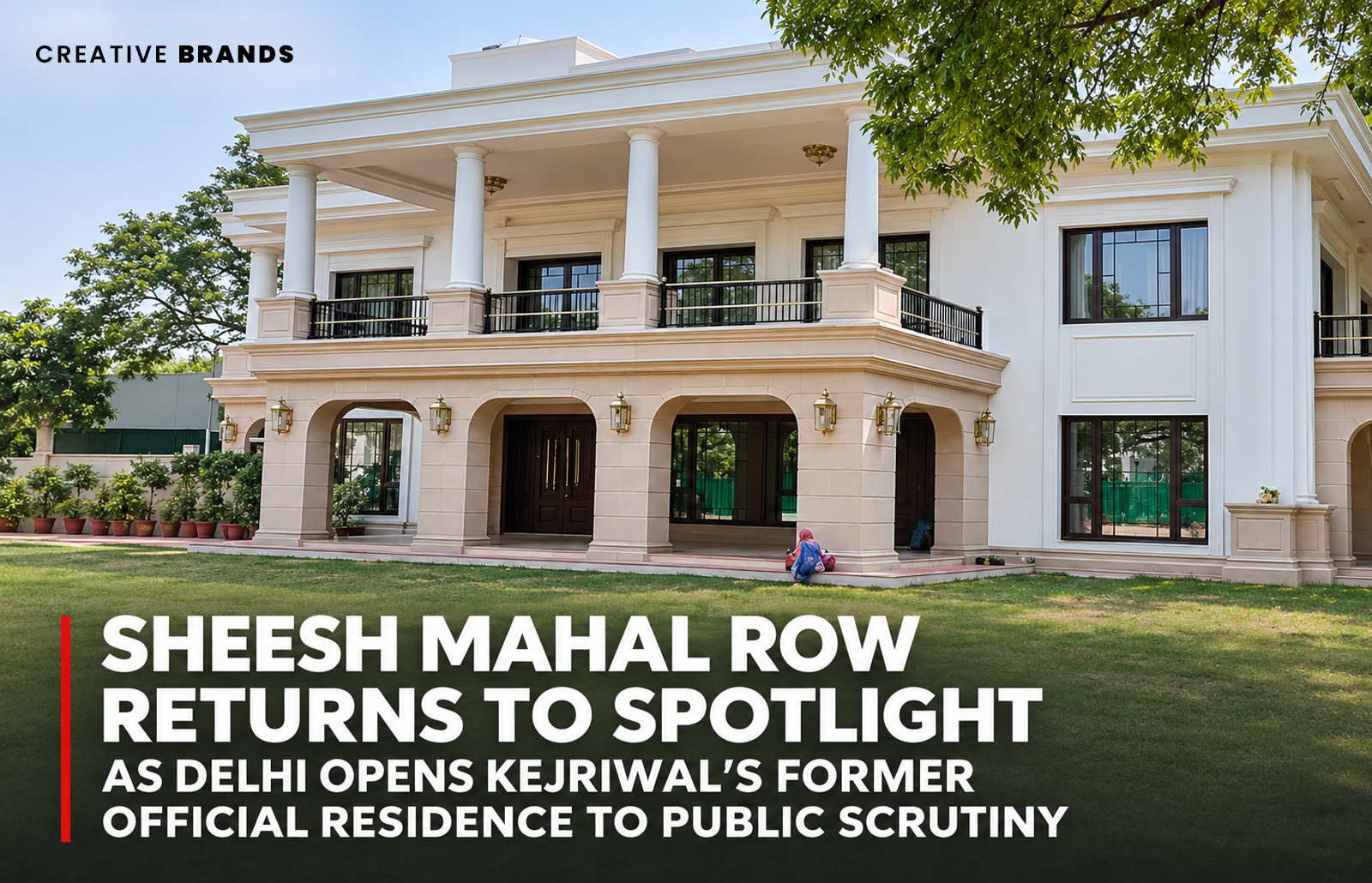
The Delhi government has thrown open the former official residence of ex-Chief Minister Arvind Kejriwal to media visitors, reviving a long-running political controversy over renovation costs. Dubbed “Sheesh Mahal” by the BJP, the Civil Lines bungalow is set to become accessible to the public amid renewed debate over governance and expenditure.
For decades, the name “Sheesh Mahal” in Delhi evoked images of Mughal grandeur, referring to the 17th-century palace pavilion in Shalimar Bagh. Today, however, the term has acquired an altogether different political meaning, becoming shorthand for one of the capital’s most contentious controversies: the renovation of former Delhi Chief Minister Arvind Kejriwal’s official residence at 6, Flagstaff Road in Civil Lines.
The sprawling government bungalow, which served as Kejriwal’s residence from 2015 until October 2024, has remained at the centre of a fierce political battle between the Aam Aadmi Party (AAP) and the Bharatiya Janata Party (BJP). The BJP coined the nickname “Sheesh Mahal” to highlight what it alleges was an extravagant refurbishment of a property meant to serve as the chief minister’s official residence.
The controversy stems from the escalating cost of renovation works carried out at the bungalow. What reportedly began as a project estimated at less than ₹8 crore later became the subject of scrutiny after audit findings indicated expenditure exceeding ₹33 crore, while BJP leaders have repeatedly claimed the total outlay reached ₹58.83 crore. The issue quickly evolved from a question of construction expenses into a broader political debate about public accountability, governance and the use of taxpayer funds.
The dispute has remained a potent political weapon, with opponents portraying the residence as a symbol of excess at odds with AAP’s long-standing image of clean and frugal governance. Supporters of the former chief minister, meanwhile, have argued that the allegations have been amplified for political gain and have rejected attempts to equate official infrastructure upgrades with personal luxury.
The debate has now entered a new phase. In a move that has reignited public interest, the Delhi government recently opened the bungalow to media representatives, allowing journalists to tour its interiors. Images and descriptions emerging from the walkthrough have once again fuelled discussion over the scale and nature of the renovation works.
Officials have also announced plans to allow members of the public to visit the property through an online ticketing system. Tickets are expected to be priced at around ₹20, effectively transforming a residence that was once at the centre of a political storm into a public attraction.
The decision reflects an unusual intersection of politics, public transparency and curiosity. While government residences are typically associated with administrative functions, the Flagstaff Road bungalow has become a symbol laden with political meaning. For supporters and critics alike, the property represents more than brick and mortar; it has become a physical manifestation of competing narratives about power, privilege and accountability in contemporary Indian politics.
As visitors prepare to walk through rooms that have generated years of headlines, Delhi’s two “Sheesh Mahals” stand in striking contrast. One is a restored Mughal monument celebrated for its historical significance and architectural heritage. The other is a modern political landmark, whose legacy will likely continue to be debated long after the visitors’ queues have faded.
Discover more from Creative Brands Mag
Subscribe to get the latest posts sent to your email.















Leave a comment