


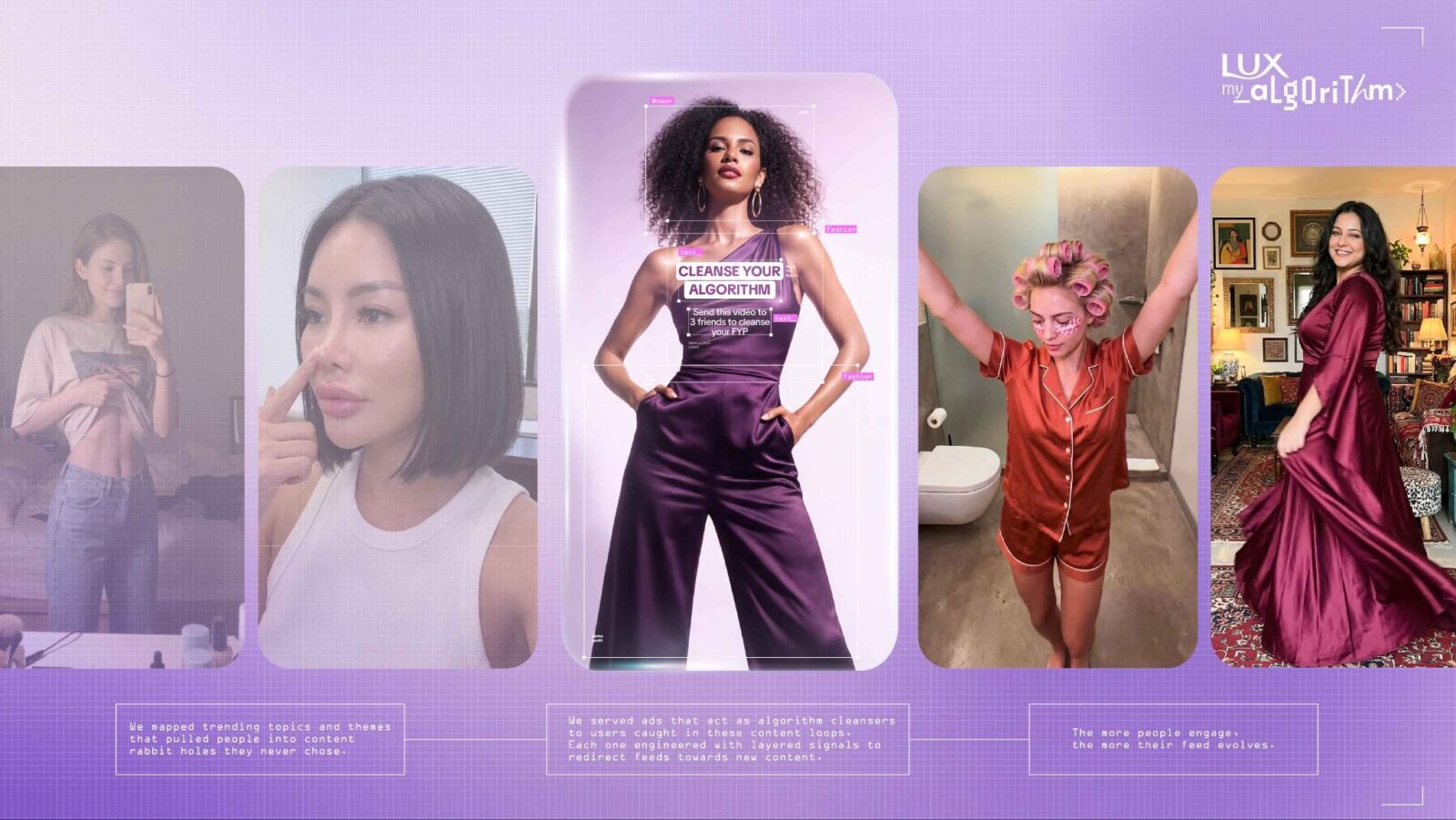
LUX has partnered with VML to launch “LUX My Algorithm,” a global campaign that transforms advertising into behavioural signals designed to reshape social media feeds. By encouraging intentional engagement, the initiative aims to diversify content and reposition paid media as a tool for influencing algorithms rather than interrupting them.
What if the advertisements woven into social media feeds did more than momentarily distract? What if they actively reshaped the very content ecosystems they inhabit? That is the premise behind “LUX My Algorithm”, a global initiative from LUX in collaboration with VML, which seeks to transform digital advertising into a tool that influences how algorithms behave.
At a time when social media platforms are often criticised for trapping users in repetitive loops of content, the campaign proposes a subtle but significant shift. Rather than positioning advertisements as interruptions, LUX is reframing them as “algorithm cleansers”—designed not merely to be viewed, but to generate behavioural signals that alter what users see next. Drawing from its longstanding association with cleansing in the physical world, the brand is now extending that metaphor into digital spaces, where the accumulation of data signals quietly shapes everyday experiences.
The idea emerges from a growing awareness of how algorithms function. Social media feeds, while often perceived as personal, are in fact shaped by patterns of interaction—what users pause on, watch, save or share. Over time, these signals feed into recommendation systems, narrowing content into increasingly predictable streams. Research conducted by LUX across regions including Asia, Latin America and the Middle East indicates that women may spend up to five hours a day engaging with such content, much of it driven by fleeting attention rather than deliberate choice.
This dynamic, the campaign suggests, creates a disconnect between what users truly value and what they are repeatedly shown. Algorithms, after all, are optimised for attention, not necessarily for diversity, inspiration or what LUX terms “bold beauty”. The result is a digital environment that can feel both immersive and limiting.
“LUX My Algorithm” is built on a deceptively simple insight: every interaction is a signal. While users cannot fully control algorithmic outputs, they can influence probabilities over time. By engaging with LUX’s content—whether through watching, liking or sharing—users introduce new data points into the system. These signals, in turn, can gradually diversify the recommendations that follow.
The campaign’s reliance on paid media is deliberate. Unlike organic content, which is largely confined within established algorithmic boundaries, paid advertisements can enter feeds regardless of existing user patterns. This gives them a unique capacity to disrupt and reshape. LUX has leveraged this advantage by designing ads specifically engineered for engagement, encouraging consistent interactions that feed clear signals back into recommendation systems.
In doing so, the initiative challenges conventional thinking about digital advertising. Instead of focusing solely on reach or visibility, it positions ads as functional inputs—tools capable of influencing the organic content that surrounds them. This marks a notable evolution in how brands might approach algorithm-driven platforms, where the distinction between paid and organic content is increasingly fluid.
The campaign was developed in consultation with algorithm experts, reflecting a broader attempt to bridge marketing with data science. Among those commenting on the initiative is Catherine Ball, who describes the approach as fundamentally different. By reframing advertising as an intervention rather than an interruption, she suggests, the campaign taps into a key paradox of social media: while most content keeps users within algorithmic loops, certain stimuli—often advertisements—can break them.
This reframing aligns with LUX’s broader brand positioning. Historically associated with beauty and self-expression, the brand is now extending its narrative into the digital realm, where identity is increasingly mediated by algorithms. For Judy Zu, the campaign reflects a simple but powerful truth: what people engage with shapes not only what they see, but how they feel.
To test its premise, LUX conducted a real-world experiment in which participants consistently interacted with its content over time. The study tracked how their feeds evolved as new behavioural signals were introduced. According to the findings, there were observable shifts in both the type and diversity of recommended content, suggesting that even small, repeated interactions can gradually influence algorithmic outcomes.
Such findings arrive at a moment when digital fatigue is becoming increasingly common. As users grow more aware of how platforms shape their attention, there is a corresponding demand for greater agency and transparency. LUX’s initiative does not claim to offer full control, but rather a means of subtle influence—an incremental way to steer feeds towards greater variety and relevance.
The campaign’s global rollout reflects its ambition. Spanning markets including China, India, Thailand, Brazil, Egypt, Indonesia and Vietnam, it reaches a combined population of more than 3.5 billion people. Across these regions, the initiative will unfold through a mix of branded films, creator collaborations and culturally responsive content, each designed to encourage intentional engagement at scale.
In a landscape where most advertisements are skipped, blocked or ignored, “LUX My Algorithm” proposes a different role for paid media. Not as a disruption to be minimised, but as an input to be harnessed. By aligning its creative strategy with the mechanics of algorithms, LUX is effectively repositioning advertising as part of the system it inhabits—capable not only of reflecting user behaviour, but of shaping it.
Whether this approach signals a broader shift in the industry remains to be seen. Yet it underscores an emerging reality: in the age of algorithms, influence is no longer confined to content alone. It resides in the patterns of engagement that determine what comes next.
Discover more from Creative Brands Mag
Subscribe to get the latest posts sent to your email.










Leave a comment