


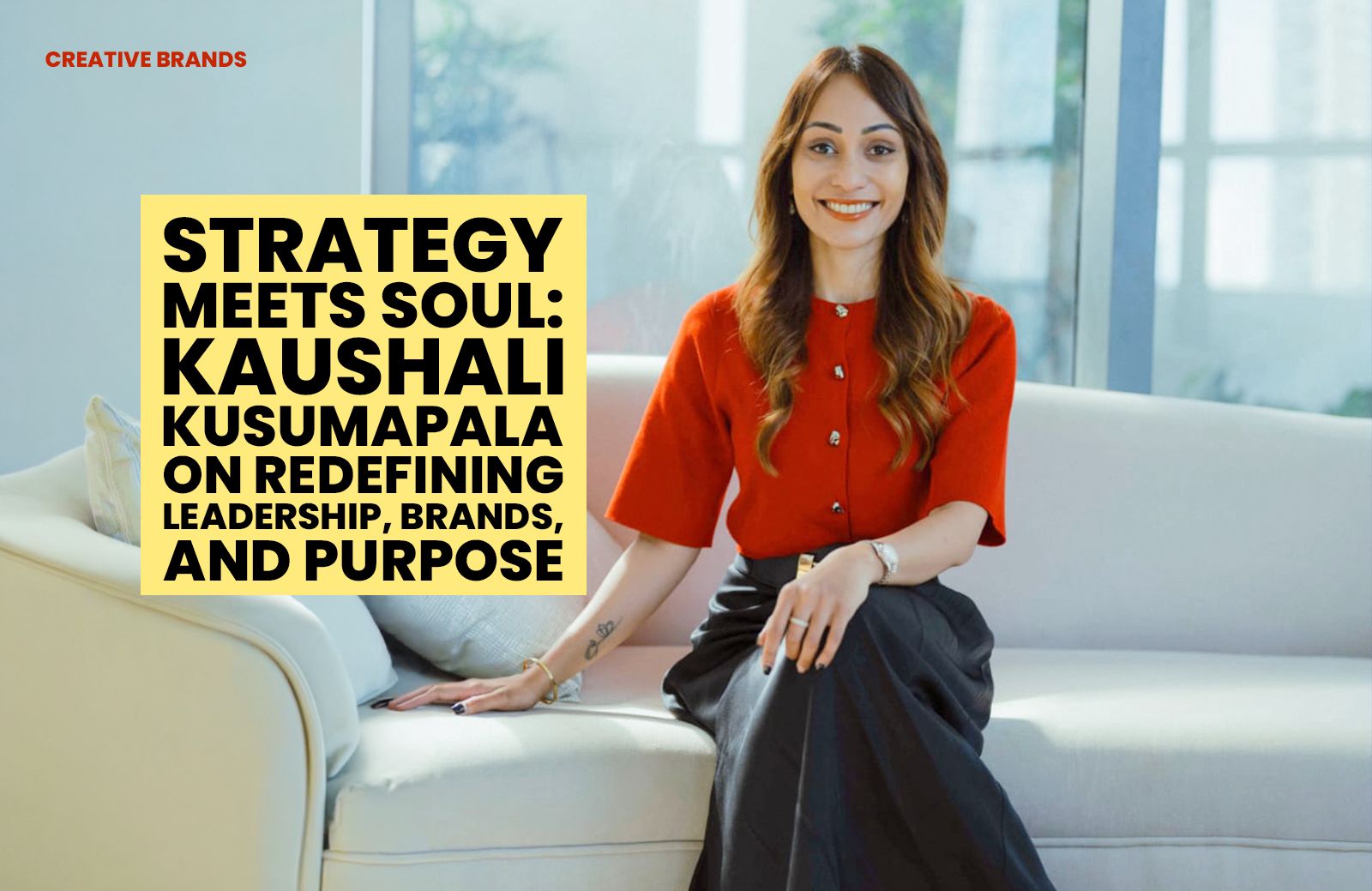
Brand leadership is often defined by scale, speed, and shareholder value. Kaushali Kusumapala, Former Managing Director of Coca-Cola Sri Lanka Pvt. Ltd. and former Country Director for Sri Lanka and the Maldives, represents a more nuanced evolution—one that bridges commercial excellence with conscious living. With over 16 years spent shaping some of the world’s most recognisable brands, culminating in her role as Country Director for Coca-Cola Sri Lanka, Kusumapala has built a reputation for driving growth with both rigour and purpose. Yet, beyond the boardroom, her journey has taken a deeply personal turn.
In this exclusive conversation with Creative Brands Magazine , she reflects on the defining moments that shaped her leadership, from navigating brand crises to steering iconic portfolios across complex markets. From her early grounding in global marketing at Fonterra to rebuilding trust and cultural relevance at Atlas Axillia during one of its most challenging periods, Kusumapala’s career has been marked by an ability to return to first principles—identity, purpose, and human truth—when it matters most.
But this conversation goes beyond boardroom strategy. It captures a leader in transition—one who is questioning, unlearning, and expanding the very definition of success. In recent years, Kusumapala has embarked on a parallel journey of conscious living, exploring the intersections of leadership, well-being, and self-awareness. It is a shift that is increasingly influencing how she approaches both business and life: moving from performance-driven outcomes to people-centred impact, from external validation to internal alignment.
As she steps into a new phase—integrating brand consulting with coaching and wellness-led initiatives—Kusumapala is helping others find clarity in a world that often rewards noise over nuance. Her philosophy is disarmingly simple yet powerful: that the most enduring brands, like the most impactful leaders, are those that are deeply anchored in who they truly are.
What emerges is a portrait of a modern leader who is not content with building successful brands alone, but is equally committed to shaping more conscious organisations and more self-aware individuals. In a region where leadership has traditionally been defined by hierarchy and authority, Kusumapala’s voice offers a compelling alternative—one grounded in authenticity, empathy, and the courage to evolve.
You’ve built a diverse career across agencies and leading brands before joining The Coca-Cola Company. What were the defining moments that shaped your journey into leadership?
There have been a few moments that genuinely changed the trajectory of my career — not just in terms of titles or roles, but in how I understood leadership itself.
Early on at Fonterra, I was thrown into the deep end of global marketing. Sri Lanka was a small market within a massive multinational dairy operation, and I had to learn very quickly how to conceptualise and quantify marketing within a global framework. It taught me rigour. It taught me how to build a case, how to measure impact, and how to earn your seat at the table through the quality of your thinking. And at a relatively early stage in my career, I found myself navigating a brand through crisis into growth, which was formative. It was at Fonterra that I learned that marketing is not just creativity; it is the disciplined translation of insight into commercial value.
The second defining moment came at Atlas Axillia, a subsidiary of Hemas Holdings. When I joined in 2019, it was a heritage stationery brand with over sixty years of history. Weeks after I arrived, the Easter Sunday attacks happened, and because of the company’s ownership structure, Atlas became the target of a devastating PR crisis. Parents refused to buy the brand. Schools banned our products. Retailers chased our sales reps away. A teacher snapped a child’s pencil in half simply because it was Atlas. Our market share collapsed by double digits.
In that moment, instead of defending or arguing, we stopped and asked ourselves one question: Who are we really? That process of returning to identity — of rediscovering that Atlas was not just stationery but a part of Sri Lankan childhood — became the foundation for everything that followed. We repositioned the brand from “Tools for Success” to “Making Learning Fun,” and rebuilt it on three pillars: democratising education, quality education, and infrastructure. By 2023, Atlas reached its highest-ever market share of 59%, became the most profitable subsidiary, and won Local Brand of the Year. That experience taught me that the most powerful strategy is identity. When you know who you are, you know what to do.
And then there was joining Coca-Cola, which was a defining moment of a completely different kind. For the first time, I was stepping out of marketing and into the leadership of one of the world’s most iconic brands in a franchise model. It required a fundamentally different skill set: understanding franchise management, aligning with bottling partners, and driving shared success across two different entities. It stretched me in ways I hadn’t anticipated, and it deepened my belief that real leadership is about learning to operate in systems larger than yourself.
As the first Sri Lankan woman to lead Coca-Cola operations in Sri Lanka and the Maldives, what did that milestone mean to you personally and professionally?
Honestly, when the appointment came through, the first thing I felt was nervousness. Not about the opportunity itself, but about whether I was truly ready. My entire career has been built as a marketer. This was a step into a Managing Director role, in a franchise business model that was fundamentally different from anything I had done before. The learning curve was steep.
And then there was the weight of being the first Sri Lankan woman in this position. That carries something. There is a responsibility that comes with it — to step into the role in a way that carries pride for the country, while also setting the right benchmark from a gender perspective. You are aware that people are watching, and that how you lead will shape perceptions about what women can do in these roles.
But I have always been someone who is up for a challenge. Even when self-doubt creeps in, even when there is a smidgen of imposter syndrome — and there always is — I have consistently been able to talk myself into facing new challenges. I was able to summon the courage and stamina required to learn the ropes and navigate the demands of the role. My intent was clear: to ensure that Coca-Cola, a brand I had always admired as a marketer, continued to be built as a powerhouse within the Sri Lankan context.
Your leadership has been described as human-centred. How do you balance business performance with empathy and people-first thinking in a competitive market?
My approach to leadership has evolved significantly over time. Early in my career, and even in the initial phases of my leadership journey, I was far more performance-oriented. Results mattered above everything. And they still do — but the way I think about how results are achieved has changed.
As I grew into leadership, I began to recognise that while business successes and failures were powerful teachers, the people I worked with — those I led and those who were my peers — were equally transformative. I came to understand that sustained performance, in people and in business, requires a deep sense of human centricity. At the same time, I also realised that human centricity is not one-size-fits-all. It looks different for different individuals.
For me, this has meant consistently advocating for the right resources for my people. It means ensuring they are taken care of sustainably, that they have the flexibility to truly unleash their potential, and that their development is a real priority — not a line in a performance review.
Beyond resourcing, I have also grown into the role of a mentor. Initially, mentorship for me was about sharing knowledge — business knowledge, marketing expertise — and grooming individuals to become future leaders. Today, it has evolved into something more meaningful. I now connect with people from a place of empathy. I focus on understanding their values and their needs, and co-creating pathways that enable them to excel in their own right — aligned to who they are, congruent with their aspirations, strengths, and style. That shift from performance-first to people-first hasn’t weakened business outcomes. If anything, it has strengthened them.
Having worked with brands like Leo Burnett, Fonterra, and Domino’s, what, in your view, differentiates a good brand from a truly enduring one?
A good brand gets the basics right. It has a clear proposition, it communicates well, and it delivers on its promise. There are many good brands. But an enduring brand is something different. An enduring brand knows who it is.
The brands that last are the ones rooted in a genuine identity — not a manufactured positioning statement, but a real understanding of what they stand for, why they exist, and what human truth they connect to. When a brand has that clarity, it can weather crises, navigate market shifts, and evolve without losing its essence.
I saw this firsthand at Atlas. When that brand was under existential threat, the thing that saved it was not a campaign, not a media buy, not a price promotion. It was a return to identity. The moment we understood that Atlas was part of Sri Lankan childhood, everything else — the strategy, the communication, the innovation — fell into place.
I believe the same principle applies across categories and markets. Whether it is dairy, quick-service restaurants, or beverages, the brands that endure are the ones that are honest about who they are and build from that truth outward. Identity is the strategy. Everything else is execution.
Sri Lanka and the Maldives are unique markets. What are the biggest opportunities and challenges in building beverage brands across these regions today?
These are two fascinating but very different markets. Sri Lanka is a market that has been through extraordinary disruption — a pandemic, a severe economic crisis, and political instability — and consumers have fundamentally changed as a result. They are more value-conscious, more discerning, and more selective about where they spend. That creates a challenge for any brand, because you cannot rely on legacy loyalty alone. You have to keep earning relevance.
At the same time, that disruption has also created opportunity. There is a resilience in the Sri Lankan consumer that is remarkable, and there is a growing appetite for brands that stand for something real. The opportunity is in building deeper, more meaningful connections — not just through product, but through purpose and presence in communities.
The Maldives is a completely different proposition. It is a very youthful market, heavily oriented around sports and entertainment, and importantly, it is an export-oriented economy. That means there is a constant influx of international brands and an incredible amount of variety available to consumers. Competition is not just local — it is global, and it sits on every shelf.
The advantage for Coca-Cola in the Maldives is that we are one of the only beverage brands to be manufactured within the country. That local manufacturing presence, combined with the ability to leverage global sponsorships and partnerships such as FIFA, gives us a powerful way to drive local relevance through globally recognised platforms. In a market saturated with imported options, that combination of local roots and global credibility is a genuine differentiator.
The Maldives is also taking the sustainability agenda seriously as a nation, and this aligns directly with Coca-Cola’s global mandate. Working within that context — looking at long-term, meaningful solutions that impact both the country and the brand — has been one of the more interesting dimensions of the role. It is not just about selling beverages; it is about contributing to a national conversation about environmental responsibility.
Across both markets, the fundamental challenge and opportunity is the same: how do you build brands that are locally resonant while connected to a global standard? That tension — between global consistency and local authenticity — is where the real strategic work happens.
Your role involves working closely with bottling partners, customers, and stakeholders. How important is collaboration in driving growth for a brand like Coca-Cola?
Franchise management was a completely different ballgame for me. It involves two different entities working toward a shared goal, but often approaching problems in different ways, operating with different complexities, and sometimes even speaking different languages in a business sense.
At its core, franchise management is about finding pathways to solve common problems despite these differences. And one of the most important lessons I have learned is that tension is often a necessary component of success. It humbles you quickly. Your role is not to eliminate tension, but to steward it — to convert it into productive, collaborative outcomes.
Through this approach, we have been able to advance key priorities. This includes driving more sustainable formats such as glass bottles, expanding their penetration across the country, and strengthening partnerships around sustainability. These are not things that one entity can achieve alone. They require genuine alignment — not just on the goal, but on the process of getting there.
For a brand like Coca-Cola, collaboration is not a nice-to-have. It is the operating model. The brand’s success in any market depends on the strength of the relationship between the company and its bottling partners. And that relationship is built on trust, transparency, and a willingness to navigate discomfort together for the sake of shared outcomes.
Consumer preferences are evolving rapidly. How is Coca-Cola adapting its brand storytelling and product strategy to stay relevant to younger audiences?
The truth about younger consumers is that they are not looking for brands to tell them what to think or feel. They are looking for brands that are honest, that show up authentically, and that earn their place in culture rather than demanding it.
For a brand like Coca-Cola, which has such deep heritage and global recognition, the challenge is not awareness — it is continued relevance. And relevance comes from understanding the real lives of young people in these markets, not from projecting a global campaign onto a local reality.
A good example of this is the rise of the energy category. The younger generation in Sri Lanka is increasingly on the go — studying on the go, working more, freelancing, juggling part-time jobs alongside education. Energy is no longer just about entertainment or nightlife; it has become a functional necessity of daily life. That shift in need-state is significant, and brands that recognise it early have a real advantage.
We saw this opportunity clearly with the introduction of Charged — Coca-Cola’s energy drink. What I am proud of is the approach we took. We did not go all out with a massive national launch. Instead, we took an experimental approach — regional launches that allowed us to understand the dynamics of each market, learn what was working, test the positioning, and then scale based on real evidence. That kind of disciplined, insight-led rollout is how you build a new brand within an established portfolio without overextending.
More broadly, the approach I believe in is rooted in human insight over data-driven generalisation. Data tells you what consumers do. Insight tells you why. And when you understand the why, your storytelling becomes genuinely connecting rather than performative. That is what younger audiences respond to — not polish, but truth. The brands that win with this generation are the ones that keep evolving their portfolio to meet real, lived need-states without losing their core identity.
Coca-Cola globally emphasises sustainability and community impact. How do you translate these global priorities into meaningful local action?
Sustainability for me has never been a corporate reporting exercise. It has to be lived in the market, through real actions that communities can see and feel.
Within our franchise partnership, one of the key priorities has been driving more sustainable formats — particularly glass bottles — and expanding their reach across the country. This is not just an environmental initiative; it is also a commercial one. When sustainability and business logic align, you get action that is genuine and lasting, not performative.
Beyond product formats, the work I am most proud of across my career has been in community impact. At Atlas, during Sri Lanka’s economic crisis, we faced the real possibility of 50% of children dropping out of the education system. We launched Light A Future, a global fundraising initiative to keep children in school. We built and rebuilt preschools. We ran teacher development programmes. We created scholarship access through Sipsavi. These were not campaigns — they were commitments.
That same philosophy carries into my work at Coca-Cola. The question I always ask is: what does this community actually need, and how can we contribute meaningfully? Global priorities provide the framework, but local action requires understanding the specific context, the real challenges, and the genuine opportunities to make a difference. Without that local understanding, sustainability becomes a slide in a deck rather than a reality on the ground.
What advice would you give to young women aspiring to leadership roles in marketing and corporate management in South Asia?
The first thing I would say is: do not wait for permission. In South Asia, there is still a deeply ingrained culture of deference, particularly for women. You are expected to be patient, to wait your turn, to earn the right to speak. And while respect and humility are important, they should never become excuses for silence. If you have a perspective, share it. If you see an opportunity, pursue it. Your voice is not a disruption — it is a contribution.
Second, invest in your craft before you invest in your career. Titles will come and go. What stays with you is skill, judgement, and the ability to think clearly under pressure. I spent years learning marketing rigour — not just the creative side, but the analytical, the commercial, the strategic. That depth is what gave me the credibility to lead, not the title.
Third, be honest about who you are. Leadership is not about performing a version of strength that doesn’t belong to you. It is about understanding your own values, your own style, and leading from that place. The most powerful thing I ever did as a leader was stop trying to be the leader I thought I should be, and start being the leader I actually was. That shift changed everything.
And finally — expect it to be hard. It will be. There will be imposter syndrome. There will be rooms where you are the only woman. There will be moments where your competence is questioned in ways your male peers never experience. But that difficulty is not a signal to stop. It is the terrain. Learn to navigate it, and keep going.
When you look ahead, what kind of legacy do you hope to build—not just as a business leader, but as someone shaping brands and people?
I have thought about this a lot, and the answer has changed over the years. Earlier in my career, legacy meant achievement — market share, awards, titles. And those things mattered. They still do, to an extent. But the legacy I care about now is different.
I want to be someone who helps people see themselves more clearly. Whether that is helping a brand rediscover its identity or helping an individual understand their values and lead from that place, the work is the same. It is about clarity. It is about truth. It is about building something that lasts because it is real, not because it was manufactured.
I also want to contribute to a shift in how leadership is understood in this region. Leadership does not have to look like command and control. It does not have to be aggressive or extractive. It can be conscious. It can be empathetic. It can be built on self-awareness and genuine care for the people you serve. I want more leaders — especially more women — to know that this kind of leadership is not only valid, but powerful.
Ultimately, the legacy I hope to build is one of impact — on brands that serve communities well, and on people who go on to lead with integrity and purpose. If I can contribute to that, even in a small way, then the work will have been worth it.
Discover more from Creative Brands Mag
Subscribe to get the latest posts sent to your email.












Leave a comment