


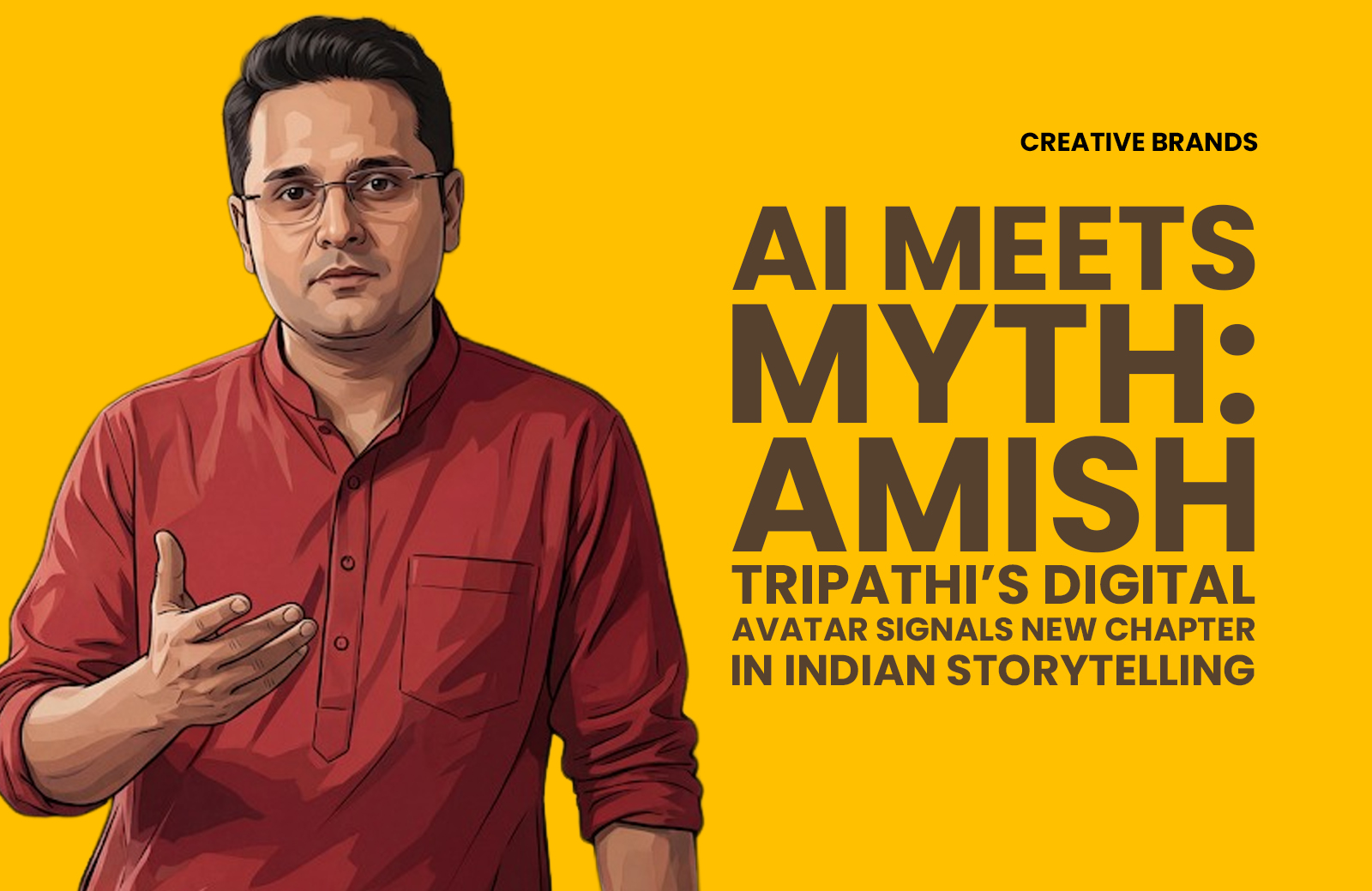
Collective Artists Network has unveiled an AI-powered avatar of bestselling author Amish Tripathi, launching a short-form content slate rooted in Indian history and mythology. The initiative blends technology with tradition, aiming to reimagine cultural storytelling for digital audiences through immersive, scalable narratives beginning May 2026.
In a move that underscores the growing convergence of technology and cultural storytelling, Collective Artists Network has introduced an AI-powered avatar of Amish Tripathi, one of India’s most widely read contemporary writers. The initiative marks a decisive shift in how literary voices may be extended into the digital realm, positioning tradition-rich narratives within a rapidly evolving content ecosystem.
Tripathi, whose works have consistently drawn from Indian mythology, history and philosophical traditions, is widely regarded as the fastest-selling author in Indian publishing. His storytelling, deeply rooted in epics and ancient cultural frameworks, has already reshaped how younger audiences engage with classical Indian themes. The creation of his AI avatar represents not merely a technological experiment but a strategic expansion of that narrative influence into new formats and platforms.
The avatar will serve as the central figure in a premium short-form content slate, forming the backbone of a dedicated AI Amish Tripathi channel. Developed in collaboration with Collective Artists Network, the slate is expected to focus on history, legends, philosophy and immersive storytelling, presenting them in formats designed for contemporary consumption. The emphasis is on creating a distinct digital universe where ancient narratives are not simply retold but reinterpreted with a modern sensibility.


At the heart of the project lies an ambition to develop culturally rich intellectual properties that transcend conventional storytelling. By extending Tripathi’s presence through an AI-driven persona, the initiative seeks to maintain the authority and authenticity associated with the author while achieving scalability across digital platforms. This hybrid approach blends human creativity with machine-driven adaptability, opening up possibilities for storytelling that is both deeply rooted and widely accessible.
The creative development of the content slate is being shaped by Collective Artists Network’s Historyverse division, which has been tasked with crafting a narrative tone that balances devotion with contemporaneity. The approach aims to retain the philosophical depth and cultural nuance of traditional Indian stories while making them engaging for a generation accustomed to fast-paced digital content. The result is envisioned as an ecosystem where intellectual storytelling meets entertainment, without diluting its cultural significance.
For Tripathi, the venture represents a natural evolution of storytelling itself. He has described the use of artificial intelligence as an “exciting new frontier”, highlighting its potential to deepen audience engagement and expand access to complex narratives. His collaboration with Vijay Subramaniam, Founder and Group CEO of Collective Artists Network, is positioned as a meeting point between cultural insight and technological innovation. Tripathi has emphasised that the partnership brings together an understanding of India’s heritage with the demands of modern audiences, enabling a reimagining of how stories can be experienced.
Subramaniam, for his part, views the initiative as part of a broader shift in storytelling paradigms. He has pointed to the intersection of culture and technology as the defining space for the future of content creation. With Tripathi already credited for transforming how younger Indians engage with epics and puranas, the collaboration aims to extend that transformation into a scalable digital format. The goal is to bring Indian history and philosophy into mainstream digital consumption in ways that are both meaningful and compelling.
The launch also reflects a wider industry trend towards the creation of AI-driven personalities and virtual influencers. However, what distinguishes this project is its grounding in cultural heritage rather than purely commercial or entertainment-driven objectives. By anchoring the initiative in India’s rich narrative traditions, Collective Artists Network appears to be positioning itself at the forefront of a new genre of content—one that blends education, philosophy and storytelling within an accessible digital framework.
As digital audiences increasingly seek content that is both engaging and meaningful, the timing of the launch is significant. The rise of short-form video platforms and the growing appetite for culturally resonant content have created a fertile ground for such experiments. The AI avatar of Tripathi is expected to cater to this demand, offering bite-sized yet intellectually rich narratives that resonate across demographics.
The rollout of the AI avatar and its accompanying content slate is scheduled to begin in May 2026, with distribution planned across multiple digital platforms. This phased launch is likely to test audience reception while allowing for iterative development of the content ecosystem. If successful, it could pave the way for similar initiatives involving other authors, historians and cultural figures, fundamentally altering the relationship between creators and their audiences.
Beyond its immediate impact, the project raises broader questions about authorship, authenticity and the role of artificial intelligence in creative expression. While AI offers unprecedented opportunities for scale and accessibility, it also challenges traditional notions of storytelling as a uniquely human endeavour. In this context, the AI Amish Tripathi avatar may serve as both a prototype and a point of debate, illustrating the possibilities and complexities of this emerging frontier.
For now, the initiative stands as a bold attempt to bridge India’s past and future, using technology to breathe new life into age-old stories. Whether it succeeds in reshaping the digital storytelling landscape will depend not only on technological execution but also on its ability to retain the emotional and cultural depth that has long defined Indian narratives.
Discover more from Creative Brands Mag
Subscribe to get the latest posts sent to your email.















Leave a comment