


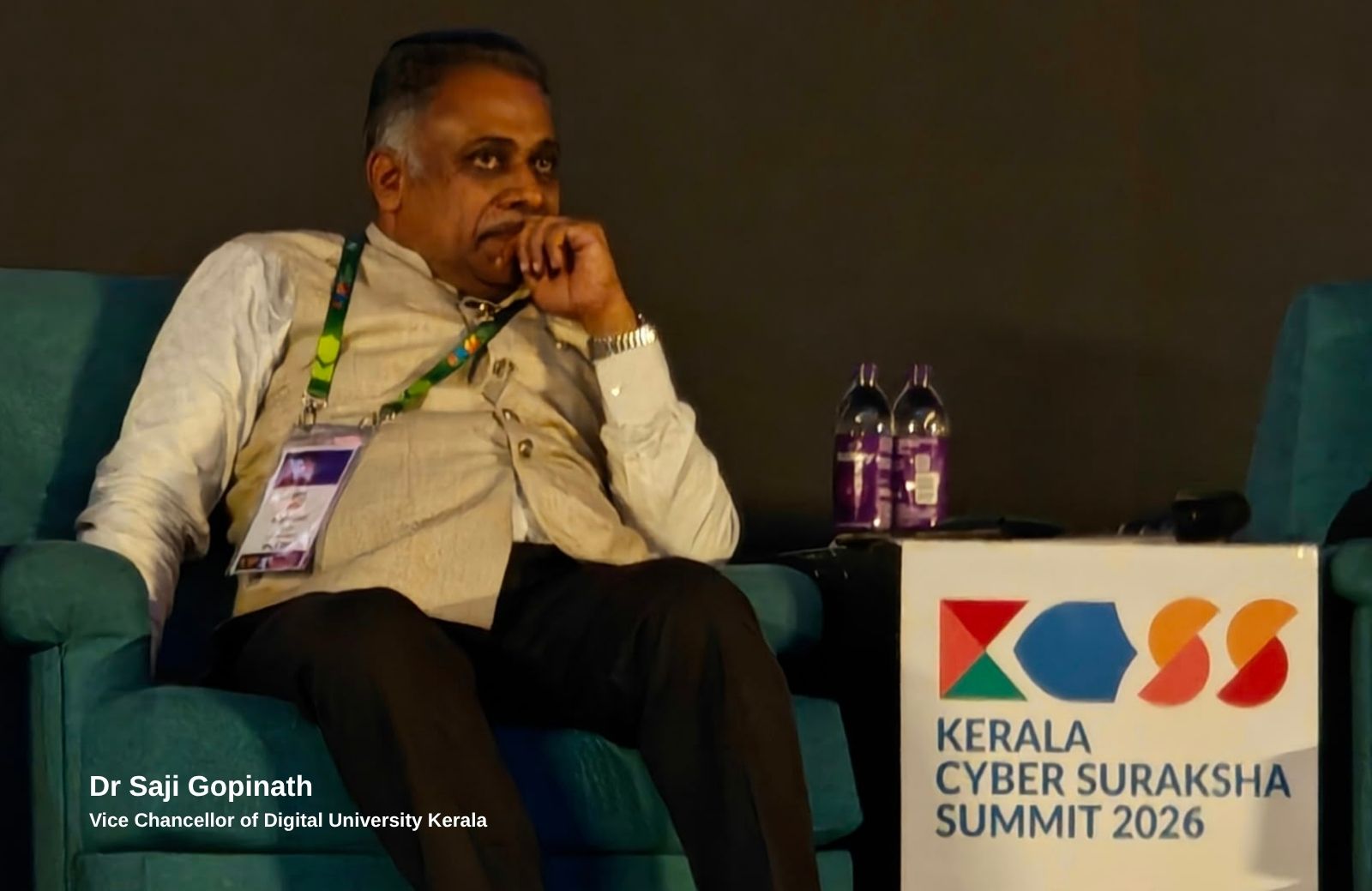
Speaking at the Kerala Cyber Sureksha Summit 2026, Dr Saji Gopinath, Vice Chancellor of Digital University Kerala, outlined how the institution is aligning academic training with emerging global job markets. By integrating technical skills with foundational knowledge, the university prepares students to adapt self-sufficiently to rapidly changing career landscapes.
The modern global economy is undergoing an unprecedented structural transformation driven by the rapid pace of technological innovation. As artificial intelligence, automation, and advanced digital frameworks reshape conventional industries, higher education institutions face an urgent imperative to re-evaluate their educational models. The traditional paradigm of university training—designed primarily for an industrial era characterised by predictable, long-term career trajectories—is no longer sufficient to prepare students for a volatile, uncertain, and rapidly shifting labour market.
Addressing these challenges at the recent Kerala Cyber Sureksha Summit 2026, held at the Le Méridien Hotel in Kochi, Dr Saji Gopinath offered an insightful vision for the future of higher education and talent development. As the Vice Chancellor of the Kerala University of Digital Sciences, Innovation and Technology (Digital University) and former Professor and Dean at IIM Kozhikode, Dr Gopinath brought a wealth of academic and administrative experience to the discussion. His address focused on how educational frameworks must evolve to equip the next generation with both the technical capabilities and adaptive mindsets required to thrive in an AI-driven global economy.
Forecasting the Future of Work: The Global Job Watch Tower
A central theme of Dr Gopinath’s address was the critical need to anticipate industry trends rather than merely reacting to them. To bridge the gap between academic output and industry requirements, Digital University Kerala has spearheaded key forecasting initiatives, including the Global Job Watch Tower and the Digital Workforce Management System. These platforms function as strategic intelligence tools, analysing global employment trends, identifying emerging skill requirements, and forecasting key growth sectors across international markets.
By leveraging real-time data and predictive analytics, these systems allow educators and policymakers to map out future job profiles before they become mainstream. This proactive approach ensures that academic curricula remain relevant, agile, and directly aligned with the actual needs of global employers. Furthermore, it enables students to target career paths that offer long-term sustainability rather than training for roles at risk of automation.
Decentralising Global Work and Retaining Local Talent
Historically, regions like Kerala have experienced significant brain drain, with skilled graduates migrating abroad or to major industrial hubs in pursuit of high-paying career opportunities. However, Dr Gopinath emphasised that the digital transformation of the workforce has fundamentally altered this dynamic. The rise of remote work platforms, decentralised global teams, and digital-first enterprises means that geographical location is no longer a barrier to international career success.
Today’s professionals can participate in the high-value global economy while remaining in their home state. This shift allows local talent to contribute to global enterprises, access competitive international salaries, and drive domestic economic growth without enduring the personal and social disruptions associated with physical migration. Digital University Kerala’s curriculum and infrastructure are specifically designed to support this borderless employment model, preparing students to seamlessly integrate into global, distributed teams right from Kerala.
Navigating AI Disruptions and Harnessing Human-Centric Sectors
While artificial intelligence continues to disrupt traditional job roles and automate routine tasks, Dr Gopinath pointed out that it simultaneously opens vast new frontiers of opportunity. The key to navigating this disruption lies in identifying and cultivating domains that rely on intrinsically human strengths—such as creative problem-solving, emotional intelligence, complex critical thinking, and specialised technical judgment.
One prominent area highlighted during the summit is the Audio-Visual, Gaming, and Comics (AVGC) sector. As AI tools automate administrative and repetitive tasks, individuals gain increased leisure and creative bandwidth, leading to expanded demand for high-quality digital content, entertainment, and immersive media. Kerala already possesses a robust creative foundation, making the AVGC industry a prime candidate for exponential growth.
Concurrently, the rapid digitisation of enterprise operations has heightened demand for specialised technical expertise, particularly in cybersecurity. Referencing insights shared by senior law enforcement and security officials at the summit, Dr Gopinath noted a critical global talent gap in the cybersecurity domain. Addressing this shortfall requires targeted educational frameworks that train specialists capable of safeguarding digital infrastructure against increasingly sophisticated threats.
A Fundamental Shift in Academic Philosophy: Learning How to Learn
To effectively navigate these rapid industry shifts, Dr Gopinath advocated for a fundamental transformation in academic philosophy. In the past, universities focused on training students for specific, static vocations. However, as technological cycles shorten, technical skills acquired at the beginning of a degree program may become outdated shortly after graduation.
Consequently, the primary responsibility of a modern university is no longer just imparting static domain knowledge, but teaching students “how to learn” independently. When students develop strong metacognitive skills and self-directed learning habits, they acquire the agility needed to unlearn obsolete techniques and continuously acquire new competencies throughout their professional lives. Whether an industry pivots toward new engineering frameworks or emerging computing paradigms, adaptable professionals can transition smoothly across domains without requiring complete retraining.
Synthesising Theoretical Knowledge with Practical Skills
A persistent challenge in higher education is the divide between theoretical knowledge and practical skill application. Traditional universities have historically excelled at teaching core principles and analytical frameworks but often lacked hands-on vocational training. Conversely, short-term skill development programs frequently focus on immediate tool usage without providing the underlying theoretical foundations necessary for long-term growth.
Dr Gopinath emphasised that sustainable career development requires a deliberate synthesis of both elements. Practical skills ensure immediate employability and allow graduates to contribute effectively on day one. However, it is deep, foundational knowledge that provides the structural framework needed to scale up, lead teams, innovate, and achieve executive or entrepreneurial success over time.
To bridge this gap, Digital University Kerala integrates experiential learning frameworks, such as ‘earn while learn’ initiatives and industry-embedded projects. These programs allow students to apply classroom theory directly to real-world business challenges, refining their skills in live operational environments.
By combining real-time workforce intelligence, human-centric domain specialisation, adaptive learning philosophies, and practical application, the university aims to cultivate a new generation of resilient tech leaders, researchers, and entrepreneurs capable of driving innovation on a global scale.
Discover more from Creative Brands Mag
Subscribe to get the latest posts sent to your email.















Leave a comment