


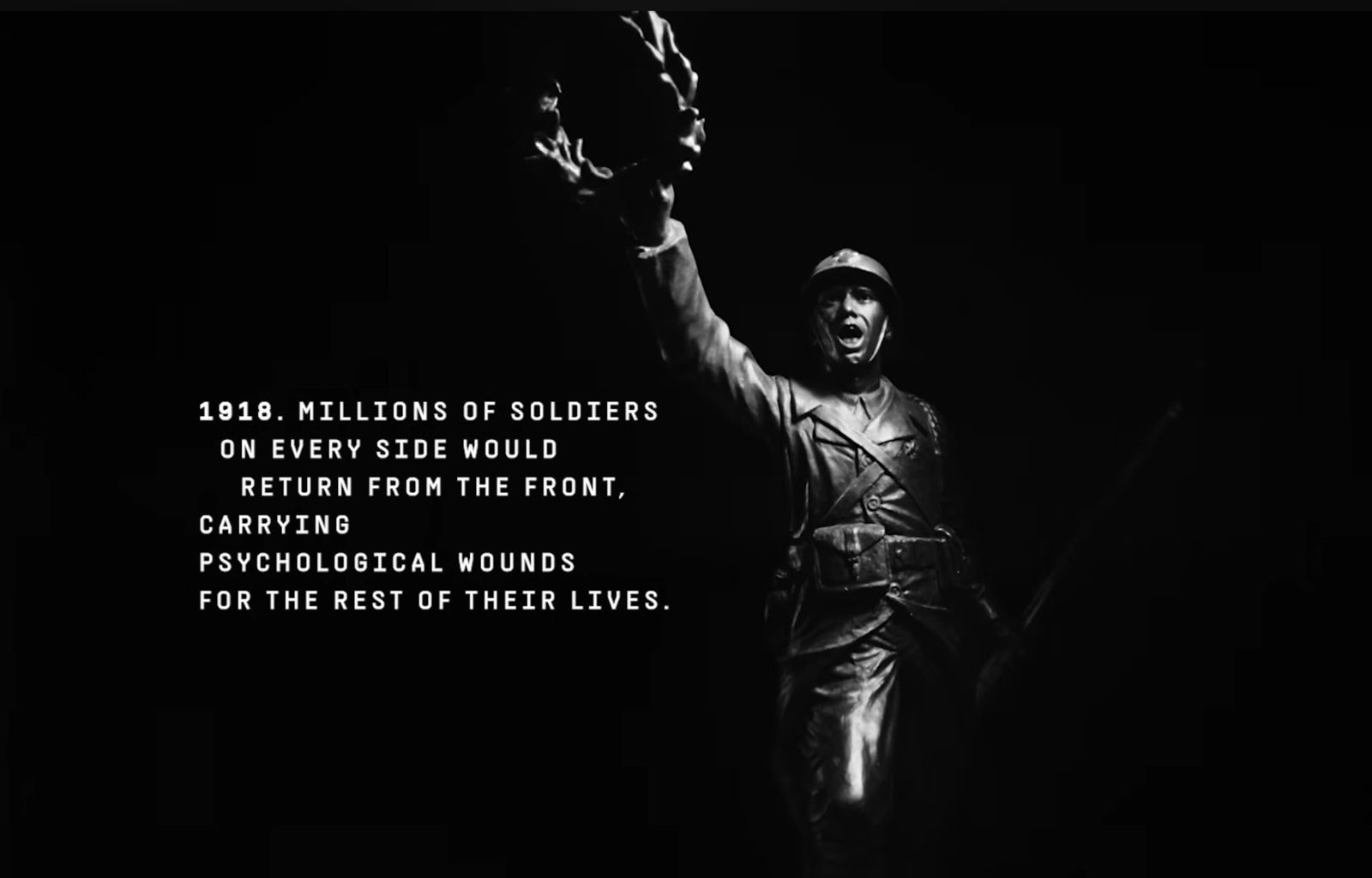
A new film from the Museum of the Great War challenges the enduring symbol of France’s “Victorious Soldier”, revealing the psychological scars borne by survivors of the First World War. Part of the “Broken Souls” campaign, it reframes heroism through an intimate exploration of trauma and memory.
For more than a century, the figure of the “Victorious Soldier” has stood in silent triumph across nearly 900 towns in France, immortalised in war memorials that commemorate those who perished in the First World War. Upright, resolute, and unyielding, the statue has long embodied an ideal of heroism—an image of strength untouched by doubt or suffering. Yet a new artistic intervention seeks to fracture this familiar narrative, exposing the unseen wounds carried by those who survived.
At the heart of this reimagining is a film titled The Victorious Soldier, created as part of the “Broken Souls” campaign by BBDO for the Museum of the Great War in Meaux. The project coincides with the unveiling of an artist’s model by sculptor Eugène Bénet, whose original work inspired the statues that have come to define France’s collective remembrance of the war.
Rather than presenting the soldier as a distant icon, the film draws viewers into an intimate and disquieting encounter. Through a sequence of lingering close-up shots, the camera fixes on the immobile statue, gradually peeling back its veneer of invincibility. The triumphant pose begins to feel strained, its stillness heavy with unspoken emotion.
Set against the haunting composition “Remains” by Volker Bertelmann and narrated by actor Finnegan Oldfield, the film transforms the statue into a vessel of inner turmoil. What initially appears as a symbol of victory slowly reveals itself as a mask concealing fear, anxiety, and enduring distress. The celebratory cry associated with triumph is recast as something altogether different—an internal scream, silent yet overwhelming.
This reinterpretation challenges deeply ingrained perceptions of war and remembrance. By subverting a national symbol, the film shifts attention away from the glorified image of the soldier towards the human reality beneath it. It confronts viewers with the psychological aftermath of conflict, highlighting the experiences of those who returned home alive but irrevocably changed.
The campaign underscores a broader mission embraced by the museum: to foster a more nuanced and humane understanding of war. While traditional memorials honour the dead, The Victorious Soldier brings into focus those whose suffering persisted long after the battlefield fell silent. It invites audiences to reconsider not only what is remembered, but how it is remembered.
Available since 9 April 2026 on the museum’s website and social media platforms, the film represents a striking evolution in the language of commemoration. In place of unyielding heroism, it offers vulnerability; in place of certainty, it presents complexity. Through this lens, the “Victorious Soldier” is no longer an untouchable emblem, but a reminder that survival itself can carry its own enduring cost.
Discover more from Creative Brands Mag
Subscribe to get the latest posts sent to your email.














Leave a comment