


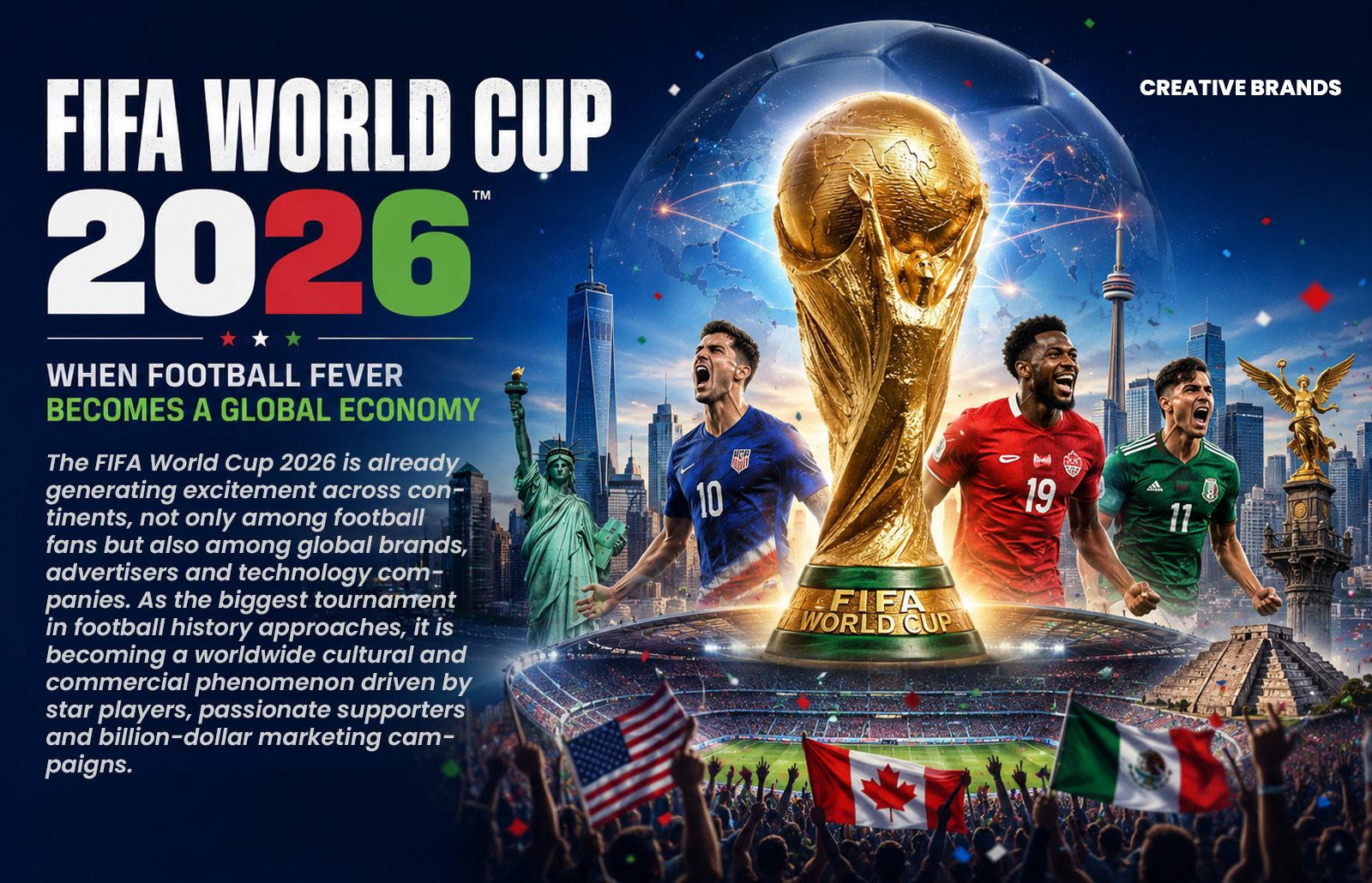
The FIFA World Cup 2026 is already generating excitement across continents, not only among football fans but also among global brands, advertisers and technology companies. As the biggest tournament in football history approaches, it is becoming a worldwide cultural and commercial phenomenon driven by star players, passionate supporters and billion-dollar marketing campaigns.
The countdown clock to the FIFA World Cup 2026 is still running, but in many parts of the world, the tournament has already begun.
Not on the pitch, but on television screens, social media feeds, advertising billboards and digital platforms where football has become the centre of a rapidly expanding global conversation. From Buenos Aires to Bengaluru, from London to Lagos, anticipation for the biggest FIFA World Cup in history is building with remarkable intensity.
When the tournament kicks off across the United States, Canada and Mexico in June 2026, it will feature 48 teams for the first time, expanding football’s biggest competition into an event of unprecedented scale. Yet long before the first whistle is blown, football fever is already driving a global ecosystem worth billions of dollars and engaging audiences that stretch far beyond traditional sports fans.
For FIFA, broadcasters, advertisers and sponsors, the World Cup is much more than a sporting event. It is one of the few occasions capable of commanding the attention of billions of people simultaneously. The tournament’s unique ability to unite diverse audiences has transformed it into a cultural phenomenon and one of the most powerful marketing platforms in the world.
Evidence of that influence can already be seen across global media.
Football-related content dominates online discussions as supporters debate team selections, speculate about potential winners and analyse the prospects of football’s biggest stars. Fan groups are organising viewing parties a year in advance. Merchandise sales are increasing. Travel companies are reporting growing interest from supporters planning journeys to North America.
At the centre of the excitement are football’s global superstars.
The names of Lionel Messi and Cristiano Ronaldo continue to resonate far beyond football circles. Whether or not they make their final World Cup appearances, both remain among the most influential sporting figures on the planet. Their careers have helped transform football into a truly global entertainment product.
Meanwhile, a younger generation is preparing to take centre stage. France’s Kylian Mbappé, England’s Jude Bellingham, Brazil’s Vinícius Júnior, Spain’s Lamine Yamal and Norway’s Erling Haaland represent a new era of football talent whose influence extends well beyond the pitch.
For many supporters, allegiance is increasingly attached to players as much as national teams. Across Asia, Africa and the Middle East, fan communities dedicated to individual footballers attract millions of followers. Social media platforms have amplified these relationships, allowing supporters to engage directly with athletes and follow every aspect of their professional journeys.
In Kerala, Argentina supporters have become a visible presence during international tournaments. Similar scenes are repeated throughout South Asia, where fan clubs organise public screenings, football festivals and community events. Across the globe, murals featuring football stars adorn city walls, while online communities produce artwork, videos and commentary dedicated to their sporting heroes.
This growth of football fandom has created enormous opportunities for advertisers.
The World Cup has historically produced some of the most memorable marketing campaigns in modern advertising. For global brands, football offers access to audiences that are emotionally invested, highly engaged and geographically diverse.
Consequently, preparations for FIFA World Cup 2026 are already underway in boardrooms and advertising agencies around the world.
Among the most prominent names is Coca-Cola, one of FIFA’s longest-serving commercial partners. The beverage giant has traditionally used the World Cup to promote messages of unity, celebration and friendship, themes that align naturally with football’s global appeal.
Adidas, another major FIFA partner, occupies a central position in World Cup marketing. As the supplier of the official match ball and sponsor of numerous national teams and players, the company is expected to launch extensive campaigns featuring some of football’s biggest stars. New team jerseys, limited-edition products and digital fan experiences are likely to form a key part of its strategy.
Nike, despite not being an official FIFA sponsor, remains one of the most influential brands during every World Cup. Through partnerships with elite athletes and leading national teams, the company consistently generates significant visibility during major tournaments.
Financial services giant Visa is expected to focus on themes of digital connectivity and seamless transactions, while Qatar Airways will likely use the tournament to showcase international travel experiences. Hyundai Motor Group, a long-standing FIFA partner, continues to position itself through fan-focused initiatives and mobility solutions.
Technology companies are increasingly becoming central players in football’s commercial landscape. Lenovo’s partnership with FIFA reflects the growing importance of artificial intelligence, cloud computing and data analytics within sport. Industry analysts expect AI-powered fan experiences to feature prominently during the 2026 tournament.
Electronics manufacturer Hisense is likely to promote next-generation viewing technologies, while companies such as Samsung, Sony and Google are expected to leverage football’s popularity through targeted advertising campaigns and digital activations.
The competition among brands extends far beyond official sponsorship agreements.
Companies including McDonald’s, PepsiCo, Mastercard, Emirates, Airbnb, Booking.com, Amazon and Puma are all expected to launch World Cup-themed campaigns aimed at capturing consumer attention during the tournament. For many businesses, football represents an opportunity to engage audiences through storytelling rather than traditional advertising.
That storytelling increasingly takes place on digital platforms.
Television remains important, but social media has fundamentally changed the nature of World Cup marketing. Brands now compete not only for airtime but also for online engagement. Short-form videos, influencer partnerships, interactive polls and user-generated content have become essential components of major campaigns.
Footballers themselves have emerged as powerful media channels. A single social media post from a leading player can reach tens of millions of people within hours. As a result, athlete endorsements have become a cornerstone of contemporary marketing strategies.
The rise of artificial intelligence is expected to further transform fan engagement during FIFA World Cup 2026.
Technology firms are developing personalised content experiences that allow supporters to receive customised highlights, predictive match analysis and interactive features tailored to individual preferences. Virtual and augmented reality applications are also expected to play a growing role, enabling fans to experience the tournament in new ways.
For host cities, the World Cup represents both an economic opportunity and a global showcase.
Millions of visitors are expected to travel across North America during the tournament. Hotels, restaurants, transport providers and local businesses are preparing for increased demand. Tourism authorities view the competition as a chance to promote their destinations to international audiences.
Yet amid the commercial activity, the enduring appeal of the World Cup remains rooted in its emotional power.
Every tournament produces moments that transcend sport. A dramatic goal, an unexpected victory or a breakthrough performance can unite entire nations and create memories that endure for generations. The World Cup continues to provide a rare platform where shared experiences cut across political, cultural and economic divides.
That ability to connect people is ultimately what attracts both supporters and sponsors.
For fans, the World Cup represents passion, identity and belonging. For brands, it offers a unique opportunity to associate themselves with those emotions. For FIFA, it remains the flagship event that showcases football’s extraordinary global reach.
As the tournament approaches, football fever is only expected to intensify. Advertising campaigns will become more visible. Fan activities will expand. Social media conversations will multiply. New stars will emerge, while established icons prepare for what may be defining moments in their careers.
When the FIFA World Cup 2026 finally begins, the matches themselves will undoubtedly dominate headlines. Yet the story of this tournament extends far beyond the stadiums.
It is also a story about how football has evolved into one of the world’s most powerful cultural forces—a force capable of mobilising billions of fans, attracting the world’s biggest brands and creating a global conversation unlike any other.
For one month in 2026, the world will once again stop to watch football. But long before the opening whistle, the game has already captured the world’s attention.
Discover more from Creative Brands Mag
Subscribe to get the latest posts sent to your email.













Leave a comment