


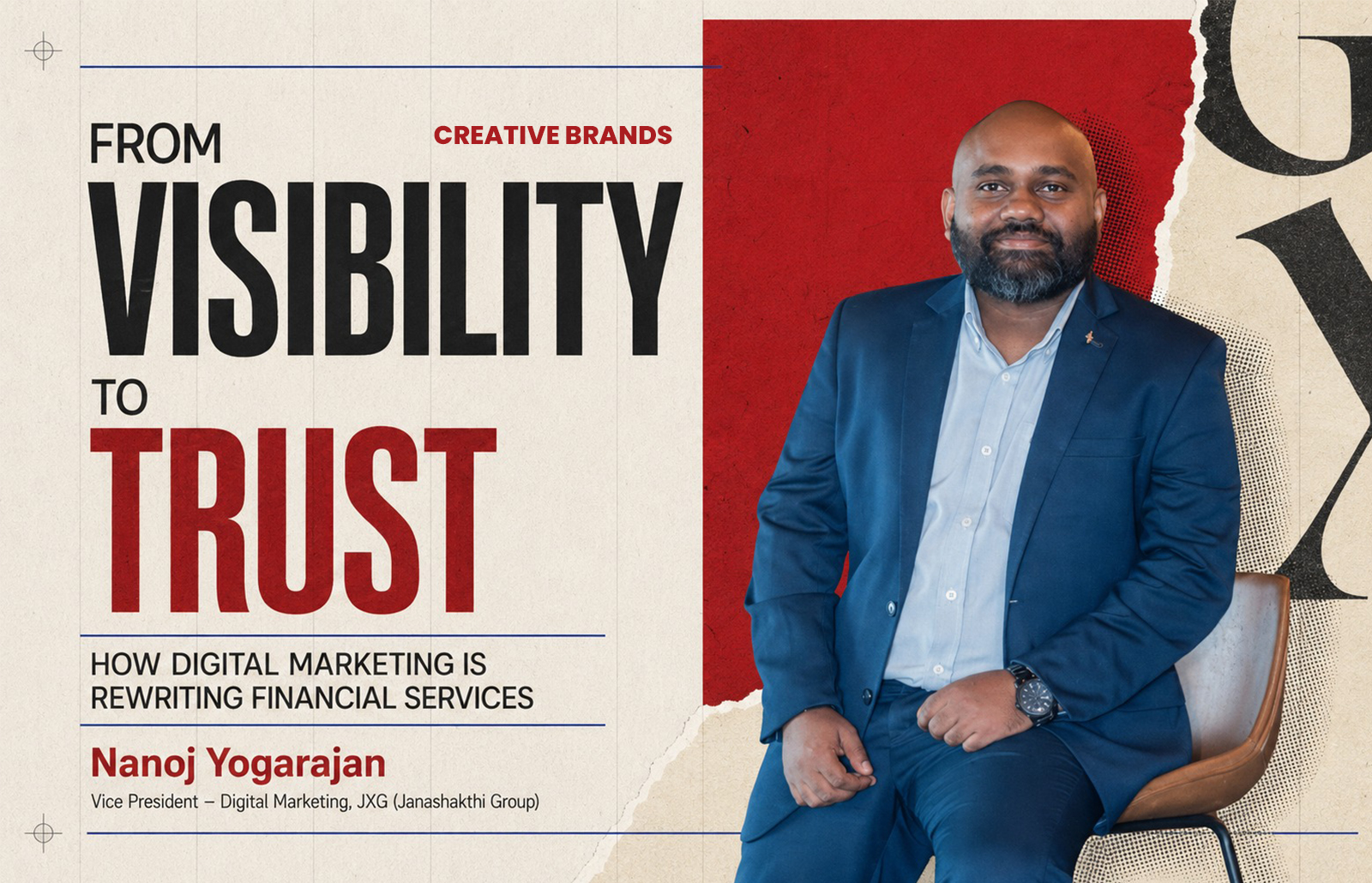
Exclusive Interview with Nanoj Yogarajan, Vice President – Digital Marketing, JXG (Janashakthi Group)
Financial marketing is undergoing a fundamental transformation. In a world where consumers discover brands through social platforms, creators, search engines and increasingly AI-powered recommendations, visibility alone is no longer enough. Financial institutions must earn trust at every digital touchpoint while making complex products simpler, more relevant and more human. Nanoj Yogarajan, Vice President – Digital Marketing at JXG (Janashakthi Group), is at the forefront of this transformation. Leading the Group’s digital marketing agenda across its financial services businesses, he brings a data-driven, platform-focused approach to new-age marketing, customer engagement and brand building. From JXG’s globally recognised TikTok campaign to AI-driven discovery, personalised customer journeys and the growing influence of creators and digital communities, Yogarajan offers a compelling perspective on how financial brands can remain relevant in an increasingly connected world. In this exclusive conversation with Creative Brands Magazine, he explores why the future of financial marketing will be defined not simply by technology, but by how intelligently brands use it to understand customers, simplify decisions and build lasting trust.
As financial services evolve, digital marketing has become a key tool within integrated marketing communication, enabling brands to build relevance, deepen engagement and create more connected customer experiences. As Vice President – Digital Marketing at JXG (Janashakthi Group), Nanoj Yogarajan leads the Group’s digital marketing agenda across its financial services businesses, with a focus on new-age marketing, platform-led engagement and data-driven strategies. In this conversation, he shares his perspective on how digital marketing is reshaping financial sector marketing, building trust and creating stronger connections with today’s increasingly informed and connected consumers.
Financial services have long relied on heritage and reputation to earn trust. In an era where consumers discover brands through algorithms, creators and digital content, what does it take for a financial brand to move beyond visibility and build genuine trust?
Nanoj Yogarajan: I believe the definition of trust has fundamentally changed. Heritage and reputation remain important, but in a digital-first world, customers experience a financial brand long before they speak to someone or walk into a branch. They discover brands through search engines, social media, AI-powered recommendations, creators and digital content. Every one of those interactions contributes to how credible and trustworthy the brand feels.
For me, the starting point is consistency across the entire digital ecosystem. A brand’s website, mobile app, social platforms and search presence need to provide accurate, relevant and up-to-date information, while making the customer journey as simple and frictionless as possible. A strong digital presence means very little if the experience itself creates uncertainty or inconvenience.
There is also a constant need to adapt to changing algorithms and consumer behaviour. Brands must continuously optimise content, use relevant search strategies, create genuinely useful information and develop platform-native creative that resonates with the audience. The objective is not visibility for its own sake but being present with the right message when the customer is making a decision.
Ultimately, I see trust as something that is earned through repeated digital experiences. When customers consistently receive useful content, secure platforms, transparent information and responsive service, visibility becomes credibility. Over time, that credibility becomes trust.
The financial sector has traditionally been cautious in its marketing approach. How has new-age marketing changed the way financial brands communicate, and what opportunities does it create that were not possible through traditional channels?
Nanoj Yogarajan: One of the biggest changes I have seen is the shift from financial marketing being primarily about communicating a message to becoming a continuous customer conversation. That is a significant change for an industry where communication has traditionally been carefully controlled because of the responsibility associated with managing people’s money, security, and future.
Traditional media gave financial institutions the ability to reach large audiences with a consistent message. Digital has fundamentally expanded that capability. Brands can now understand who is engaging, what they are interested in, what questions they have and where they are in their decision-making journey. They can educate, listen, respond and personalise communication in ways that were not possible at scale through traditional channels.
I also believe new-age marketing gives financial brands a better way to make intangible products relatable. We are often selling protection, confidence, opportunity or future financial stability rather than something customers can physically experience. Short-form videos, podcasts, expert discussions, customer stories, explainers and interactive tools can bring those propositions to life in a much more accessible way.
From a marketing perspective, the other major advantage is measurability and agility. We can reach audiences based on interests, needs and life stages, work with relevant creators, retarget people based on their interactions, measure the journey from awareness to conversion, and continuously test and optimise creative and media based on live performance data.
That flexibility, however, must sit within strong governance. Financial brands cannot trade accuracy or regulatory compliance for engagement. Claims need to be responsible, risks and conditions need to be clear, and customer data needs to be handled appropriately.
For me, new-age marketing is therefore not about making financial services more promotional. It is about making them more accessible, useful, measurable and human while preserving the trust that underpins the sector.
JXG’s IPO corporate campaign was recently recognised by TikTok Global as an official case study, demonstrating how a financial brand can successfully leverage emerging platforms to engage new audiences. What made this campaign different, and what broader lessons does it offer for financial marketers embracing new-age marketing?
Nanoj Yogarajan: For me, the real success of the JXG Corporate & IPO Campaign was not just the numbers; it was proving that a financial brand could create for a new platform rather than simply advertise on it. The campaign was officially recognised by TikTok Global as a TikTok for Business Case Study, making JXG (Janashakthi Group) the first financial conglomerate in Sri Lanka to receive that recognition.
I am particularly proud that this was an integrated marketing communications effort, with digital playing a key role in extending reach, reinforcing the campaign message and keeping the brand top of mind. The digital strategy, platform planning, creative optimisation, campaign execution and performance management were led entirely in-house, demonstrating how a strong understanding of digital behaviour and platform dynamics can complement broader marketing efforts and enable a local financial brand to deliver work to global standards.
Our starting point was also very deliberate. We understood that before asking audiences to engage with the IPO, we first had to introduce them to JXG. We had an existing television commercial, but we knew that simply placing the same creative on TikTok would not work. The platform demands a different approach to attention, storytelling and visual communication.
We therefore reimagined the campaign specifically for TikTok across three phases. The first focused on awareness, using a strong opening hook and introducing the JXG logo within the first two seconds. We transformed the television creative into a three-panel vertical execution designed for the full mobile screen, creating a more distinctive and platform-native experience. That creative generated more than 4 million video views.
The second phase built awareness around the IPO announcement, while the third moved audiences from awareness to action through website traffic campaigns directing users to the IPO registration page. This generated more than 200,000 website visits through TikTok.
The broader lesson I would highlight for financial marketers is that new-age marketing requires a shift from platform adaptation to platform understanding. Consumers, particularly younger audiences, do not consume financial advertising in the same way they did a decade ago. Brands need to understand the behaviour of each platform and build content around it.
For me, trust in the digital age is built not only through heritage, but through relevance, creativity and the ability to communicate in a way that feels native to the consumer’s world.
As Vice President – Digital Marketing, overseeing multiple subsidiaries, how do you develop a marketing strategy that creates synergy across the Group while allowing each brand to maintain its own positioning, personality and customer relevance?
Nanoj Yogarajan: Managing digital marketing across five brands requires me to constantly balance two things: creating a common strategic direction while ensuring that every brand remains distinct. I do not believe synergy should mean making every subsidiary look, sound or behave the same.
Each business operates in a different category, serves different audiences and has different commercial objectives. My approach is therefore to establish the Group-level digital foundations while allowing each brand to define how those foundations translate into its own positioning, tone of voice, content strategy and customer journey.
There are clear areas where scale creates an advantage. Marketing technology, analytics, SEO, AI tools, media partnerships, content capabilities, creator relationships and employee advocacy can often be shared across the Group. This allows us to improve efficiency, strengthen capabilities and, importantly, share successful ideas and learnings across businesses.
Measurement remains central to effective marketing. Common performance principles can be established around qualified leads, conversion, customer acquisition cost, engagement and retention, but the KPIs must reflect the commercial reality of each business. The way success is measured for an investment business should not necessarily be the same as for an insurance, finance or health and wellness brand.
Cross-brand collaboration also works best when it is driven by a genuine customer need or commercial opportunity. Being part of the same Group, on its own, is not a reason to bring brands together. The strongest opportunities emerge through purposeful collaboration, whether through integrated campaigns, partnerships, shared content or cross-selling.
Ultimately, I see the Group’s digital strategy as a shared backbone rather than a common communication template. We create alignment around capabilities, data, standards and business objectives, while allowing every brand to remain distinctive and relevant to its own audience.
Consumers today are more informed, more selective and increasingly resistant to conventional advertising. How should financial brands rethink content, storytelling and customer engagement to remain relevant, particularly among Millennials and Gen Z?
Nanoj Yogarajan: The biggest shift, in my view, is that younger consumers are no longer looking for financial brands simply to tell them what to buy. They want brands to help them understand, decide and act. Millennials and Gen Z have grown up with digital platforms that are fast, simple and highly personalised, and they expect the same experience from financial institutions.
That means financial content needs to become more useful and less product-centric. Complex financial concepts should be translated into simple, accessible formats such as short-form videos, explainers, relatable stories and practical financial education. The question should move from “What product are we selling?” to “What problem are we helping the customer solve?”
I also believe financial storytelling needs to become more human. Customer experiences, employee perspectives, credible creators and expert voices can bring authenticity to subjects that can otherwise feel technical or corporate. Younger audiences are often quick to recognise overly polished advertising, so relevance and authenticity matter.
However, the content experience and the customer experience must work together. If a brand creates an engaging social post but the website is difficult to navigate or onboarding is complicated, the brand promise breaks down. Digital journeys need to be mobile-first, fast and frictionless.
Data can further strengthen relevance through behavioural insights, social listening and sentiment analysis, allowing brands to understand what audiences need and deliver content that is more personalised. That needs to be balanced with responsible data use, consent and privacy.
Ultimately, I believe financial brands will remain relevant to Millennials and Gen Z by being useful before being promotional, human before being corporate, and seamless across every digital interaction.
Artificial intelligence is rapidly transforming the marketing landscape. Beyond improving efficiency, how do you see AI reshaping creativity, customer experiences and strategic decision-making within financial services marketing?
Nanoj Yogarajan: What excites me most about AI is not simply the ability to produce content faster. It is the way it changes the entire customer discovery and decision-making journey.
The traditional digital journey often began with a Google search, followed by a review of search results and a visit to a website. That behaviour is changing. Customers can now ask an AI platform a question and receive an immediate response that may include information, comparisons or recommendations. Financial brands therefore need to think beyond traditional SEO and ensure their digital presence is also structured and optimised for AI-driven discovery.
We have already seen this through our work on the FirstCapital.lk website. By optimising the site for AI-driven search, we generated more than 2,000 monthly visits through ChatGPT referrals, with engagement time comparable to organic search traffic. For me, that is a clear indication that AI platforms are becoming meaningful acquisition channels.
AI also creates significant opportunities in creativity. A strong campaign idea will always need human thinking behind it, but AI can help marketers develop multiple creative variations, adapt content for different platforms and audiences, and accelerate testing and optimisation. Human creativity, cultural understanding and brand judgment still need to lead the process.
On the customer experience side, AI can support personalised content, intelligent customer assistance, faster onboarding and more relevant recommendations. At a strategic level, it can help marketers identify trends, anticipate behaviour, improve targeting and make faster evidence-based decisions.
But financial services require a particularly strong layer of governance. Accuracy, privacy, data security, regulatory compliance and human oversight cannot be compromised.
I see the future as a combination of machine intelligence and human judgment. The brands that benefit most from AI will not necessarily be those producing the most content, but those using it to make better decisions, create better experiences and understand customers more deeply.
Consumers now engage with brands across multiple platforms before making financial decisions. How important is creating a seamless, integrated customer experience across digital and physical touchpoints, and what role does strategic content play throughout that journey?
Nanoj Yogarajan: A financial decision rarely happens in a single interaction anymore. A customer may see a product on social media, search for more information, ask an AI platform a question, visit the website, speak to a relationship manager and only then make a decision. For me, that makes a connected customer journey absolutely critical.
Customers do not think in terms of departments or channels. They see one brand. If the experience changes dramatically from social media to the website, or from the website to a branch, that inconsistency can create friction and reduce confidence.
This is where connected data and CRM become particularly important. A unified customer view allows organisations to understand previous interactions, reduce repetition and provide more relevant support. It also gives marketers a clearer understanding of which touchpoints influence conversion and where customers drop off.
Content has a role throughout this journey. At the awareness stage, it introduces the brand. Educational content helps customers understand financial concepts and products. Testimonials, comparisons and expert-led content can build confidence, while conversion-focused content provides a clear next step. After conversion, onboarding content, market updates and personalised communication can help strengthen the relationship.
However, an integrated experience does not mean publishing identical content across every channel. I believe the message should remain consistent, but the execution must reflect the behaviour of each platform. LinkedIn may require a more professional and insight-led approach, while Instagram or TikTok may need visual, concise and platform-native storytelling. The website then becomes the place where customers can access deeper information and complete the desired action.
With creators, podcasts, short-form video, online communities and financial influencers increasingly shaping public opinion, how should established financial institutions participate in these conversations while protecting trust, credibility and regulatory compliance?
Nanoj Yogarajan: The conversation around financial services has already moved beyond traditional media, so I believe established institutions need to be part of the spaces where customers are actively learning, asking questions and forming opinions. The key is participating in a way that feels relevant without compromising the standards expected from a financial institution.
Different audiences trust different formats and voices. Some may prefer a short-form video, while others may engage more deeply with a podcast, industry expert, creator or online community. Financial brands therefore need to think beyond traditional corporate communication and identify the formats and voices that genuinely help audiences understand financial topics.
I do not believe financial content has to be dry or overly technical. It can be creative, relatable and even entertaining, as long as accuracy and transparency remain non-negotiable. The role of the marketer is to simplify complexity without removing the information customers need to make responsible decisions.
Creator selection is particularly important. Follower count should never be the only consideration. I would look at credibility, audience relevance, previous content, public behaviour and the creator’s understanding of financial responsibility. Clear content guidelines, disclosures, fact-checking and compliance approvals are essential, particularly when discussing investments, returns or financial outcomes.
Podcasts also create interesting opportunities because they allow institutions to demonstrate expertise through deeper conversations. Through our own podcast, JXG Spotlight, we have used expert-led educational content not only to build engagement and credibility, but also to generate qualified leads for our business units. That experience has reinforced my belief that valuable content and commercial outcomes can work together.
Brands also need to pay attention to what customers are saying independently of their own channels. Positive experiences can create powerful advocacy, while poor experiences can escalate quickly online. Social listening, transparent responses and clear escalation mechanisms therefore need to be part of the wider reputation strategy.
Ultimately, financial institutions do not need to control every conversation. They need to earn a credible place within those conversations by bringing expertise, transparency and value while maintaining the governance expected of the sector.
Looking ahead, what do you believe will define the next era of digital marketing for financial brands, and how can organisations remain relevant in an increasingly connected and fast-changing digital landscape?
Nanoj Yogarajan: I think the next phase of digital marketing will be less about reaching the largest audience and more about understanding the individual customer. Personalisation, predictive intelligence and connected experiences will increasingly shape how financial brands compete.
Consumers have become accustomed to platforms such as Spotify, Netflix and e-commerce brands anticipating what they may want next. Financial institutions will face the same expectation. Broad audience segmentation will gradually give way to more personalised experiences based on behaviour, interests, financial needs and where the customer is in their journey.
The opportunity is to connect the entire experience. A customer may first see a broad brand message through traditional media, but subsequent interactions across social media, search, websites and apps should become increasingly relevant to that individual. Of course, this needs to be built on consent, responsible data usage and strong privacy controls.
Predictive analytics will also become more important. Instead of simply analysing what customers have done, financial institutions can increasingly anticipate what they may need next, identify potential service issues and determine which content or product is most relevant. The objective should be to create value at the right moment, rather than simply pushing another product.
AI will further change how customers discover brands. As people increasingly ask AI platforms for information and recommendations, financial institutions will need authoritative, structured and accurate digital content that can be understood by both customers and AI systems.
At the same time, organisations will need to break down the silos between advertising, social media, websites, apps, CRM, contact centres and physical branches. The customer should experience one connected brand, regardless of where the journey begins.
From my perspective, remaining relevant will ultimately require a culture of continuous experimentation. Digital teams need to test, learn, optimise and adapt quickly as platforms and consumer behaviours evolve. But innovation has to move alongside cybersecurity, regulatory compliance, transparency and human oversight.
The next era of digital marketing will therefore not be defined by technology alone. I believe the real competitive advantage will come from how intelligently organisations use technology to understand customers, simplify their decisions and build trust at every stage of the relationship.
Discover more from Creative Brands Mag
Subscribe to get the latest posts sent to your email.
















Leave a comment