


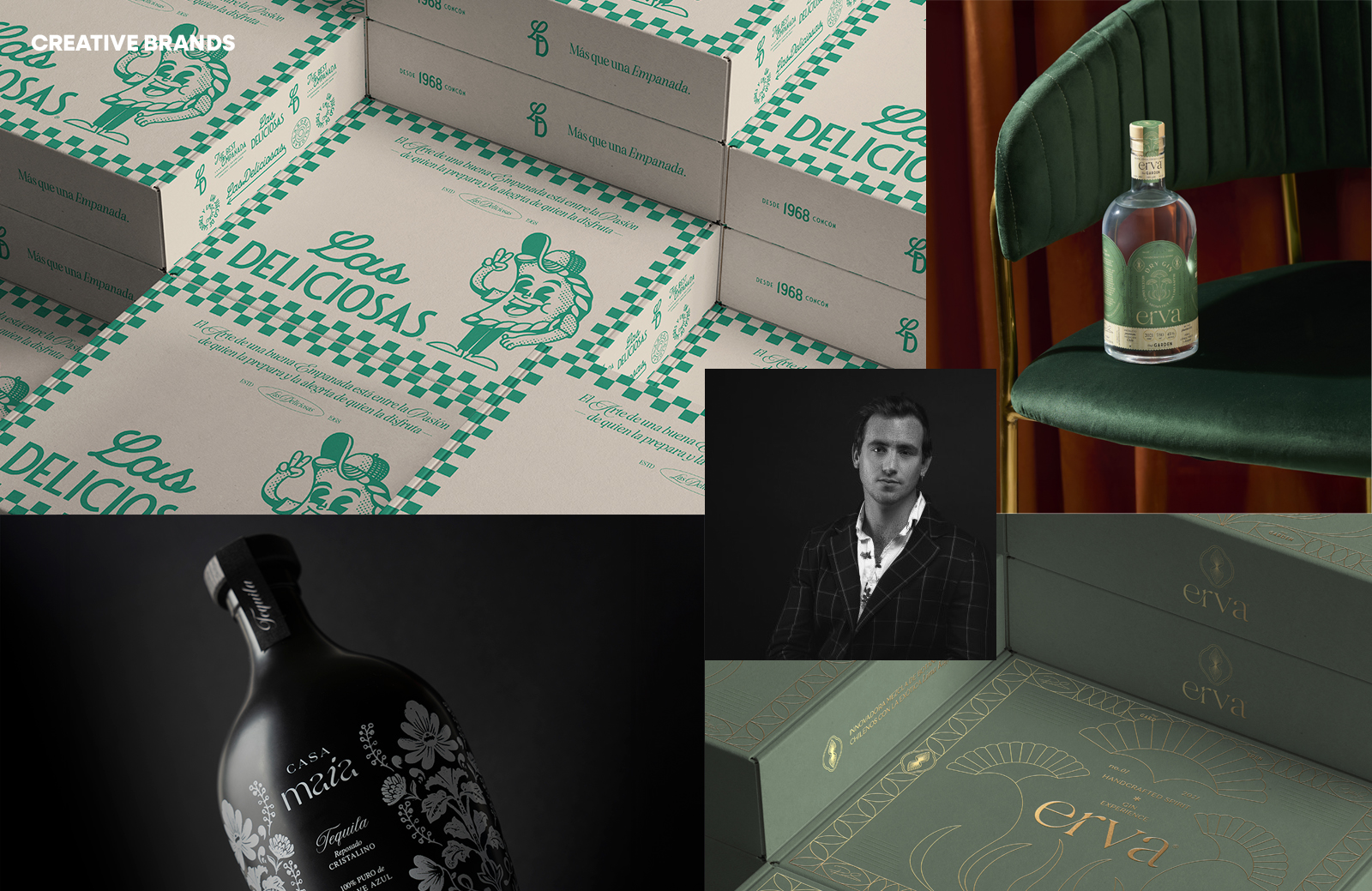
Designer Ian Wallace has won six Indigo Awards, including Gold and Silver, for his striking branding and packaging projects. His work on Chile’s Las Deliciosas, premium gin Erva, and Casa Maia Tequila demonstrates how tradition and innovation can merge, creating identities that resonate across generations and cultures with authenticity and artistry.
In the world of design, few achievements speak louder than international recognition, and Ian Wallace has just secured his place among the most influential creative voices of the moment. With six Indigo Awards to his name, including Gold and Silver honours, Wallace’s work exemplifies the power of branding and packaging design to transcend mere aesthetics and become cultural storytelling. His projects—spanning Chilean empanadas, a premium gin from Chile, and a tequila rooted in Mexican heritage—showcase how design can breathe new life into tradition while appealing to contemporary sensibilities.
The rebranding of Empanadas Las Deliciosas is perhaps the most emblematic of Wallace’s approach. Founded in 1968 in Chile’s Fifth Region, Las Deliciosas has long been a household name, deeply embedded in the country’s culinary tradition. Yet, like many legacy brands, it faced the challenge of remaining relevant to younger generations without losing the authenticity that made it beloved. Wallace’s solution was not to erase history but to reinterpret it. He created a visual system that fuses vintage charm with modern playfulness, using caricatures of empanadas and ingredients alongside colloquial Chilean language. The result is a brand identity that feels both nostalgic and fresh, inviting audiences to rediscover a familiar name with renewed affection. More than a facelift, the rebranding builds a cultural bridge, ensuring Las Deliciosas remains an intergenerational meeting point where people gather, converse, and enjoy. It is a reminder that tradition is not preserved by standing still, but by evolving with care and creativity.
Wallace’s work on Gin Erva demonstrates his ability to craft identities that are not only visually striking but conceptually profound. Created under the umbrella of Garden Distillery, Erva is the product of two pharmaceutical chemists whose scientific expertise intersects with the botanical artistry of gin-making. Wallace seized upon this fusion of science and nature, elevating kaffir lime as the protagonist botanical and the conceptual backbone of the brand. The label design unfolds like a flower, its arched die cuts evoking petals opening to daylight, while the bottle itself recalls antique alchemical flasks. The packaging engages multiple senses—sight, touch, and even the imagination of aroma—through pearlescent paper, embossed details, and gold foiling. Every element reflects the delicate alchemy of distillation, positioning Erva as a gin with clear authorship and a narrative that lingers long after the glass is empty. It is not just packaging; it is ritual, memory, and storytelling distilled into design.
If Erva celebrates the union of science and nature, Wallace’s Casa Maia Tequila project delves into the silence and shadows of Mexico’s ancestral craftsmanship. Inspired by black clay workshops and Mayan cosmogony, Casa Maia rejects superficial folklore in favour of a deeper, more contemplative vision. The bottle is conceived not as a conventional container but as a sacred vessel, matte black and elegant, designed to command presence whether on a bar shelf or in a collector’s cabinet. Subtle illustrations evoke Mexico’s natural landscape, while the restrained design allows texture and shadow to speak louder than ornamentation. Casa Maia is not about immediate impact but gradual discovery, inviting consumers to pause in a world of visual noise. It transforms tequila into a ritual object, charged with memory and meaning, honouring tradition without freezing it in time. In Wallace’s hands, packaging becomes a symbolic artefact, a vessel of culture as much as of spirit.
What unites these three projects is Wallace’s philosophy that branding is not simply about appearance but about experience. Each design tells a story that connects past and present, science and nature, heritage and innovation. Las Deliciosas becomes a playful yet authentic celebration of Chilean culinary tradition. Erva embodies the delicate balance of chemistry and botany. Casa Maia reflects the sobriety and depth of Mexican craftsmanship. Together, they illustrate how design can elevate products into cultural icons, shaping not only how they are consumed but how they are remembered.


Winning six Indigo Awards is no small feat, and Wallace’s recognition underscores the growing importance of branding and packaging in a global marketplace where consumers seek authenticity and meaning. His work demonstrates that design is not a superficial layer but a vital narrative tool, capable of preserving legacy while inviting reinvention. In an era where brands must constantly adapt to shifting audiences, Wallace offers a blueprint: respect history, embrace innovation, and craft identities that resonate emotionally as well as visually.
For Las Deliciosas, the rebranding ensures that a brand born in 1968 continues to thrive in 2026, bridging generations with humour and warmth. For Erva, the design transforms a gin into a sensory ritual, embedding scientific precision within botanical storytelling. For Casa Maia, the vessel becomes a meditation on heritage, tactility, and light, elevating tequila into an object of reverence. Each project is distinct, yet all share Wallace’s signature: a commitment to authenticity, a mastery of visual language, and an ability to make brands feel alive.
Wallace’s Indigo Awards are not just personal triumphs; they are milestones for the design industry, reminding us that branding is about more than logos and labels. It is about creating cultural experiences, shaping collective memory, and ensuring that products are not only consumed but cherished. In his hands, design becomes a dialogue between tradition and modernity, a gesture that invites us to fall in love again—with empanadas, with gin, with tequila, and with the stories they carry.
At a time when global brands often risk homogenisation, Wallace’s work stands out for its specificity, its rootedness in place and culture, and its refusal to sacrifice authenticity for trend. His designs prove that the most powerful identities are those that honour origin while projecting confidently into the future. With six Indigo Awards now under his belt, Ian Wallace has not only revitalised brands but redefined what branding itself can achieve: a living, breathing connection between product, culture, and people.
Discover more from Creative Brands Mag
Subscribe to get the latest posts sent to your email.










Leave a comment