


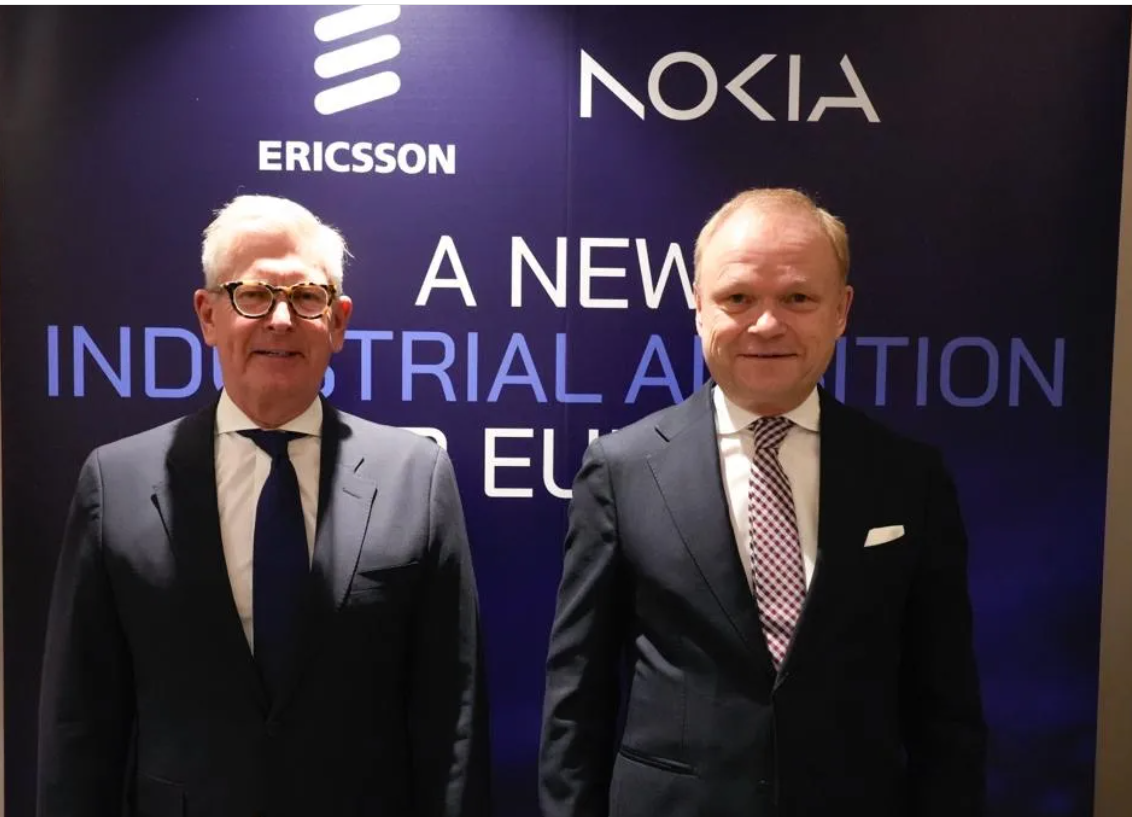
Nokia and Ericsson have agreed a landmark collaboration to advance autonomous networks through open standards and multivendor automation. By joining each other’s automation ecosystems, the companies aim to simplify rApp integration, expand marketplace access and give operators a more flexible, future-proof foundation for next-generation network management.
In a move set to reshape the evolution of telecoms automation, and have announced a strategic collaboration designed to accelerate the industry’s shift towards Autonomous Networks, built on open standards and multivendor interoperability.
The agreement signals a notable thaw in the traditionally competitive relationship between two of the sector’s most prominent network equipment providers. At its core lies a mutual commitment to openness: Ericsson will join the Nokia SMO Marketplace, while Nokia will become a member of the Ericsson rApp Ecosystem, which is built around the Ericsson Intelligent Automation Platform. The cross-participation is intended to simplify how communication service providers deploy and scale automation tools across complex, multivendor network environments.
As telecom operators grapple with surging data traffic, growing service expectations and increasingly distributed architectures, automation has become central to operational efficiency and resilience. Yet the promise of Autonomous Networks — systems capable of self-configuration, self-optimisation and self-healing — has often been hindered by fragmentation. Vendors have developed their own software management and orchestration layers, creating silos that make cross-platform integration costly and complex.
By opening their respective ecosystems to one another, Nokia and Ericsson aim to reduce that friction. Through access to rApps — specialised applications that run on service management and orchestration frameworks — operators will be able to select and deploy automation capabilities across both platforms with greater flexibility. The approach is designed to promote innovation without locking service providers into a single vendor’s stack.
The collaboration centres on alignment around open frameworks and intelligent operational models. In practice, this means building automation solutions that can operate seamlessly in multivendor environments, a necessity for most large telecom operators whose infrastructure typically spans multiple generations and suppliers.
Ari Kynäslahti, Chief Technology Officer at Nokia, described the agreement as a pivotal step for the industry. He said the partnership marked a significant advance in how next-generation autonomous networks would be delivered, adding that aligning on open frameworks would give service providers a more adaptive and future-proof foundation for automation. He noted that the collaboration would also accelerate the development of robust rApp environments, enabling operators to introduce new capabilities more rapidly, optimise network performance with greater precision, and scale innovation across diverse global deployment scenarios.
The emphasis on rApps reflects a broader industry shift towards modular, software-driven network management. Rather than relying solely on monolithic upgrades, operators can deploy targeted applications to address specific performance, energy efficiency or quality-of-service challenges. In theory, this model reduces time-to-market for new services while improving operational agility.
For Ericsson, participation in the Nokia SMO Marketplace extends the reach of its automation tools and opens the door to a wider developer and operator community. For Nokia, membership in the Ericsson rApp Ecosystem offers similar advantages, embedding its solutions within a broader innovation framework. For customers, the reciprocal arrangement promises greater choice and simplified integration.
The partnership also aligns with the telecom sector’s increasing emphasis on open standards, including the principles championed by industry bodies promoting open radio access networks and cloud-native architectures. As networks become more software-defined and cloud-integrated, interoperability becomes less a technical preference and more a commercial imperative.
While the announcement stops short of deeper product integration or joint development roadmaps, the symbolic significance should not be underestimated. By collaborating on automation — the intelligence layer of modern networks — Nokia and Ericsson are signalling that industry-wide progress towards Autonomous Networks may depend as much on shared ecosystems as on individual technological breakthroughs.
For communication service providers navigating the pressures of 5G expansion, edge computing and the early foundations of 6G research, the prospect of more cohesive multivendor automation could prove timely. If the partnership delivers on its ambitions, it may help transform autonomous networking from aspiration to operational reality, underpinned not by isolated platforms but by interoperable, open innovation.
Discover more from Creative Brands Mag
Subscribe to get the latest posts sent to your email.
















Leave a comment