


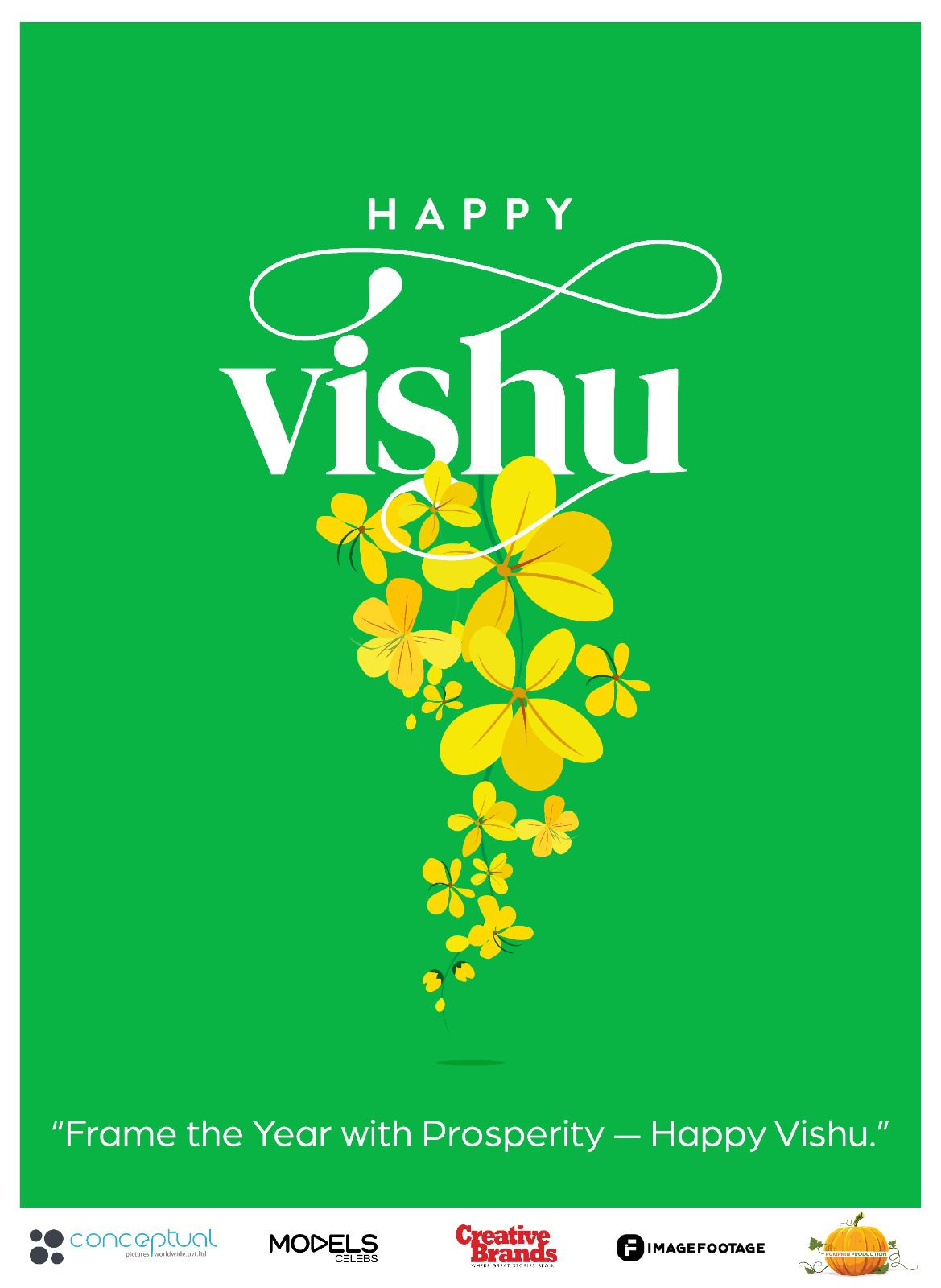
Vishu, Kerala’s harvest festival, is a deeply nostalgic celebration marked by the sacred Vishukkani, firecrackers, and family rituals. Beyond prosperity, it evokes memories of childhood, tradition, and togetherness among Malayalees across the world, blending spiritual belief with cultural continuity and emotional longing for home.
As the first light of dawn slips quietly over coconut groves and paddy fields, homes across Kerala awaken not to alarms or urgency, but to a ritual older than memory. On Vishu morning, time seems to pause. Eyes remain closed, hands guided gently by elders, as families approach a carefully arranged vision of abundance—the Vishukkani. In that fleeting moment of opening one’s eyes, generations of belief, hope, and nostalgia converge.
For Malayalees, Vishu is not merely a festival marking the Malayalam New Year; it is an emotional return to roots. It is a day that carries the scent of konna flowers, the crackle of firecrackers, and the soft rustle of kasavu sarees. It is also a day when distance collapses—when those living in cities like Dubai, London, or Bengaluru find themselves mentally transported back to ancestral homes in Palakkad, Thrissur, or Kottayam.
At the heart of Vishu lies the Vishukkani, an arrangement that is both symbolic and deeply personal. A traditional uruli is filled with rice, fruits, vegetables, a mirror, a copy of the Ramayana or Bhagavad Gita, and the golden blooms of the konna tree. A lit nilavilakku casts a warm glow over the arrangement, believed to bring prosperity for the year ahead. The ritual is often prepared the night before by the eldest woman in the household, who becomes both curator and custodian of tradition.
The act of seeing the Vishukkani at dawn is guided and deliberate. Children are woken gently, their eyes covered, and led to the kani. The first sight is meant to set the tone for the year—a visual prayer for abundance. For many, this ritual remains etched in memory long after they have grown up and moved away. It is not uncommon for Malayalees abroad to recreate a modest Vishukkani in apartments, using whatever elements they can find, bridging continents with tradition.
Equally cherished is the custom of Vishukkaineetam, where elders gift money to younger members of the family. The crisp feel of currency notes placed into eager hands carries more than monetary value—it is a gesture of blessing, affection, and continuity. For children, it is often the highlight of the day, rivalled only by the joy of bursting firecrackers.
Fireworks are an inseparable part of Vishu celebrations, particularly in central Kerala. The morning air resonates with sharp bursts of sound, marking the arrival of the New Year with exuberance. Unlike the night-time spectacle of Diwali, Vishu’s fireworks belong to the morning, symbolising awakening rather than illumination. The streets, still soft with early light, come alive with laughter and excitement.
The Vishu feast, or sadya, is another centrepiece of the celebration. Served on banana leaves, it features a medley of dishes—avial, sambar, thoran, olan, and the essential payasam. Each dish carries the flavours of Kerala’s agricultural bounty, reinforcing Vishu’s identity as a harvest festival. Families gather to share the meal, often dressed in traditional attire, reinforcing bonds that extend beyond the dining table.
Yet, what makes Vishu particularly poignant is its emotional texture. For many Malayalees, Vishu is inseparable from childhood memories—of waking up before sunrise, of the smell of oil lamps, of grandparents narrating stories, and of the thrill of new clothes. It is a festival that does not merely occur in the present; it exists simultaneously in memory.
In recent years, as migration has reshaped Kerala’s social fabric, Vishu has taken on new meanings. With millions of Malayalees living outside the state, the festival has become a powerful anchor of identity. Social media fills with images of Vishukkani setups from across the world—small, improvised, yet deeply sincere. Video calls replace physical gatherings, but the essence of the ritual endures.
Interestingly, Vishu’s cultural significance extends beyond Kerala. It shares thematic similarities with other New Year and harvest festivals across India, such as Baisakhi and Ugadi. Yet, Vishu remains uniquely Malayali in its aesthetics and emotional resonance.
The konna flower, with its cascading yellow blossoms, has become an unofficial emblem of Vishu. Blooming precisely around this time of year, it symbolises both seasonal change and cultural continuity. In literature and cinema, the konna often appears as a motif of nostalgia, representing a Kerala that is at once timeless and transient.
For older generations, Vishu is also a reminder of simpler times—when celebrations were less commercialised, when communities were more tightly knit, and when rituals were observed with quiet devotion. There is a gentle melancholy in these reflections, a sense that something intangible has been lost even as much has been gained.
Younger generations, however, are finding new ways to engage with the festival. From curated Vishu-themed content on digital platforms to community celebrations in urban spaces, the festival is evolving. Yet, even in its modern iterations, the core elements remain intact—the kani, the kaineetam, the sadya, and the shared sense of beginning anew.
In Kerala’s temples, Vishu is marked with special prayers and offerings. Devotees visit early in the morning, seeking blessings for the year ahead. The spiritual dimension of Vishu underscores its deeper significance—not merely as a cultural event, but as a moment of introspection and renewal.
As the day progresses, the initial quietude of dawn gives way to a more relaxed rhythm. Families visit relatives, exchange greetings, and spend time together. The pace is unhurried, reflecting a broader philosophy embedded within the festival—the importance of pausing, reflecting, and reconnecting.
In an age defined by speed and fragmentation, Vishu offers something rare: continuity. It is a festival that resists reinvention even as it adapts, that holds onto its essence even as its context changes. For Malayalees, it is less about spectacle and more about sentiment.
Perhaps that is why Vishu continues to endure so powerfully in the Malayali imagination. It is not just a day on the calendar, but a feeling—a quiet, golden moment at dawn when the world seems full of promise. It is the memory of being led by the hand, eyes closed, towards a vision of abundance. It is the sound of laughter echoing through ancestral homes. It is the taste of payasam shared with loved ones.
And above all, it is the knowledge that no matter where life takes them, Malayalees can always return—if only for a moment—to that first light of Vishu morning, where everything begins again.
Discover more from Creative Brands Mag
Subscribe to get the latest posts sent to your email.











Leave a comment