


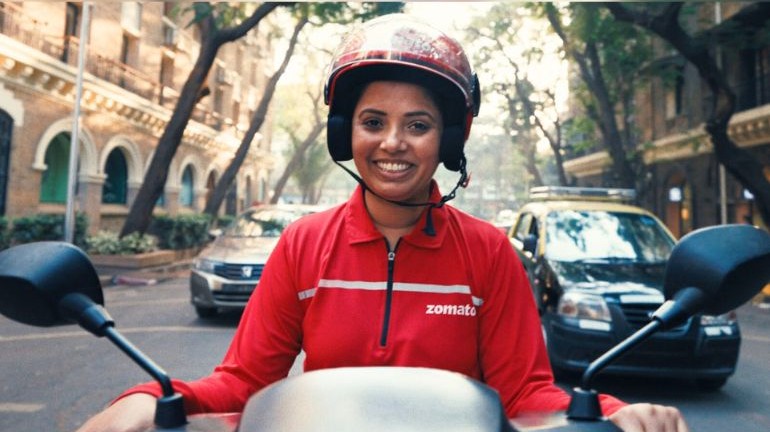
Zomato’s International Women’s Day film captures the subtle biases women delivery partners face, from surprised stares to pointed questions. With over 3,500 women delivering half a million orders monthly, the campaign reframes capability beyond gender, spotlighting resilience and redefining what it means to deliver in India’s fast-changing gig economy.
“Do you also deliver?” It is a question that still lingers in the air for many women who step forward as delivery partners. Sometimes it comes as a hesitant query at a restaurant counter, sometimes as a startled remark at a doorstep. The words may be simple, but they carry the weight of societal assumptions about who belongs in certain jobs and who does not.
This International Women’s Day, Zomato chose to confront that question head-on. The company launched a film that captures these everyday moments—those fleeting looks of surprise, those awkward pauses, those unexpected questions—and then gently flips the script. Instead of focusing on the women, the lens turns towards society itself. The message is clear: capability has nothing to do with gender.
The film is not loud or confrontational. Its strength lies in subtlety. By showing the ordinariness of these interactions, it highlights how deeply ingrained biases can be, often unnoticed by those who express them. Yet, the women delivery partners continue to ride, walk, and navigate the city streets, proving through action what words sometimes fail to acknowledge—that they are equally capable of delivering, in every sense of the word.
As of February 2026, Zomato has more than 3,500 women delivery partners across India. Together, they deliver over half a million orders every month, a number that continues to grow. These figures are not just statistics; they represent a shift in the gig economy, where women are increasingly visible in roles once considered unconventional for them.
The campaign resonates because it reflects a larger cultural moment. India’s workforce is evolving, and women are claiming space in industries that were once male-dominated. Food delivery, with its long hours, unpredictable routes, and physical demands, was often seen as unsuitable for women. Yet, the presence of thousands of women on the roads every day challenges that perception.
For Zomato, the film is both a celebration and a call to reflection. It celebrates the women who have chosen this path, who navigate traffic and weather, who balance family responsibilities with work, and who continue to deliver despite the questions. At the same time, it asks society to examine why those questions exist in the first place. Why should a woman delivering food be surprising? Why should capability be measured against gendered expectations?
The campaign also underscores the importance of representation. When customers open their doors to see women delivery partners, when restaurants hand over orders to them, when colleagues ride alongside them, each moment chips away at stereotypes. Visibility matters, and every delivery becomes a small act of normalisation.
The film’s timing on International Women’s Day is deliberate. It situates the conversation within a global context of gender equality, while grounding it in the everyday realities of Indian cities. It reminds viewers that progress is not only about boardrooms and leadership positions but also about recognising dignity and capability in every role, from the corporate office to the delivery route.
For the women themselves, the job is often about independence and financial stability. Many join to support families, to pay for education, or simply to carve out a livelihood on their own terms. The questions they face may be frustrating, but they also serve as reminders of the barriers they are breaking.
Zomato’s film does not claim to have all the answers. What it offers instead is a perspective shift. By turning the gaze back on society, it invites viewers to reconsider their assumptions and to see delivery partners not as anomalies but as professionals. In doing so, it reframes the act of delivery itself—not just as the movement of food from one place to another, but as the delivery of change, of possibility, of a future where capability is never questioned because of gender.
In the end, the question “Do you also deliver?” becomes less about doubt and more about recognition. Yes, they deliver. They deliver meals, they deliver independence, they deliver resilience. And with every order completed, they deliver a message that is impossible to ignore: capability is universal, and it is time society caught up.
Discover more from Creative Brands Mag
Subscribe to get the latest posts sent to your email.















Leave a comment