


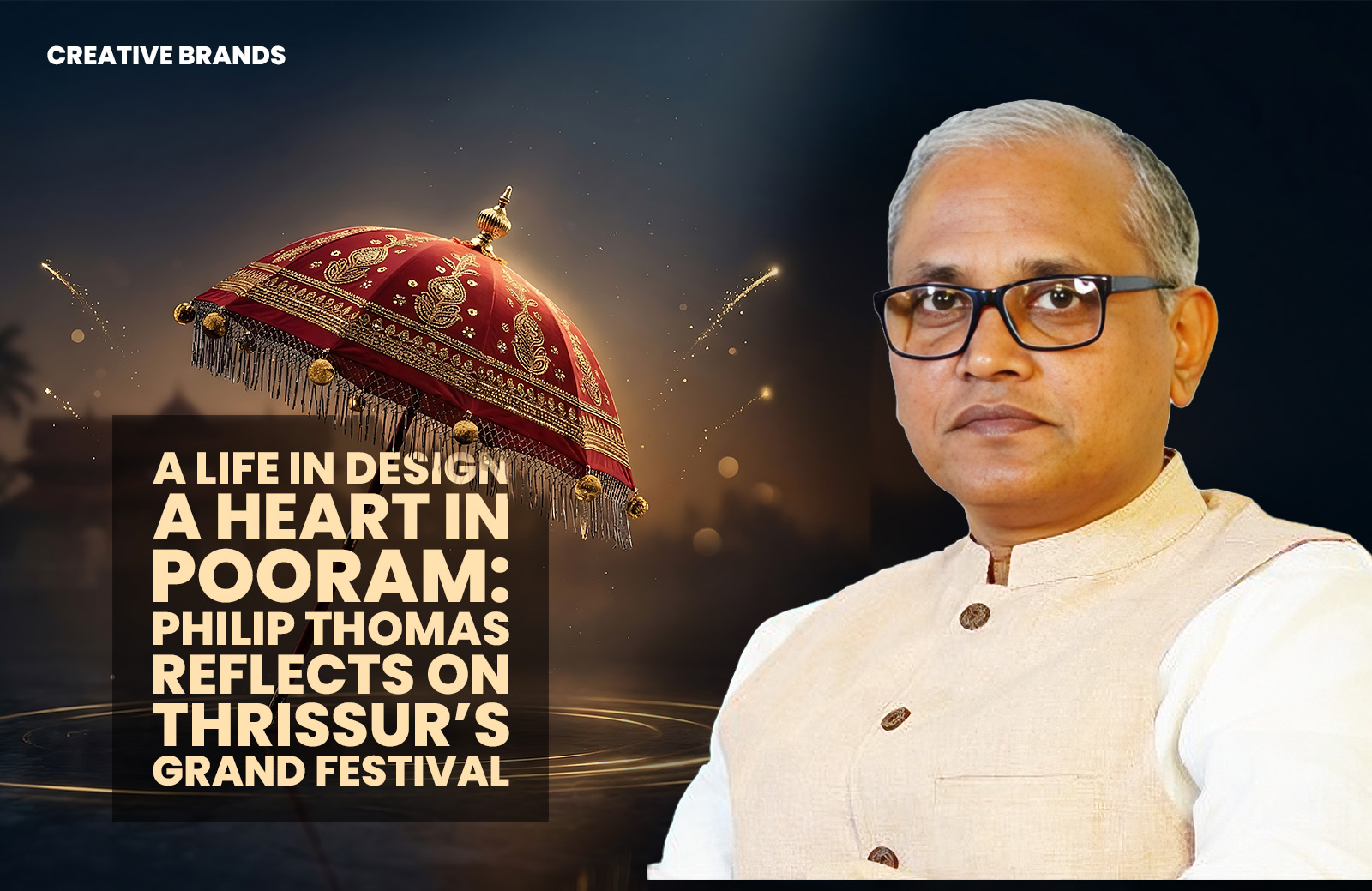
As a professional in the design field, Philip Thomas, Country Head of the World Design Council, interprets Thrissur Pooram as more than a festival. He sees it as a masterclass in systems, process, and precision—an event that has been flawlessly executed for centuries through clearly defined roles and inherited responsibilities. This structured complexity, he believes, reflects a deep indigenous knowledge system that modern design thinking can learn from.
Rooted deeply in Kerala’s cultural landscape, his reflections on Thrissur Pooram are not just observations but lived experiences spanning nearly fifty years. From childhood memories of holding his grandmother’s hand and walking to the Pooram grounds to witnessing the festival as a design thinker, his journey mirrors the evolution of perspective—from wonder to understanding.
“Holding my grandmother’s hand and walking to the Pooram ground is my earliest memory connected with this festival. These memories go back nearly fifty years. In a time when there were no shops selling toys, Pooram was an opportunity for us children to get them.
During my childhood, we lived in Mayilippadam, about half a kilometre below the Paramekkavu temple. I studied at Model Boys School, which is very close to the temple, and later continued my studies at St. Thomas College nearby. The annual meeting of our school’s alumni association is itself called “Model Pooram,” and it is held every year on the Sunday exactly one week before Pooram. That is why Thrissur Pooram is an inseparable part of our lives.
In school days, Pooram was something we celebrated with excitement and joy. My perspective on Pooram began to change when I entered the field of design. Meeting Shri Aravindaksha Menon, who brought our local festivals onto the global tourism map, also influenced my thinking. He played a major role in bringing leading global television channels, including the BBC, to broadcast Pooram.
The 36-hour-long Thrissur Pooram is always a wonder to me. It operates with a precise system and process. That is how such a massive festival can be organised without any lapses. It is astonishing how these methods were established centuries ago, assigning responsibilities to specific inheritors. For instance, there are designated custodians for preparing the temple flagpole and clearly defined methods for making ceremonial items like the venchamaram.
Each person views Pooram from their own perspective. Oscar-winning Resul Pookutty admires the soundscape of Pooram. Our Ilanjithara Melam can even be described as one of the longest orchestral performances in the world.
To truly understand the attention to detail in every aspect of Pooram, one must witness the “Chamaya Pradarshanam” (ornamental exhibition). The intricate craftsmanship displayed in each parasol and caparison is simply astonishing.
Memories of fireworks accidents and elephants running amok are painful. Equally distressing are the controversies associated with Thrissur Pooram.
The crowd that gathers to watch the Kudamattam (exchange of parasols) is something one must experience at least once. In earlier days, we used to bring straw mats to watch the fireworks. We would spread them in front of the Paramekkavu temple and lie down. At dawn, when the fireworks began, we would wake up startled and then lie there enjoying the display for nearly two hours until daybreak.
Friends who love elephants would camp on the grounds of Paramekkavu temple and around the CMS School, where the elephants are stationed.
Personally, I love watching Pooram at night, in the beauty of oil lamps. Without any artificial lighting, it feels like a very original and authentic visual experience.
The British Council once conducted a detailed study of the Durga Festival in Kolkata, examining not only its cultural aspects but also its potential within the creative economy. Thrissur Pooram is not just a cultural event; it has dimensions beyond that. However, I am not sure whether anyone has studied it in depth. Even as we describe Thrissur Pooram as world-famous, I feel we have not fully explored its potential. I believe it can play a crucial role in the local economic development of Thrissur.
The fact that lakhs of people from around the world flock to the Pooram ground, ignoring the scorching heat of the Malayalam month of Medam, strengthens this belief.
I now live barely two kilometres away from the Pooram ground. From my apartment balcony, I can see the tall lights of the festival grounds, and I can beautifully enjoy the fireworks from there.”
Discover more from Creative Brands Mag
Subscribe to get the latest posts sent to your email.
















Leave a comment