


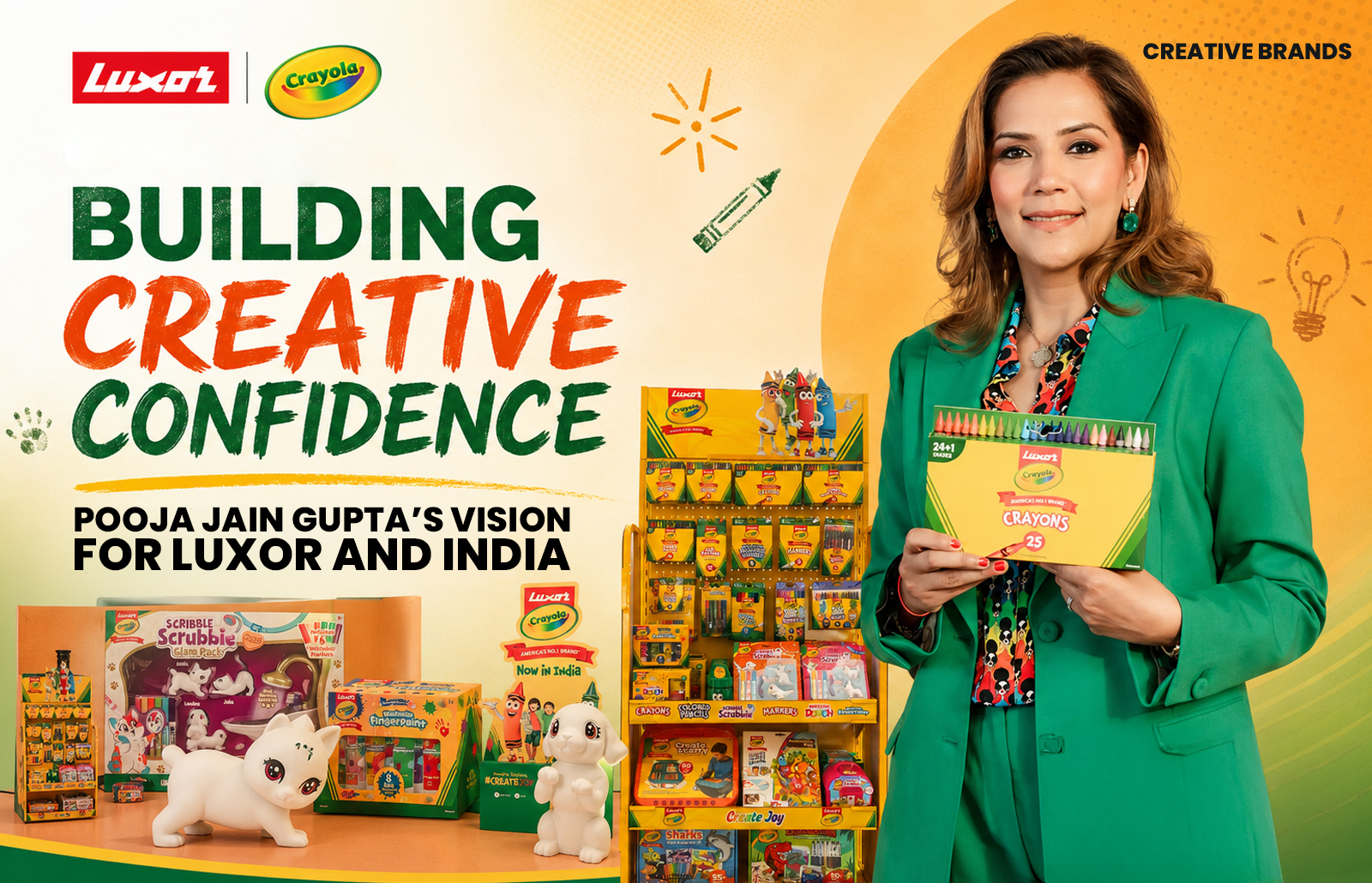
For generations, the simple act of putting pen to paper has shaped ideas, ambitions, and aspirations across India. Few brands have been as closely associated with that journey as Luxor, which has remained at the forefront of it. From classrooms and boardrooms to personal journals and creative studios, Luxor has played a quiet yet significant role in nurturing expression and learning, becoming an enduring part of the country’s cultural and educational landscape.
Today, as digital technologies transform the way people communicate and create, Luxor is redefining its purpose for a new era. Under the leadership of Managing Director Pooja Jain Gupta, the company is embracing innovation while remaining rooted in its legacy, championing the enduring value of handwriting, creativity and mindful expression. As the brand expands into new creative categories inspiring a fresh generation of makers, thinkers and storytellers, its journey offers a fascinating lens through which one can view India’s evolving relationship with creativity.
In this exclusive interview, Pooja Jain Gupta reflects on Luxor’s remarkable evolution from a trusted writing instruments company to a broader creative ecosystem, the challenges and opportunities of leading a legacy brand in a digital age, and why the future of creativity may still begin with a pen in hand.


Luxor has been part of India’s writing culture for decades. How do you see the brand’s legacy contributing to India’s larger nation-building journey, especially in education and creative development?
Luxor’s journey has closely mirrored India’s own growth story. For decades, we have enabled access to quality writing instruments at scale, reaching classrooms, institutions, and homes across the country. In fact, Luxor was ‘Making in India for the world’ long before Make in India was even a buzzword, the brand was manufacturing world-class products in India and exporting them to over 120 countries, while building strong global partnerships alongside robust domestic capabilities. But what truly defines our legacy is the diversity of users we serve. Our products are used by everyone from a lab attendant recording critical data in healthcare settings, to government census officers documenting the nation, to Army officials signing important documents to professionals across sectors like banking, logistics, education, retail, and administration, where accuracy and reliability are non-negotiable.
Writing is one of the most fundamental tools of learning, and in that sense, our role has always gone beyond products to participation in the education ecosystem. From a nation-building perspective, literacy and expression are foundational but equally important is the ability to think, articulate, and create.
Our legacy lies in democratising these tools of expression making them accessible, reliable, and aspirational across industries, use cases, and socio-economic segments. As India continues to invest in education, governance, and skill development, we see ourselves as quiet enablers of that journey supporting not just writing, but the confidence, precision, and creativity that come with it.
Under your leadership, Luxor is repositioning itself beyond stationery into a broader creativity ecosystem. What inspired this transformation, and why is this the right moment for it?
The shift is both intuitive and strategic. If you look at how consumers, especially younger audiences engage today, creativity is no longer confined to traditional formats. It is fluid, multi-dimensional, and embedded in everyday life whether it’s doodling during meetings, adult colouring for relaxation, parent-child creative play, or personalising everyday objects through DIY and acrylic art. At the same time, there is growing recognition that creativity is not a ‘soft skill’ but a core life skill critical for problem-solving, innovation, and adaptability.
This creates a natural adjacency for us to evolve from a writing instruments company to a broader enabler of creative expression. The timing is key. India is at an inflection point with a young demographic, rising aspirations, and openness to explore creativity more actively. For us, building a creativity ecosystem through products, experiences, and partnerships is how we stay relevant while leading that shift.
In an era dominated by screens and instant communication, why do you believe handwriting and analogue creativity still matter for younger generations?
Digital and analogue are not opposing forces they serve different cognitive and emotional purposes. As screen exposure continues to rise, the importance of balancing digital engagement with hands-on creative activities has become increasingly evident. According to 2025 data published by the U.S. National Institutes of Health (NIH), children under the age of five spend an average of 2.22 hours per day on screen more than double the World Health Organization’s recommended limit of one hour per day for children aged two to four, while no screen time is advised for those under one year of age. Handwriting, for instance, is deeply linked to memory retention, comprehension, and fine motor development. It engages the brain in ways that typing does not. Beyond that, analogue creativity offers something that digital often cannot present. When you write, sketch, or colour, you are fully engaged in the moment. That has a direct impact on focus, mindfulness, and emotional expression. For younger generations growing up in highly stimulated digital environments, these forms of engagement become even more valuable. They provide balance. Our belief is not about replacing digital, it is about ensuring that foundational, tactile forms of creativity continue to have a meaningful place.
You have spoken about bringing creativity back into mainstream learning. According to you, what are the biggest gaps in India’s current education system when it comes to nurturing imagination and original thinking?
India’s education system has made significant progress in scale and access, and policies like the National Education Policy (NEP) 2020 are a step in the right direction placing strong emphasis on experiential learning, multidisciplinary education, and the integration of creativity and critical thinking into the curriculum. However, the on-ground reality is that the approach to learning is still largely outcome-driven and assessment-led. This often leaves limited room for exploration, experimentation, and failure all of which are essential for creativity. While NEP 2020 rightly positions creativity as a core life skill, its structured integration into everyday classroom learning is still evolving.
Creativity continues to be treated, in many cases, as an extracurricular activity rather than a core component of education. The continued emphasis on standardised answers can also unintentionally discourage original thinking. Bridging this gap requires a deeper shift in mind-set from learning what to think, to learning how to think. It also calls for the right tools, environments, and curricula that actively encourage curiosity and expression. This is where stronger collaboration between industry, educators, and policymakers can truly accelerate impact.
Crayola’s entry into India through Luxor marks a major strategic move. What opportunities do you see in the Indian market for hands-on creativity and imaginative play?
As one of the world’s most recognised creativity brands, the 120-year-old Crayola is tapping into India’s vast youth demographic and rapidly expanding learning ecosystem. Our partnership with Crayola is anchored in a shared belief that creativity should be nurtured early and experienced hands-on. India presents a very compelling opportunity in this space. There is a large and growing base of young consumers, increasing parental awareness around holistic development, and a willingness to invest in products that go beyond academics. At the same time, there is still a significant gap in access to high-quality, safe, and globally benchmarked creative tools. This is where we see strong potential not just in product adoption, but in building an ecosystem around imaginative play, learning, and engagement. For us, it is not just about bringing a global brand into India; it is about contextualising it for Indian consumers and expanding the culture of creative confidence and create joy amongst younger generation.
India is witnessing renewed interest in mindfulness, slow living, and intentional learning. Do you think the revival of writing, sketching, and creative expression is connected to these broader cultural shifts?
There is definitely a connection. As lives become more fast-paced and digitally saturated, people are actively seeking moments of pause and intentional engagement, it is a battle between Real vs Reel. Activities like writing, sketching, or colouring naturally lend themselves to that need. They are immersive, tactile, and personal. In many ways, they offer a form of everyday mindfulness. What we are seeing is not just a revival, but a re-contextualisation where these practices are no longer seen as purely functional, but as tools for well-being and self-expression. That aligns very strongly with where we see the future of creativity.
What role can Indian brands like Luxor play in building a more creative and innovation-driven society at a time when AI and automation are rapidly changing the workplace?
As AI takes over more routine and repetitive tasks, human skills like creativity, critical thinking, and emotional intelligence become even more valuable. Brands like ours have an important role to play in enabling these skills early and consistently. This goes beyond products it involves creating platforms, partnerships, and experiences that encourage people to think differently and express themselves freely. We also have a responsibility to shift the narrative. Creativity should not be seen as optional or niche it is central to innovation. By embedding this belief into how we design our offerings and engage with consumers, we can contribute meaningfully to a more future-ready society.
Manufacturing has been a significant part of Luxor’s journey. How important is local manufacturing and ecosystem-building to your long-term vision for the company and for India’s creative economy?
Manufacturing is at the core of who we are. It gives us control over quality, agility in innovation, and the ability to scale efficiently. From a broader perspective, local manufacturing is critical to building a resilient and self-reliant ecosystem. It creates jobs, drives skill development, and strengthens supply chains. For the creative economy, this becomes even more important. If we want to make creative tools widely accessible, they need to be produced at scale and at the right price points. Our focus is on continuously strengthening our manufacturing capabilities while also building a wider ecosystem of partners and suppliers.
As Managing Director, what legacy do you personally hope to create for Luxor over the next decade, not just as a business, but as a cultural and creative force in India?
Over the next decade, my aspiration is to see Luxor evolve from being a trusted brand in writing instruments to becoming a catalyst for creativity in India. That means building a brand that is present not just in classrooms, but in everyday moments of expression across age groups and contexts. It also means contributing to a shift in how creativity is perceived moving it from the margins to the mainstream. From a business standpoint, growth and scale are important. But equally important is impact whether we are enabling a child to express themselves for the first time, or encouraging a professional to reconnect with creativity. If we can build a brand that inspires people to think, create, and express more freely, that would be a legacy worth creating.
Discover more from Creative Brands Mag
Subscribe to get the latest posts sent to your email.











Leave a comment