


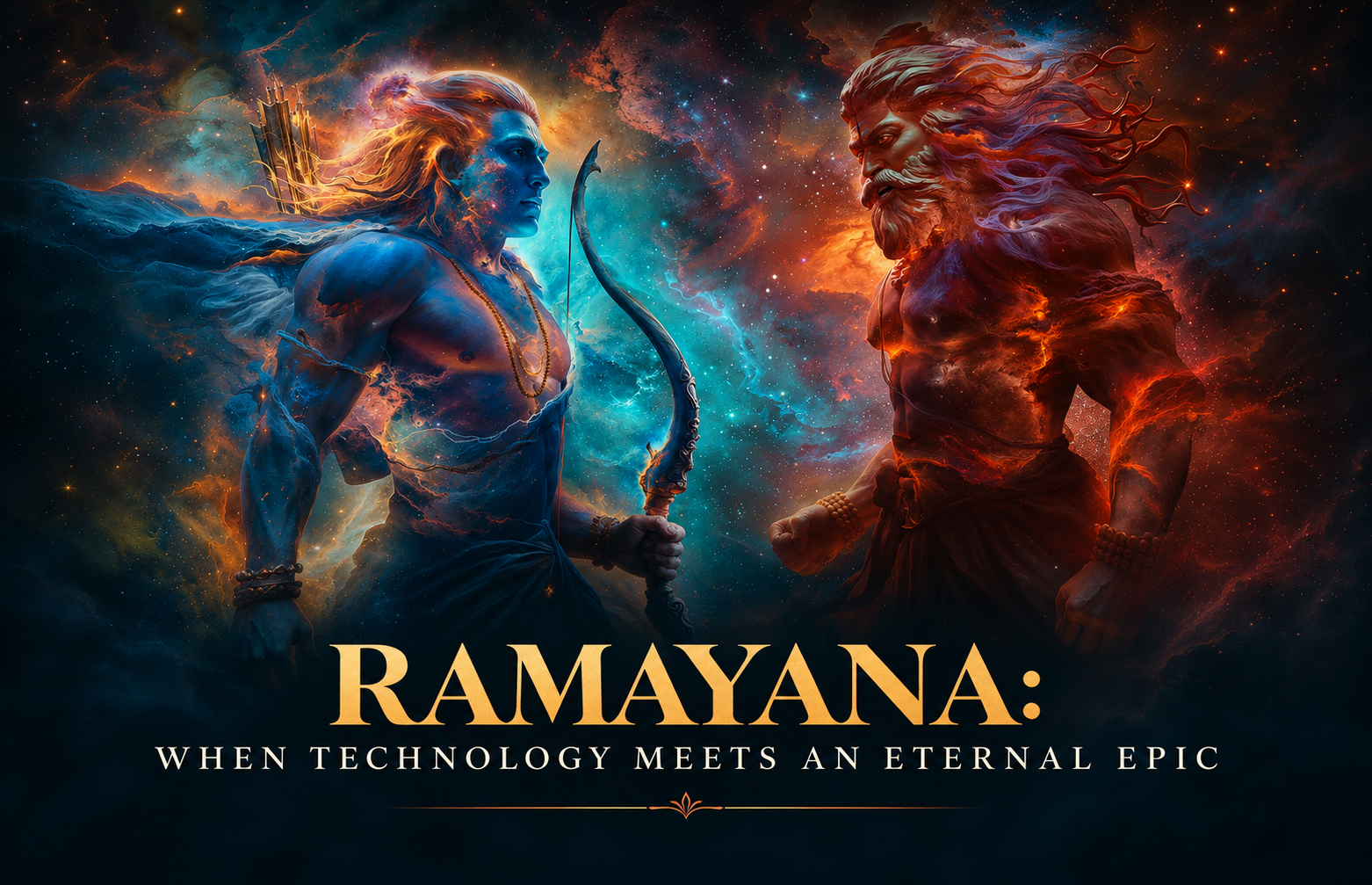
Nitesh Tiwari’s Ramayana: Part 1 represents an ambitious milestone in Indian filmmaking, combining international visual-effects expertise, advanced cinematography, artificial intelligence-assisted production and an extraordinary musical collaboration. Yet, beyond its technological achievements and cinematic grandeur, the film raises an important question: can visual perfection recreate the emotional power of an eternal epic?
The challenge of bringing the Ramayana to the big screen has never been merely about telling a story. It is about recreating a civilisation’s collective imagination, translating centuries of faith, literature, art and cultural memory into a cinematic experience that can speak to audiences across generations. With Ramayana: Rise of a Legend, popularly known as Ramayana: Part 1, director Nitesh Tiwari and producer Namit Malhotra have attempted something considerably more ambitious than another mythological film. They have set out to demonstrate that Indian cinema can combine indigenous storytelling with international filmmaking technology on an unprecedented scale.
Released in November 2026, the first instalment of this two-part cinematic undertaking has attracted attention for its technical ambition, production scale and international creative partnerships. Starring Ranbir Kapoor as Rama, Sai Pallavi as Sita and Yash as Ravana, the film is an attempt to transform one of the world’s most familiar epics into an immersive theatrical experience. Its significance, however, extends well beyond its leading stars.
One of the most interesting aspects of the project is the coming together of two different filmmaking worlds. Nitesh Tiwari, known for films such as Dangal and Chhichhore, brings an understanding of human relationships, emotional conflicts and popular storytelling. Namit Malhotra, meanwhile, represents the technological dimension of contemporary cinema. As the founder of Prime Focus and head of the internationally acclaimed visual-effects company DNEG, he brings considerable experience in creating cinematic worlds for global productions.
The collaboration is particularly significant because DNEG has been associated with some of the most technically demanding international productions, including Inception, Interstellar and Dune. Its involvement gives Ramayana access to a sophisticated visual-effects infrastructure and a global pool of creative and technical professionals.
The film’s visual ambitions are evident in its landscapes, mythical creatures, elaborate environments, aerial sequences and battle choreography. The objective is not simply to place actors against digitally created backgrounds but to establish a believable universe in which the supernatural appears physically convincing.
The attention given to individual sequences offers an extraordinary insight into the production process. Tiwari has revealed that the Ravana-Jatayu aerial battle took six and a half years to complete, from its initial development to the final visual-effects work. The Pushpaka Vimana, one of the most recognisable elements of the epic, underwent approximately 40 to 50 design iterations before the team arrived at its final appearance. The design process alone took nearly two years.
These figures reveal something important about contemporary filmmaking. What audiences see for a few minutes on screen may represent years of conceptualisation, experimentation, modelling, animation, simulation and refinement. A single visual sequence can involve artists, engineers, designers, animators, lighting specialists and compositors working across different locations and departments.
This is where Ramayana deserves particular attention. It brings into focus the often-invisible workforce behind modern cinema. Thousands of professionals contribute to creating what ultimately appears as a seamless visual experience. Their work is easily overlooked when audiences discuss only the director, actors and music composers.
The involvement of DNEG and ReDefine in visual effects, alongside Brahma AI’s support for virtual production workflows and research, also illustrates how the boundaries between filmmaking, computing and artificial intelligence are evolving. Importantly, artificial intelligence does not replace the creative labour involved in such productions. It can support complex workflows, but the artistic decisions, visual interpretation and detailed execution remain dependent on human expertise.
The production’s cinematography is another important dimension. Pankaj Kumar and Mahesh Limaye have worked on creating the film’s visual identity. The use of IMAX-certified cameras, making it the first Indian production to receive the Filmed for IMAX label, reflects the makers’ intention to create an experience designed for large-format cinema. The framing, scale and visual depth are particularly important when dealing with mythological landscapes and larger-than-life characters.
Production designers Ravi Bansal and Ramsey Avery have the equally challenging responsibility of translating a world described through ancient literature into physical and digital environments. Their work must balance historical imagination, mythology, architecture and contemporary cinematic expectations. The challenge is not to create a documentary reconstruction of an ancient period but to establish a visual language that feels convincing within the film’s interpretation of the epic.
Action choreography is another international collaboration. Terry Notary, whose experience includes major Hollywood productions, and Guy Norris, associated with Mad Max: Fury Road and Furiosa, bring considerable expertise in physical action, creature movement and large-scale sequences. Their contribution is particularly relevant to a narrative involving divine beings, supernatural powers, flying vehicles and extraordinary creatures.
The performances provide the film with its human centre. Ranbir Kapoor approaches Rama with restraint and composure, a characterisation that demands considerable control because the role carries enormous cultural and religious significance. Sai Pallavi brings gentleness to Sita, while Yash gives Ravana an imposing screen presence. Ravi Dubey’s Lakshmana provides moments of relative lightness. The casting of Arun Govil, remembered by generations for portraying Rama in Ramanand Sagar’s television adaptation, as King Dasharatha also creates an interesting connection between different eras of Ramayana storytelling.
Among the film’s most significant creative decisions is its musical collaboration. Academy Award-winning composers Hans Zimmer and A.R. Rahman have joined hands to create the soundtrack. It is an unusual meeting of two distinctive musical sensibilities. Zimmer’s experience in building expansive cinematic soundscapes meets Rahman’s ability to combine Indian musical traditions with contemporary global influences. Their collaboration, developed over approximately three and a half years, is an important international dimension of the project.
The music is not simply an accompaniment to the images. In a film of this scale, sound design, orchestration, silence and background scoring become essential elements in establishing atmosphere and emotional intensity.
The editing, handled by Huzefa Lokhandwala, also has an enormous responsibility. A film with a reported runtime of approximately 195 minutes and such an extensive visual vocabulary needs a carefully controlled narrative rhythm. Spectacle can hold attention, but the emotional progression of characters must give audiences a reason to remain invested.
This is where the film’s achievements deserve to be examined critically.
The early critical response has recognised its technological advancement and visual ambition, but has also pointed towards limitations in emotional storytelling. Some reviewers have felt that the narrative concentrates too heavily on presenting familiar episodes and spectacular sequences rather than exploring the psychological complexities of the characters. The visual effects, impressive in several major sequences, are not equally convincing throughout.
This is an important distinction. Technical perfection and cinematic perfection are not necessarily the same thing. A digitally created character may look extraordinarily realistic, but the audience must also feel its presence. An elaborate battle may demonstrate exceptional computer-generated imagery, but it must carry emotional consequences. A perfectly designed Pushpaka Vimana can generate wonder, but the story surrounding it must generate empathy.
The Ramayana has survived for centuries not because of its spectacular battles alone, but because of its human dilemmas. Rama’s commitment to duty, Sita’s courage, Lakshmana’s loyalty, Bharata’s sacrifice, Hanuman’s devotion and Ravana’s ambition offer layers of interpretation that extend beyond the conventional conflict between good and evil. The epic has been retold in hundreds of regional, literary and cultural traditions, each contributing different perspectives.
Tiwari has acknowledged the difficulty of finding a narrative structure that respects Valmiki’s Ramayana while drawing upon the richness of other versions. The screenplay, developed with Shridhar Raghavan, therefore carries a responsibility that goes beyond adapting a familiar text. It must make difficult creative choices without diminishing the cultural significance of the source material.
There is also a larger industrial story here. The reported combined investment in the two films, including global release and promotional expenditure, is approximately $500 million, or Rs 4,000 crore. This is not the production budget of Part 1 alone. Nevertheless, the scale demonstrates the financial ambition behind the project.
For Indian cinema, the implications are substantial. The industry has traditionally relied on its storytelling strengths, musical traditions, star power and enormous domestic audience. Ramayana attempts to add another dimension: the ability to conceive, develop and execute technically sophisticated productions for a worldwide theatrical market.
Its international distribution through Sony Pictures further strengthens this ambition. The film is not merely being positioned as an Indian cultural product for Indian audiences but as a cinematic interpretation of an epic with universal themes of duty, love, sacrifice, ambition and justice.
There is also an important lesson for the Indian creative industries. The success of a major production does not belong to a single individual or organisation. It is the outcome of collaboration between storytellers, performers, cinematographers, production designers, visual-effects artists, sound engineers, composers, software specialists and thousands of other professionals. Recognising this collective creative contribution is essential to understanding the real scale of modern filmmaking.
Ultimately, Ramayana: Part 1 should be assessed on two different levels. As a technological undertaking, it represents an important step forward for Indian cinema, demonstrating the possibilities of combining international expertise with Indian storytelling. As an adaptation of an enduring epic, it must be judged by a more demanding standard: its ability to make audiences experience the emotional and philosophical depth of a story they may already know.
Technology can create the heavens, the forests, the palaces and the battlefields. It can bring mythical creatures to life and make impossible journeys appear believable. But it cannot independently manufacture devotion, compassion, sacrifice or moral conviction. Those qualities must emerge from the writing, performances and emotional intelligence of the filmmakers.
Perhaps that is the greatest challenge awaiting the second instalment. Having established the visual universe, the filmmakers must now deepen the emotional conflict and deliver the dramatic confrontation that has defined the epic for generations.
Ramayana is therefore more than an expensive cinematic experiment. It is a test of India’s ability to bring together technology, creativity, cultural responsibility and international collaboration. Its most lasting achievement will not be measured by the number of visual effects shots or the size of its production budget, but by whether audiences leave the theatre feeling that they have encountered the Ramayana anew.
Discover more from Creative Brands Mag
Subscribe to get the latest posts sent to your email.













Leave a comment