


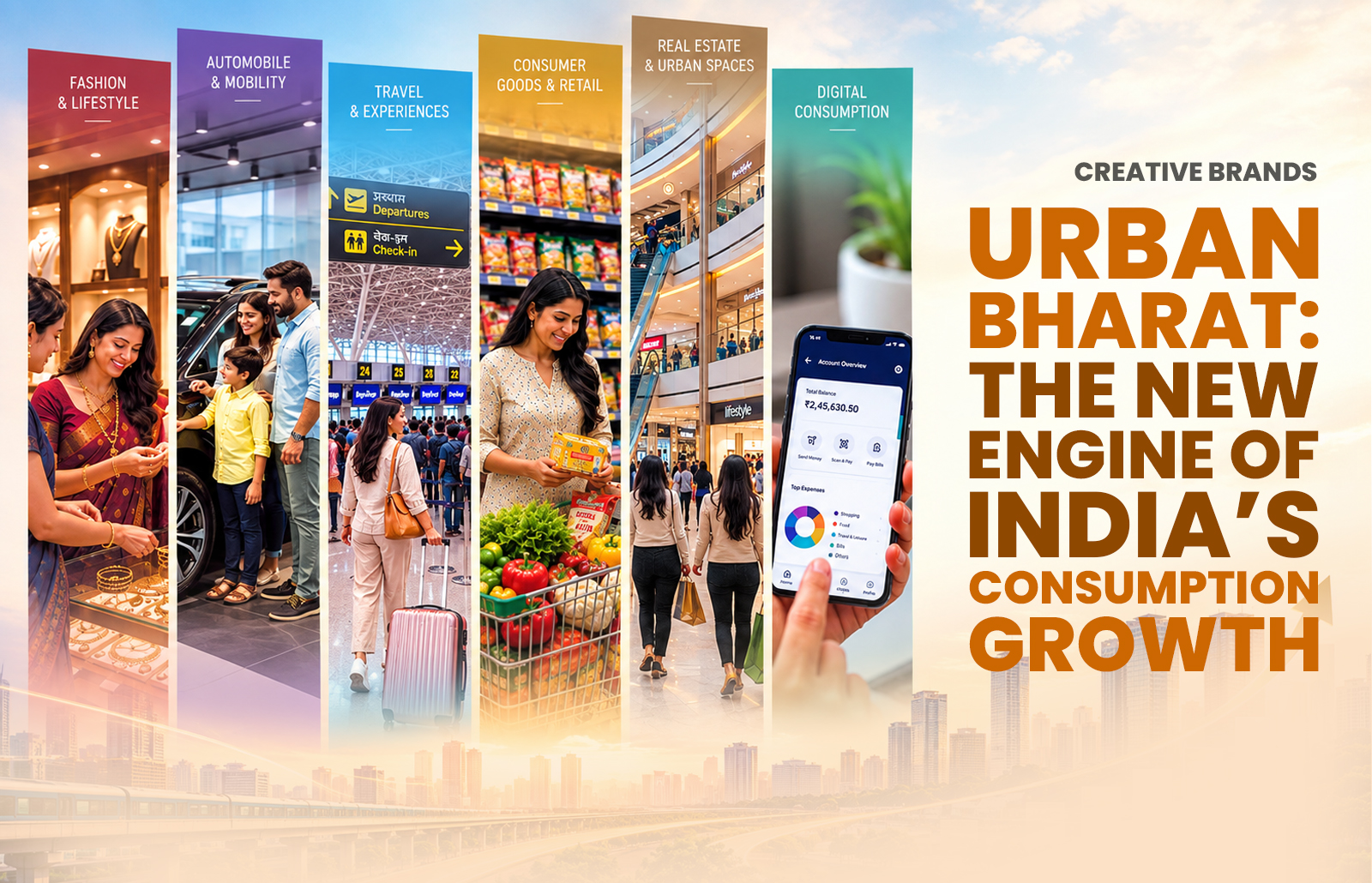
India’s consumption story is increasingly being shaped beyond its metros. The Urban Bharat report, prepared by Kantar and Dainik Bhaskar Group, examines how rising affluence, digital adoption, education, mobility, finance and cultural relevance are transforming Tier II and III markets into powerful engines of economic activity, aspiration and consumer growth.
India’s next major consumption story may not be written in Mumbai or Delhi. It is increasingly taking shape in the cities and towns that sit beyond the traditional metropolitan spotlight. From Indore and Lucknow to Jaipur, Patna, Surat and Bhopal, a new geography of aspiration is emerging, powered by rising incomes, better infrastructure, digital access and increasingly sophisticated consumers.
The Urban Bharat report, prepared by Kantar and Dainik Bhaskar Group, provides an extensive examination of this transformation. The report covers Hindi-speaking markets across Madhya Pradesh, Rajasthan, Uttar Pradesh, Bihar, Punjab, Haryana, Uttarakhand, Chhattisgarh and Jharkhand, as well as Maharashtra and Gujarat, while excluding the Mumbai and Delhi metropolitan regions. Together, the cities and towns covered represent nearly one-third of India’s urban population.
Kantar brings its consumer and marketing data expertise to the study, while Dainik Bhaskar Group contributes the perspective of a media organisation deeply embedded in regional India. The report describes Dainik Bhaskar Group as a major media conglomerate with a presence across print, digital and radio in 14 states, reaching 14 crore readers across its platforms.
What emerges from the study is a picture of urban India that is more geographically dispersed than the conventional metro-centric narrative suggests. Urban Bharat is no longer simply an extension of the large cities. It is developing its own employment bases, education ecosystems, consumer cultures and aspirational identities.
The change is visible in the digital landscape. Smartphone penetration in Urban Bharat reached 85.7 per cent in 2025, while internet reach stood at 84.9 per cent. Seventy per cent of consumers had watched online video or OTT content in the previous year, while 49 per cent accessed the internet daily. The growth of online shopping has been equally significant, with the proportion of online shoppers increasing from about one-fifth in 2016 to one-third in 2025. Debit and credit card ownership has also grown more than 2.5 times over six years.
These numbers point towards a fundamental change in how consumers discover products, compare brands and make purchasing decisions. Vernacular interfaces, voice search, Indian-language applications and digital content are reducing traditional barriers to participation. For businesses, the implication is clear: reaching consumers outside the metros increasingly requires an understanding of language, culture and local context, rather than simply extending metropolitan strategies into smaller markets.
Education is another powerful driver. The report notes that 26.5 per cent of Urban Bharat households spend more than 10 per cent of their income on education, a figure close to the 27.5 per cent reported for Mumbai and Delhi. Education is increasingly viewed not merely as an expense but as an investment in economic mobility. Cities such as Patna, Lucknow, Indore, Bhopal, Ahmedabad and Pune are developing strong education ecosystems, with schools, universities, coaching centres, hostels, transport and retail creating wider economic activity around student populations.
The financialisation of consumption is also gathering pace. Mutual funds and small-ticket systematic investment plans are expanding in Tier II and III markets, indicating a consumer base becoming increasingly comfortable with formal financial products. The report records Urban Bharat states accounting for more than 23 per cent of all-India assets under management in 2025, with assets rising from ₹16.25 lakh crore in December 2024 to ₹18.87 lakh crore a year later.
Healthcare is undergoing a similar transition. Consumers are moving from a predominantly reactive approach to health towards preventive care, diagnostics, nutrition and wellness. Digital and direct-to-consumer models are making health-related products and services more accessible, while rising awareness is creating demand for greater quality and convenience.
Jewellery consumption is also changing. Traditional occasions such as weddings and festivals remain important, but consumers are becoming increasingly interested in design, branding and organised retail. The report projects strong growth for organised jewellery and anticipates a significant increase in its share of the overall market.
Perhaps nowhere is the shift from necessity to aspiration more visible than in automobiles. Four-wheeler registrations in the Bharat states increased from 1.61 million in 2019 to 2.50 million in 2025, a rise of 56 per cent. Car ownership increased from 10.6 per cent to 14.2 per cent over the same period. The consumer mindset is changing too: agreement with the statement that “my car should express my personality” rose from 34.4 per cent in 2019 to 47.8 per cent in 2025.
Electric mobility adds another dimension. Four-wheeler EV registrations across the Bharat states increased dramatically, from 7,869 in 2024 to 44,834 in 2025. Uttar Pradesh, Gujarat, Rajasthan, Madhya Pradesh and Haryana are among the important contributors to this emerging market.
The FMCG sector is witnessing what the report calls “modernisation within tradition”. Consumers continue to value familiar regional products, but increasingly expect better packaging, hygiene, nutritional information, convenience and consistent quality. Packaged namkeen, regional dairy beverages, modernised traditional drinks and affordable beauty products illustrate how brands can combine cultural familiarity with contemporary consumption habits.
Travel is evolving in similar fashion. Digital discovery, planning and booking are reducing barriers to travel, while spiritual tourism and Tier II and III travel corridors are gaining momentum. Premiumisation does not necessarily mean luxury; increasingly, consumers associate premium experiences with reliability, comfort, quality and assurance.
Underlying all these developments is a powerful cultural factor. The report argues that culture is a gateway to consumption in Urban Bharat and that trust is built locally and amplified socially. Indian-language newspapers, regional radio, local creators and digital platforms continue to influence how consumers understand brands and information.
This has important implications for marketers. A digital-only approach may not be sufficient in markets where local language and established community relationships continue to influence credibility. Dainik Bhaskar Group’s own regional footprint illustrates the continuing relevance of local media in this environment. The report notes that language newspapers remain part of daily routines across cities such as Indore, Jaipur, Bhopal, Rajkot, Muzaffarpur, Lucknow and Dhanbad.
The report’s Urban Bharat City Opportunity Index identifies 50 cities positioned to drive the next wave of consumption growth. Its broader message is that the opportunity is no longer confined to a handful of metropolitan centres.
Urban Bharat represents a structural shift in India’s economic geography. Infrastructure has improved, digital access has widened, financial participation has increased and aspirations have become more visible. Consumers in these markets are not simply waiting to catch up with metropolitan India. They are developing consumption patterns of their own.
For brands, investors, policymakers and media organisations, the challenge now is to understand these markets on their own terms. The next phase of Indian growth will depend not only on how rapidly the metros expand, but also on how effectively businesses recognise the economic and cultural power emerging beyond them.
The Urban Bharat report, through the combined data and market perspective of Kantar and Dainik Bhaskar Group, presents that shift as one of the defining features of India’s evolving consumption landscape.
Discover more from Creative Brands Mag
Subscribe to get the latest posts sent to your email.











Leave a comment