


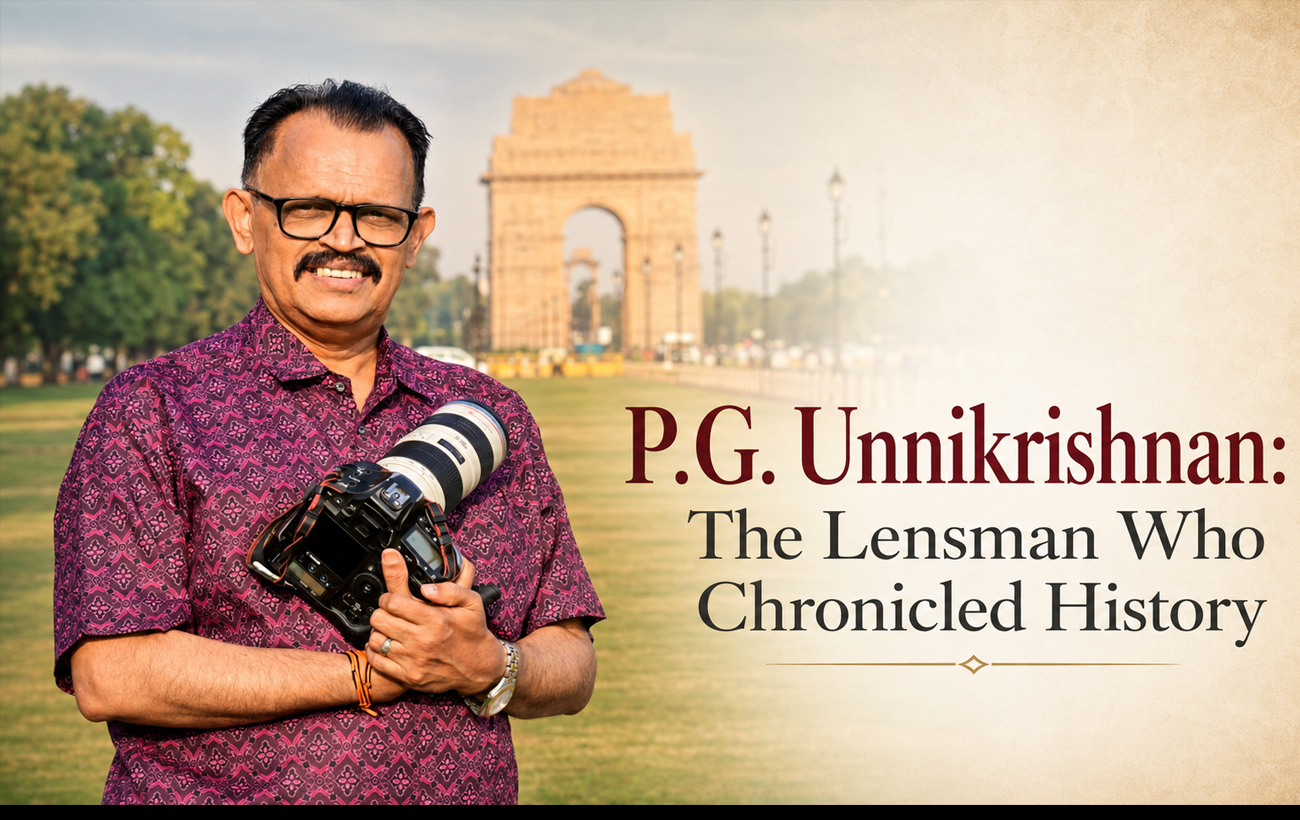
P.G. Unnikrishnan, Chief Photographer of Mathrubhumi Delhi, has retired after three decades of service. Rising from the darkroom to the frontlines of Indian journalism, his career embodies courage, equanimity, and integrity. His reflections on news photography, historic agitations, and political figures remain an inspiring legacy for future generations.
P.G. Unnikrishnan’s retirement as Chief Photographer of Mathrubhumi Delhi marks the close of a remarkable chapter in Indian photojournalism. For 40 years (10 years in other places + 30 in Mathrubhumi) his lens captured the pulse of the nation, from political upheavals to moments of quiet dignity, shaping how readers understood the news beyond words.
Unnikrishnan’s journey into journalism was far from conventional. Arriving in Delhi without a clear aim, he stumbled into photography almost by accident. From the darkroom, where he first honed his craft, he rose to prominence as the chronicler of some of the most enduring images of the late 20th century. His story is a reminder that passion and perseverance often matter more than formal qualifications, a lesson that journalism students would do well to absorb.
In an interview conducted by Manoj Menon, Unnikrishnan offered candid insights into the profession. His advice was simple yet profound: “news” photography must remain tethered to news itself. He stressed the importance of photojournalists staying abreast of developments and working in close coordination with reporters.
As R. Rajagopal, former Editor of The Telegraph, observed, photographers often spot breaking news before reporters, yet the latter walk away with the credit. A disconnect, he warned, could leave a paper publishing a smiling image of a minister who had just been sacked.
Unnikrishnan’s recollections of the Mandal agitation in 1990 reveal the grit required of a news photographer. He recalled throwing film rolls into bushes to protect them from confiscation, later retrieving them to preserve history. His icy nerves and steady hands were tested repeatedly, whether rushing to Parliament during an attack or climbing to the top floor during a quake to capture a rare image of a shaken Sonia Gandhi. Such moments underscored his ability to hold his nerve under immense pressure.
Equally striking was his professional detachment. Unnikrishnan spoke with equanimity about prime ministers across eras, acknowledging the grace of figures like President A.P.J. Abdul Kalam, who made the job less thankless. Yet, he offered a telling observation about Narendra Modi’s keen interest in how he is framed in photographs—a subtle commentary on the intersection of politics and image-making.
His career was defined not only by technical skill but also by integrity. He resisted bias, allowing his photographs to speak for themselves. For those who worked behind desks, his reflections raise intriguing questions about editorial choices—whether cropping enhanced or diminished the impact of his images.
As Unnikrishnan steps away from the newsroom, his legacy endures in the frames that documented India’s triumphs, tragedies, and transformations. His story is not just about photography but about journalism itself: the courage to leap into the unknown, the discipline to remain impartial, and the instinct to capture history as it unfolds. For the diploma-bound generation, his journey is a reminder that true journalism lies not in credentials but in conviction.
Discover more from Creative Brands Mag
Subscribe to get the latest posts sent to your email.











Leave a comment