


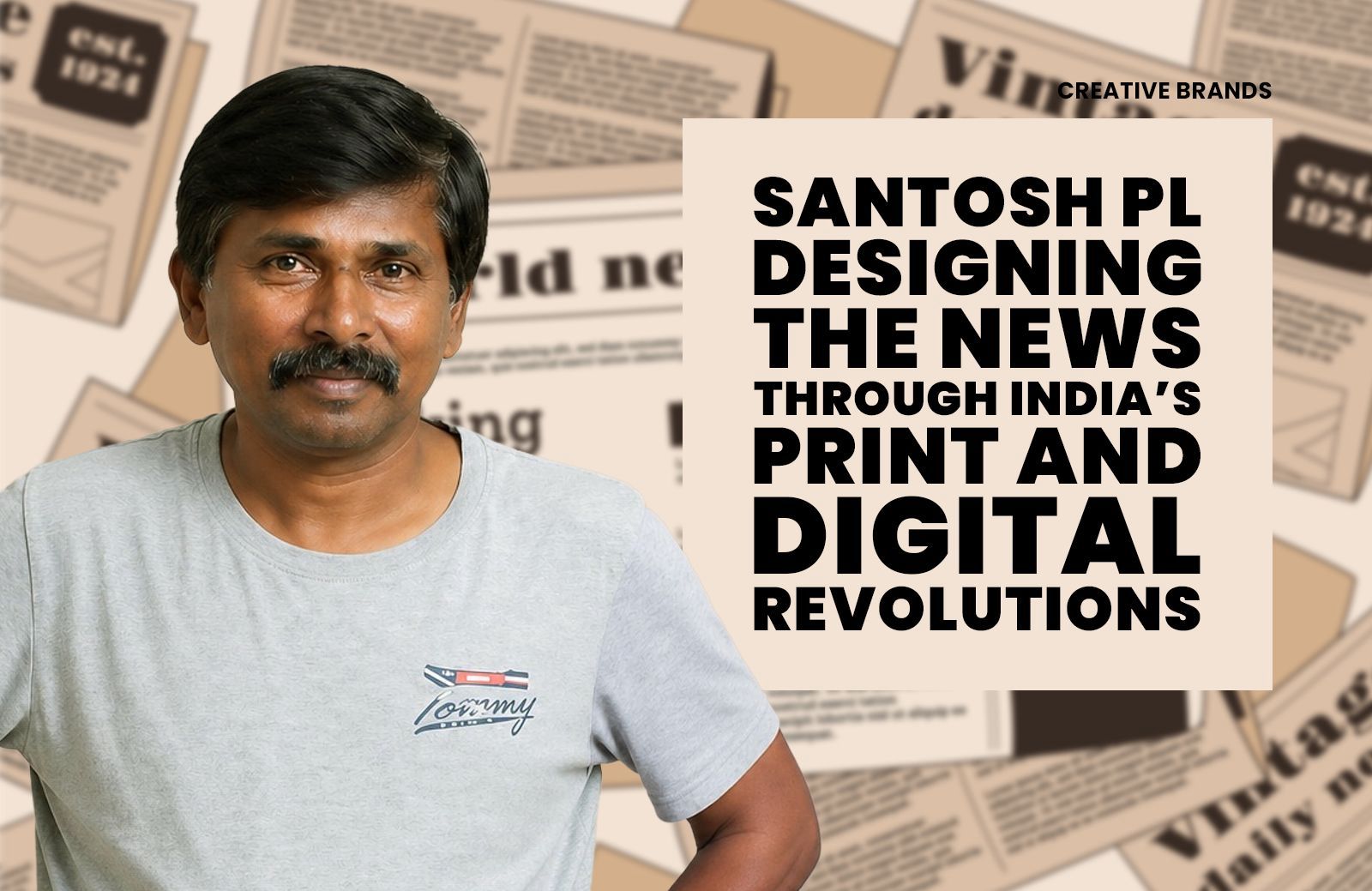
Veteran news designer Santosh PL reflects on the transformation of Indian newspaper design from dense, text-led layouts to modular formats and mobile-first platforms. Driven by technology and changing reader habits, the shift has turned design into a marketing tool, with AI and multimedia set to redefine storytelling and audience engagement.
Santosh PL does not merely talk about newspaper design—he has lived its evolution, shaped its direction, and continues to observe its future with a mix of curiosity and conviction. With more than three decades of hands-on experience, his career mirrors the transformation of Indian journalism itself, from the clatter of print rooms to the quiet precision of algorithm-driven interfaces.
A veteran of multiple redesign projects for The Indian Express and The Financial Express as Art Director, Santosh has helped redefine how millions of readers encounter the news. Before joining the Express group, he was part of India Today Magazine, where he developed an early appreciation for the power of visual storytelling in a publication environment that valued both editorial depth and design finesse.
When Santosh reflects on the early days of newspaper design in India, he describes a world that now feels almost unrecognisable. In the 1980s, newspapers were dense, text-heavy affairs. Pages were built using what designers called a “step-ladder” layout, where stories were stacked in descending order of importance with little visual variation. Functionality took precedence over form, and the reader was expected to work through columns of uninterrupted text to extract information.
“There was a certain discipline to it,” Santosh recalls, “but not necessarily a sense of engagement.” Design, at that time, was largely utilitarian. The priority was to fit as much information as possible into a limited space, often at the expense of readability and visual hierarchy. Photographs were used sparingly, colour printing was limited, and typography offered little room for experimentation.
The 1990s marked a turning point. Advances in printing technology and the gradual introduction of colour opened new possibilities. It was during this decade that Indian newspapers began adopting modular layouts—a system that broke pages into distinct, self-contained units. Stories were no longer forced into rigid columns but were instead organised into blocks that allowed for greater flexibility and visual clarity.
For Santosh, this shift was more than aesthetic; it was philosophical. Modular design acknowledged the reader’s time and attention. It made navigation intuitive and encouraged selective reading. “You could enter a page from anywhere and still understand it,” he explains. “That was a big change.”
This period also coincided with a broader liberalisation of the Indian economy, which brought increased competition in the media landscape. Newspapers began to recognise design as a differentiator, not just a support function. The idea that good design could attract and retain readers started to gain traction, laying the groundwork for what would eventually become a market-driven approach.
As the new millennium approached, the pace of change accelerated. The rise of the internet began to challenge the dominance of print, forcing newspapers to rethink their identity. Initially, digital platforms were treated as extensions of print editions, but this approach quickly proved inadequate. The habits of online readers were fundamentally different—they skimmed, they clicked, they expected immediacy.
Santosh observed this shift closely. “We moved from designing pages to designing experiences,” he says. The focus was no longer just on how a story looked on paper, but how it functioned across screens of varying sizes. This transition culminated in what he describes as a “design-down” approach by the 2020s, where content is conceived for digital-first platforms and later adapted for print if necessary.
The implications of this shift are profound. In a mobile-first world, attention spans are shorter and competition for engagement is relentless. Design has become a crucial tool for capturing that fleeting attention. Headlines need to be sharper, visuals more compelling, and layouts more intuitive. The goal is no longer just to inform, but to do so quickly and effectively.
“Design has moved from a mission to a market focus,” Santosh observes. In earlier decades, newspapers saw themselves primarily as vehicles of public service, delivering information and shaping opinion. While that mission remains important, the realities of a competitive media environment have introduced new pressures. Design is now expected to drive engagement, increase readership, and even influence revenue.
One of the most visible outcomes of this shift is the rise of infographics. Once considered supplementary, infographics have become central to storytelling. They condense complex information into digestible visuals, making it easier for readers to grasp key points at a glance. Santosh notes that this trend has evolved further with the advent of digital platforms, where static graphics are giving way to interactive and multimedia formats.
“Infographics were just the beginning,” he says. “Now we are looking at animations, data visualisations, and interactive elements that allow readers to explore stories in their own way.” This evolution reflects a broader change in how audiences consume information—not as passive recipients, but as active participants.
Despite these transformations, Santosh is quick to emphasise that the fundamentals of good design remain unchanged. Typography, colour palettes, spacing, and alignment continue to play a critical role in shaping the reader’s experience. “The principles are timeless,” he says. “What changes is how we apply them.”
He points out that even in a digital environment dominated by speed and innovation, a poorly chosen typeface or an inconsistent colour scheme can undermine credibility. Good design, in his view, is not about following trends but about maintaining clarity, coherence, and purpose.
Looking to the future, Santosh believes that artificial intelligence will be the next major disruptor in newspaper design. AI tools are already being used to automate layout processes, suggest design variations, and personalise content for individual readers. While this offers exciting possibilities, it also raises important questions about the role of the designer.
“AI can handle repetition and optimisation,” he acknowledges, “but it cannot replace human judgement.” For Santosh, the designer’s role will increasingly shift towards strategy, creativity, and ethical decision-making. Understanding the context of a story, the nuances of an audience, and the values of a publication will remain uniquely human responsibilities.
He envisions a future where designers work alongside intelligent systems, using them as tools rather than replacements. This collaboration could lead to more efficient workflows and more innovative storytelling formats, but only if guided by a strong foundation in design principles.
There is also a sense of continuity in his outlook. While the mediums have changed—from ink on paper to pixels on screens—the core objective of newspaper design remains the same: to inform, engage, and guide the reader. The challenge lies in achieving this balance in an environment that is constantly evolving.
Santosh’s career stands as a testament to the adaptability required in this field. From the disciplined layouts of the 1980s to the dynamic interfaces of today, he has navigated each phase with a willingness to learn and a commitment to craft. His insights offer not just a retrospective on design, but a roadmap for its future.
In an age where information is abundant and attention is scarce, the role of design has never been more critical. As Santosh PL makes clear, it is not merely about making news look good—it is about making it matter.
Discover more from Creative Brands Mag
Subscribe to get the latest posts sent to your email.











Leave a comment