


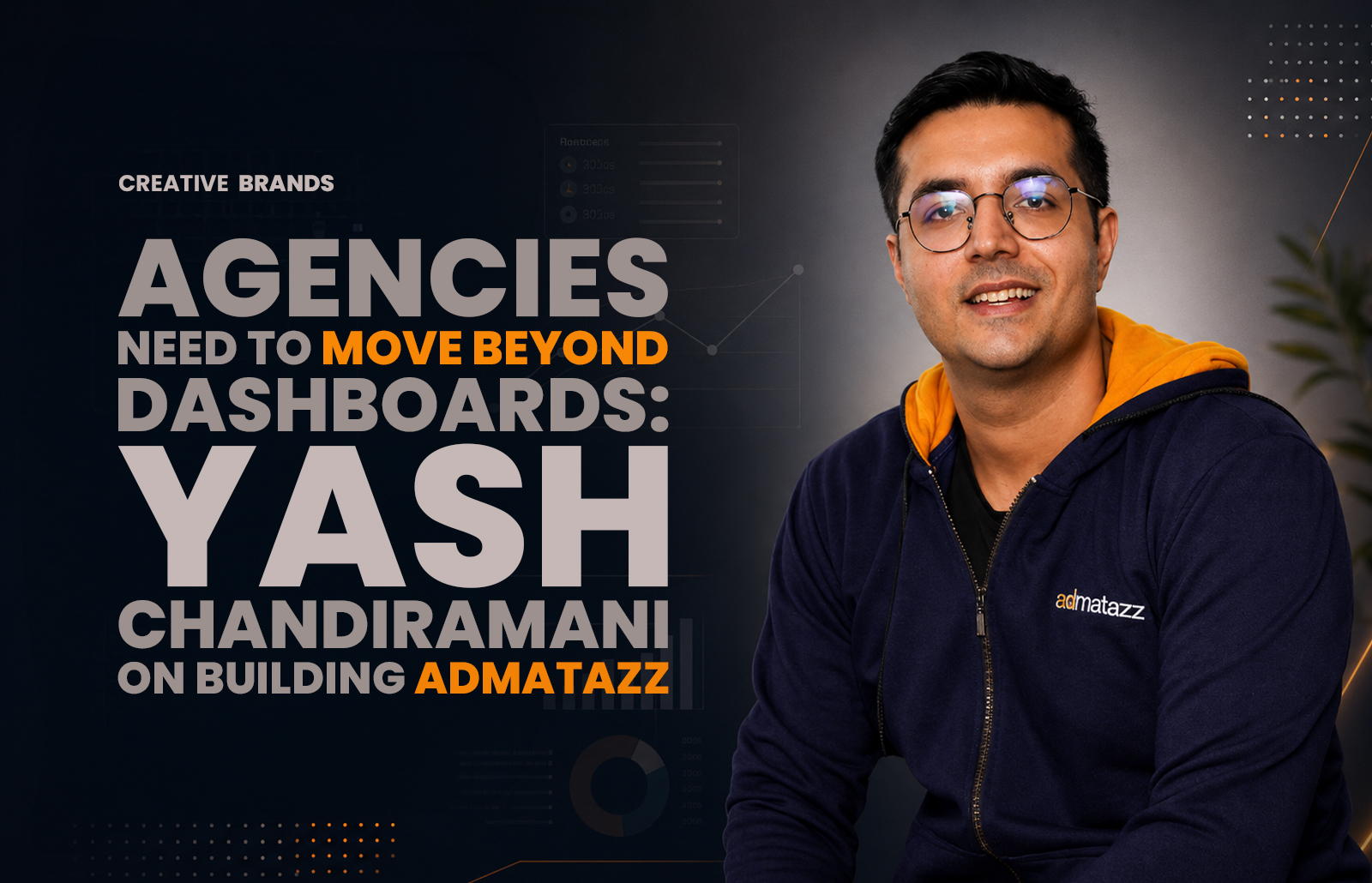
In an industry increasingly driven by dashboards, attribution models, and short-term performance metrics, Yash Chandiramani has built his agency on a markedly different belief system — one rooted in marketing science, long-term brand building, and evidence-based strategy.
The Founder & Chief Strategist of Admatazz did not enter advertising through the traditional agency route. His entrepreneurial journey began at just 17, when he launched a hospitality marketing venture before going on to build and operate restaurants, becoming one of India’s youngest restaurateurs at the time. But as digital began fundamentally reshaping how brands grow, Yash identified a structural gap in the market — one that eventually led him to exit the F&B industry and pursue marketing full-time.
In 2018, he founded Admatazz from the ground up, without external funding, legacy clients, or institutional backing. Over the past eight years, the agency has steadily evolved into an 80-member independent powerhouse based in Mumbai, earning recognition across the industry, including Foxglove Agency of the Year 2026 and Agency of the Year honours at Mad Over Marketing and OOHwards.
What sets Yash apart is not just the scale of the business he has built, but the philosophy underpinning it. EBI-certified and trained in Byron Sharp’s marketing science frameworks, he has embedded globally recognised evidence-based principles into the agency’s DNA — while also bringing these ideas into classrooms and industry conversations as a visiting lecturer in advertising and marketing science.
At a time when AI is rapidly redrawing the boundaries between independent agencies, networks, and consulting firms, Yash offers a sharp and often contrarian perspective on where the industry is headed next. In this exclusive conversation, he speaks about building an agency without institutional advantages, the limitations of today’s measurement models, the role of marketing science in India, and why the future of agencies may depend on balancing creativity, strategy, technology, and science more effectively than ever before.
At 17, you were already building ventures in hospitality marketing and restaurants. How did those formative years shape your instincts for risk, resilience, and brand-building?
Looking back, I was just a college kid who couldn’t sit still. I started a nightlife marketing company during college, helping venues with promotions and event nights. It felt exciting at the time, and it gave me an early taste of how brands communicate with an audience. Then I moved into the restaurant business, which I spent four years trying to make work. I couldn’t.
What those years gave me wasn’t a success story. They gave me the experience of watching something you’ve built not work, and still showing up the next day. That’s the muscle. Risk stopped feeling abstract once I’d actually lost sleep over payroll. Resilience isn’t a mindset you pick up in a classroom. It’s what you’re left with after the glamour wears off and the problem is still there at 2am. And brand-building? I learned it the hard way in F&B, where you could have the best product and still die if nobody remembered you or if the experience was inconsistent. Those early years gave me a very unromantic, very useful view of what marketing actually has to do.
What structural gap did you observe in the F&B space that convinced you to pivot fully into marketing, and how did that insight become the foundation for Admatazz?
The restaurant business taught me one thing very clearly: most F&B operators thought great food was the product. It isn’t. The brand is the product. The food is the proof.
I watched places with genuinely brilliant kitchens shut down because they had no mental availability. Nobody thought of them at the moment of choosing where to eat. And I watched mediocre places thrive because they’d built something distinctive and consistent in the consumer’s mind. That gap between the quality of the product and the quality of the brand communication was the structural problem. Nobody was solving it with any rigour. Agencies were either too creative and untethered from business outcomes, or too tactical with no idea how to build a brand. I started Admatazz in 2017 to sit exactly in that gap: strategy-led, execution-strong, and honest about what marketing can and cannot do.
You launched Admatazz without external funding, legacy clients, or network backing. What were the toughest early hurdles, and how did you overcome them to build credibility in a crowded market?
The toughest early hurdle was the credibility loop. Clients want case studies before they give you a chance to make case studies. You need to break that loop without compromising your standards or your pricing.
We broke it by taking smaller projects first and treating them like they were the biggest briefs in the world. We delivered more than was asked for, documented everything, and built proof points before we had a portfolio. We also said no to certain clients early, which felt insane at the time but turned out to be the right call. Saying no to bad-fit work, even when you need the money, signals something to the market about who you are. Credibility in a crowded agency market isn’t built by shouting louder. It’s built by doing a few things exceptionally well and letting those clients become your case studies and your referrals. That’s the only flywheel that works without a network or a famous name behind you.
At a time when the industry leaned on short-term metrics, you anchored Admatazz in marketing science. What drew you to Byron Sharp’s frameworks, and how have they tangibly influenced client outcomes?
I came across Byron Sharp’s work almost by accident, and then I couldn’t unsee it. Here was a body of evidence that challenged almost every received wisdom the industry runs on: that loyalty is the goal, that targeting your core customer is enough, that emotional advertising is somehow separate from effectiveness. It turned out most of what the industry believed was wrong, or at best unproven.
What drew me to it wasn’t the contrarianism. It was the rigour. Sharp and the Ehrenberg-Bass Institute were doing something rare in marketing. They were treating it as a science, not a collection of opinions. I had too many questions and I eventually learned under Byron Sharp directly for a week, which only deepened the conviction. I still have some points I differ on, but broadly I have.
The tangible outcomes for clients have been significant. When we stopped chasing niche targeting and started building for broad reach and mental availability, brand recall improved. When we built distinctive assets consistently instead of reinventing the visual identity every campaign, brand recognition went up. The evidence works. It’s just that most of the industry doesn’t want to hear it because it disrupts a lot of comfortable narratives and a lot of comfortable business models.
How do you adapt global evidence-based marketing principles to the unique realities of Indian brands and consumers, where cultural nuance often trumps textbook models?
This is where the nuance lives. The science doesn’t change. How memory works, how category entry points function, how reach drives growth: these are not Western phenomena. But the execution has to be deeply Indian.
What that means in practice is that the cultural cues that trigger category entry points in India are completely different. Festivals, life milestones like marriage and children’s education, cricket, family structures: these are the moments around which mental availability gets built or missed. The language of distinctiveness has to be rooted in something local and recognisable. You can’t just translate a global asset and expect it to land. The science gives you the what: build distinctive assets, reach light buyers, be mentally available at the moment of purchase. India gives you the how: which characters, which emotions, which codes unlock that availability in an Indian consumer’s mind. Our best work has come from holding both firmly at the same time.
From a bootstrapped startup to an 80-member independent agency recognised with multiple accolades, what milestones stand out as turning points in Admatazz’s evolution?
Two moments stand out as genuine turning points. The first was deciding very early to not be just a social media agency. When everyone was selling Facebook posts and Instagram grids, we were having conversations about brand architecture and category entry points. That positioning attracted clients who wanted real marketing thinking, not content factories. It made early growth slower but made the agency more defensible.
The second turning point was a handful of early client relationships that never left. They started small, grew with us, and today trust us with their entire marketing strategy, not just execution or promotion. That shift, from being a vendor to being a strategic partner, is the most meaningful measure of an agency’s evolution. When a client stops briefing you on deliverables and starts calling you before they’ve even formed the problem, something important has changed. Those relationships built our culture from the inside out, because the team saw what sustained, rigorous thinking could earn over time. Every other milestone, whether it’s the brand campaigns, the category creation work, or the investments we’ve made in building new capabilities, has been an extension of that compounding trust.
You’ve been vocal about the limitations of dashboards and attribution models. What do you believe current measurement frameworks fail to capture about real brand growth?
The problem with most measurement frameworks is that they measure what’s easy to measure, not what actually matters. Last-click attribution tells you who was standing at the cash register. It tells you nothing about who built the desire that brought the consumer there in the first place.
The entire industry is obsessed with dashboards that capture the final inch of the journey while ignoring the miles that preceded it. Brand-building, the kind that makes someone think of you when they’re in a buying situation, is slow, long-term, and almost impossible to capture in a 30-day attribution window. So it gets underfunded. Performance marketing gets overfunded. And brands slowly hollow themselves out while their ROAS looks great. What current frameworks fail to capture is memory. They don’t measure how many light buyers have your brand stored in the right mental category for the right occasion. Until we measure that, we’re optimising for the easy metric at the expense of the important one.
With AI closing the capability gap between independents and global networks, how do you see the agency-consulting dynamic evolving in the next decade?
AI is compressing the capability gap between a 10-person independent and a 500-person network. That’s real and it’s happening now. What it doesn’t compress is judgment. It doesn’t replace the ability to understand a client’s business problem at a structural level, to know which marketing science principle applies, or to have the creative courage to back an idea that has no precedent.
What I think changes in the agency-consulting dynamic is this: the agencies that survive will look less like execution shops and more like thinking partners. The ones that don’t adapt will be replaced, not by consulting firms, not by AI directly, but by a smarter, leaner version of themselves that never upgraded. At Admatazz, we’re already building AI-powered tools that sit inside client workflows: on-the-go sales script generators, content intelligence systems, AI-assisted media planning. We treat AI as a tool that removes friction and improves effectiveness. Not as the strategy. That distinction matters enormously.
What does your realistic vision of the agency model look like ten years from now, especially in terms of integrating creativity, science, strategy, and technology?
Ten years from now, the agencies that matter will be indistinguishable from marketing intelligence companies. They will have proprietary data, proprietary tools, and a point of view earned through evidence, not inherited through legacy relationships or bought through headcount.
The model I’m building toward at Admatazz is what I’d call the creative-scientific agency: one where the brief is interrogated before it’s answered, where the solution draws on evidence as much as instinct, and where creativity and science are not in tension but two sides of the same discipline. We are actively building a marketing science lab inside the agency, a dedicated function that sits at the intersection of research, data, and creative strategy, so that our work is always anchored in something more durable than trend or opinion. The convergence we’ve seen between creative agencies and consulting firms is not an anomaly. It’s the direction of travel. The question is whether you arrive there with genuine depth on both sides or whether you just rebrand yourself and hope nobody looks too closely. We’re investing in the depth. That’s the agency model that will still be relevant in 2036.
As both founder and Chief Strategist, how do you balance contrarian thinking with the need to inspire and align an 80-member team around a shared vision?
Contrarian thinking is easy when you’re alone with your convictions. It gets harder when you need 80 people to believe in the same direction, especially when that direction goes against what every client or competitor seems to be doing.
The way I’ve reconciled this is by making the evidence the authority, not me. When I argue against hyper-personalisation or fake UGC or last-click attribution, I’m not asking the team to trust my instinct. I’m showing them the research, the data, the published papers. That creates a different kind of alignment. It’s not “trust me,” it’s “look at this.” When people understand the why at a fundamental level, they don’t need to be managed into the direction. They own it. The second part is creating enough psychological safety for people to challenge me. I’m on record saying I’ve fallen for the same traps I criticise. That honesty matters. A team that sees the founder acknowledge his own contradictions openly is a team that feels safe enough to think, disagree, and ultimately get to better work.
Discover more from Creative Brands Mag
Subscribe to get the latest posts sent to your email.











Leave a comment