


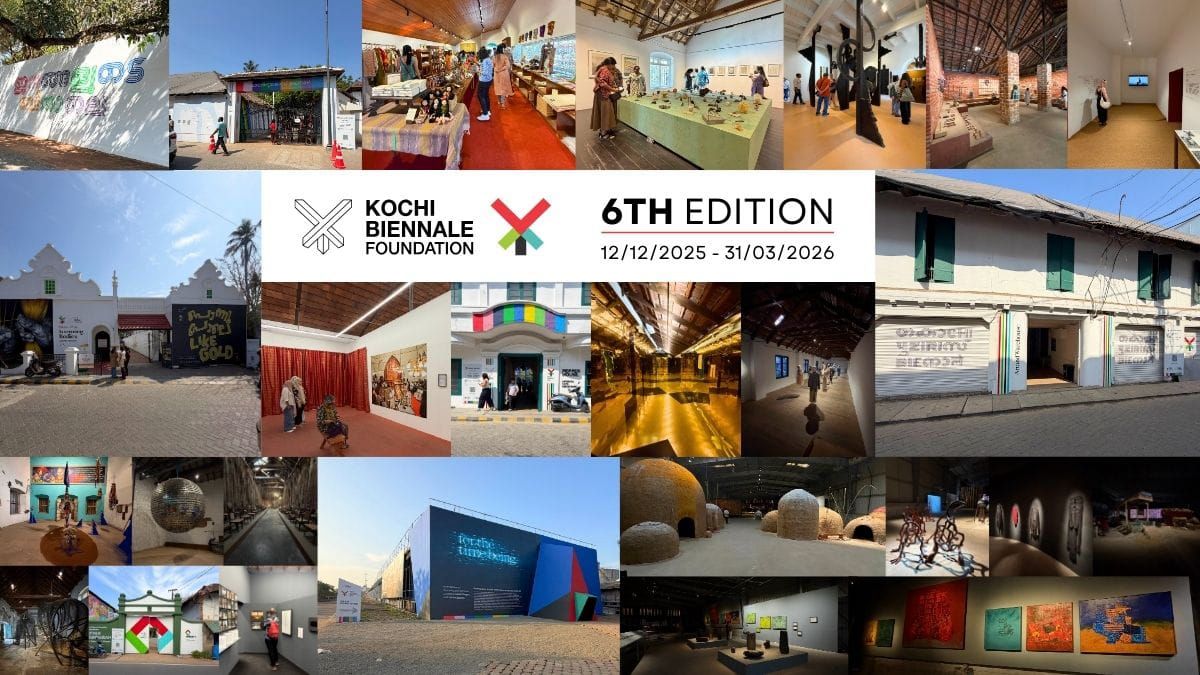
As the sixth edition of the Kochi-Muziris Biennale concludes on 31 March 2026, it leaves behind a powerful legacy of process-driven art, collaboration, and global dialogue. Curated by Nikhil Chopra, the edition reimagined the biennale as a living ecosystem, transforming Kochi into a vibrant space of shared cultural experience.
As the sun begins to set on the sixth edition of the Kochi-Muziris Biennale, the historic port city of Kochi finds itself once again transformed—not merely by art, but by a sustained act of collective imagination that has unfolded over 110 days. Scheduled to conclude on 31 March 2026, this iteration of the Biennale has resisted the spectacle-driven tendencies often associated with global art events, choosing instead to embrace something quieter yet more profound: the idea of art as a living, breathing process.
Organised by the Kochi Biennale Foundation, a non-profit, charitable trust established in 2010 to promote art, culture, heritage, and education, the Biennale has steadily grown into India’s most ambitious contemporary art platform. Over the years, it has not only redefined Kochi’s cultural landscape but has also positioned India more prominently within international art circuits. With the consistent support of the Government of Kerala, the Foundation has built an ecosystem that extends beyond exhibitions, encompassing restoration of heritage structures, revival of traditional art forms, and education initiatives that reach diverse communities.


At the core of this edition lies an inquiry into the body—not as a stable or singular entity, but as a site of memory, labour, intimacy, and transformation. The curatorial framework proposes the body as a landscape shaped by time, bearing marks that testify to lived experiences. These marks, whether physical or metaphorical, become repositories of history, connecting personal narratives to larger social and political contexts. From this perspective, artistic practices emerge as extensions of the body, capable of carrying meaning across different forms and mediums.
The 2025–26 edition, titled For the Time Being, curated by Nikhil Chopra in collaboration with HH Art Spaces, marks a decisive departure from the conventional understanding of a biennale as a singular, centralised event. Instead, it has unfolded as an evolving ecosystem, one that privileges process over product, relationships over results, and collaboration over competition. Featuring 66 projects from over 25 countries, the exhibition has sought to create a space where art is not fixed but continually reshaped through interaction, dialogue, and time.
To walk through the Biennale venues scattered across Fort Kochi is to encounter not static objects but dynamic situations. Performances stretch across hours and, at times, days, dissolving the boundaries between artist and audience. Installations shift subtly over time, responding to environmental conditions and human presence. Conversations emerge spontaneously, often blurring the lines between formal programming and everyday interaction. In this sense, the Biennale becomes less about viewing art and more about inhabiting it, about entering into a shared temporal experience that resists easy categorisation.
This focus on embodiment resonates deeply in a world still grappling with the aftereffects of a global pandemic. The past few years have altered perceptions of presence and absence, intimacy and distance, rendering the act of gathering itself a charged and meaningful gesture. Against the backdrop of digital saturation, where images and information circulate endlessly, the Biennale’s emphasis on liveness—on performance, action, and direct engagement—feels both urgent and necessary. It asks what it means to witness, to be present, and to respond in an age where attention is increasingly fragmented.
Kochi’s own history amplifies these questions. As a port city that once served as a vital node in global trade networks, it has long been a site of cultural exchange, migration, and hybridity. The Biennale draws upon this layered past, using it as a foundation for engaging with contemporary global concerns. This rootedness allows the exhibition to resist the homogenising tendencies of the international art world, offering instead a model that is both locally grounded and globally connected.
A defining feature of every edition of the Biennale is the Pavilion, an architectural structure that functions as a central hub for public programming. In the 2025–26 edition, the Pavilion once again emerges as a vibrant site of exchange, hosting an array of talks, panel discussions, performances, and experimental presentations. Scholars, artists, and thinkers from diverse disciplines converge here, exploring intersections between art, history, culture, and contemporary thought. The Pavilion’s programming underscores the Biennale’s commitment to dialogue, transforming it into a space where ideas are not only presented but actively contested and reimagined.
Parallel to the main exhibition, the Students’ Biennale continues to play a crucial role in shaping the future of contemporary art in India. Opening on 13 December 2025, just a day after the main Biennale, it brings together young artists from over 150 public institutions across the country. Guided by curators and collectives, these students engage in an intensive process of development, culminating in exhibitions that are both ambitious and experimental.
The significance of the Students’ Biennale extends beyond the works on display. It represents a commitment to education and accessibility, providing emerging artists with opportunities that are often difficult to access within traditional art infrastructures. By fostering mentorship and collaboration, it ensures that the Biennale remains a dynamic and evolving platform, continually renewed by new voices and perspectives.
Among the many international collaborations featured in this edition, the exhibition Spectres of History (2025) stands out for its powerful engagement with themes of memory, resistance, and material transformation. Presented by the Haitian collective Atis Rezistans as part of the Invitations programme, the exhibition was held at St Andrews Parish Hall in Fort Kochi, drawing audiences into a world where discarded materials are reconfigured into evocative sculptural forms.
Emerging from the Grand Rue neighbourhood of Port-au-Prince, the artists of Atis Rezistans operate within a context of economic scarcity and cultural richness. Their practice involves transforming everyday waste—engine parts, television sets, medical debris, scrap wood—into intricate assemblages that challenge conventional notions of value and aesthetics. In their work, bike tyres become wings, pistons take on symbolic forms, and springs evoke the fragility of human anatomy. These transformations are not merely formal but deeply conceptual, drawing upon African heritage, Vodou practices, and revolutionary histories to create a visual language that is at once playful and profound.
The inclusion of human bones in some works, rooted in the spiritual traditions of Haitian Vodou, introduces a dimension of reverence and continuity between the living and the dead. It invites viewers to reconsider the boundaries between material and spiritual worlds, between history and the present. Within the broader context of the Biennale, Spectres of History resonates as a meditation on survival, creativity, and the enduring power of storytelling.
Throughout its duration, the Biennale has maintained a delicate balance between fragility and resilience. Kochi’s ecological vulnerabilities, from coastal erosion to the impacts of climate change, form an unspoken backdrop to many of the works. Rather than treating these conditions as constraints, the exhibition embraces them as generative forces, allowing the environment to shape artistic processes in unpredictable ways.
The notion of “friendship economies,” articulated by the curatorial team, offers a compelling alternative to the market-driven dynamics that often dominate the art world. By foregrounding relationships, care, and mutual support, the Biennale creates a network of connections that extend beyond the temporal limits of the exhibition. These relationships, forged through shared experiences and collaborative practices, suggest new possibilities for how art can be produced, circulated, and sustained.
For visitors, the Biennale often reveals itself through moments that resist documentation—an impromptu performance witnessed by chance, a conversation that lingers long after it ends, a fleeting gesture that alters one’s perception of space. These experiences, ephemeral yet impactful, underscore the exhibition’s emphasis on presence and participation. They transform the audience from passive observers into active participants, blurring the distinction between art and life.
In the final weeks of the Biennale, a sense of reflection permeates Kochi’s art spaces. Artists begin to dismantle installations, bringing closure to works that have evolved over months. Performers conclude durational pieces that have demanded endurance and commitment. Visitors make their last journeys through familiar venues, carrying with them memories that are as much about feeling as they are about seeing.
Yet, even as the physical structures of the Biennale begin to disappear, its impact remains palpable. This persistence is perhaps its most significant achievement. By rejecting the notion of a definitive endpoint, the Biennale reimagines itself as an ongoing process, one that continues to unfold through the relationships and ideas it has generated.
In reflecting on this journey, Venu V, Chairperson of the Kochi Biennale Foundation, emphasised that the Biennale’s true success lies not in the scale of its exhibitions but in the depth of its engagement. He noted that the Foundation remains committed to nurturing a sustainable cultural ecosystem that connects artists, communities, and audiences through shared experiences. For him, the Biennale is as much about building relationships as it is about showcasing art, a platform that strengthens Kochi’s identity as a global cultural hub while remaining deeply rooted in Kerala’s social and artistic traditions.
His perspective echoes the broader ethos of this edition, which has consistently prioritised connection over completion. It reflects an understanding that art, at its most powerful, emerges not from isolation but from interaction—from the meeting of minds, bodies, and histories.
For the Kochi Biennale Foundation, the 2025–26 edition represents both a culmination and a continuation of its long-term vision. Since its inception, the Foundation has worked to bridge the gap between contemporary art and public life, ensuring that cultural engagement is not confined to elite spaces. Its efforts in heritage conservation and educational outreach further reinforce this commitment, creating a holistic model that integrates art with broader social and cultural processes.
As Kochi prepares to bid farewell to For the Time Being, the city carries forward the traces of what has unfolded within its spaces. The warehouses and heritage buildings that hosted installations now bear the memory of their transformations. The streets that witnessed performances retain an intangible resonance, as if echoing with the footsteps and voices of those who passed through them. These traces, though invisible, form a vital part of the Biennale’s legacy.
In a world increasingly defined by speed, immediacy, and consumption, the Biennale’s insistence on slowness, attentiveness, and care offers a compelling counterpoint. It reminds us that art is not merely an object to be consumed but a process to be experienced—a way of engaging with the world that values connection, reflection, and empathy.
As the final installations are taken down and the last performances draw to a close, Kochi returns, on the surface, to its everyday rhythms. Boats continue to move through its backwaters, markets buzz with activity, and life resumes its familiar pace. Yet beneath this apparent normalcy lies a transformed landscape, shaped by months of creative exchange and collective reflection.
The Biennale may be ending, but the conversations it has sparked continue to ripple outward, finding new forms and contexts. They live on in the practices of the artists who participated, in the ideas carried forward by students, and in the memories of those who experienced it. In this sense, the sixth edition does not conclude on 31 March 2026; it lingers, quietly but persistently, in the spaces between people, in the stories they tell, and in the possibilities they imagine.
What remains, ultimately, is not a collection of artworks but a way of thinking—an approach to art that embraces uncertainty, values process, and recognises the importance of being present. It is an invitation to continue the conversations that began in Kochi, to carry them into other contexts, and to allow them to evolve in ways that cannot yet be predicted.
In the end, the Kochi Biennale 2025–26 leaves behind not a monument but a movement—one that continues to breathe, to shift, and to grow, long after its physical manifestations have disappeared.
Discover more from Creative Brands Mag
Subscribe to get the latest posts sent to your email.













Leave a comment